Royal Navy’s New Ships To Probe Ocean Secrets
pp. 85-87 · Read in the full issue
Probe Ocean Secrets
From Trevor Blore, in London Building is beginning at a Scottish shipyard on the River Clyde of three sister-ships for the Royal Navy’s Hydrographic Department, ships which will next year start charting and ex ploring the oceans of the world, including the South Seas.
THIS is the greatest material development in the history of maritime surveying and exploration carried on for centuries by great navigators of the British Navy, such as Captain James Cook, who made Jiree famous voyages to the Pacific Dcean in the second half of the 18th century.
For many years a small fleet of aaval surveying ships has carried aut the unending task of charting he sea-bed in home and overseas vaters to make oceans safe for lavigators.
Additional Task The new ships are to carry this ask a long step farther. They are he first deep-sea survey ships for he Royal Navy to be designed for he surveying work known as hydro- ;raphy, and the scientific probing of he deeps and submarine life known is oceanography.
The only ship in service specially lesigned for ocean survey is the 7 idol, which carries its own heliopter and lithographic chart-print- □g machine. The ships to be reilaced are converted frigates.
Previously the Navy’s survey ships tave been almost entirely devoted to uch tasks as charting the great oilanker highway of the Persian Gulf, napping the sea-lanes of the Carib- •can around the West Indies, or the
waters of Fiji and other Pacific Islands groups.
They have carried out certain oceanographical jobs like water sampling or taking samples of the sea-bed in various parts of the world.
The survey ships have also taken civilian scientists to sea for short periods.
The new ships, of 2,800 tons dis placement, will be 260 ft long, with a beam of 49 ft and a draught of 15 ft and have a range of 12,000 miles at an operational speed of 14 knots. Each will carry two large surveying launches for independent inshore work.
The Hydrographer of the Navy, Rear-Admiral E. G. Irving, says that the new ships will have flexibility in handling, thanks to diesel-electric propulsion, and controls on the open wings of the bridge to give the com manding officer finger-tip control of his ship from those positions.
Although not as packed with scientific instruments and facilities as Discovery, the new ships will each have two laboratories on the forecastle deck. There will also be special winches for lowering scientific instruments over the side, and for such special duties as taking samples from the sea-bed or trawling or dredging for specimens of marine life. They will also carry equipment for underwater photography.
Naturally, every kind of precise navigational aid will be installed.
The ships will have a garage for a Land-Rover motor vehicle and trailer to make the shore work of surveying parties easier, and a hangar for a Wasp-type of naval helicopter.
Cinemas, Laundries
In view of the long periods spent at sea on such work, comfortable air-conditioned accommodation and amenities like a cinema, library and laundry will be provided for each ship’s company of 100.
“For the first time,” Rear-Admiral Irving told me, “we will also be able to provide properly for scientists.
There will be permanent accom modation in the new ships for six civilian scientists engaged in the biological, chemical and other aspects of oceanography.”
He also explained how the sur veying work of his little fleet was changing.
Increasing numbers of super tankers in the world’s shipping lanes, some of them more than 100,000 tons deadweight, call for a much more extensive knowledge of under water topography.
The growing quest for untapped oil fuel and gas reserve under the sea is stimulating urgent interest in the shape, extent and composition of the continental shelves which extend out from the shores of most seaboard countries.
And the rapid development of fast, deepdiving submarines has called for
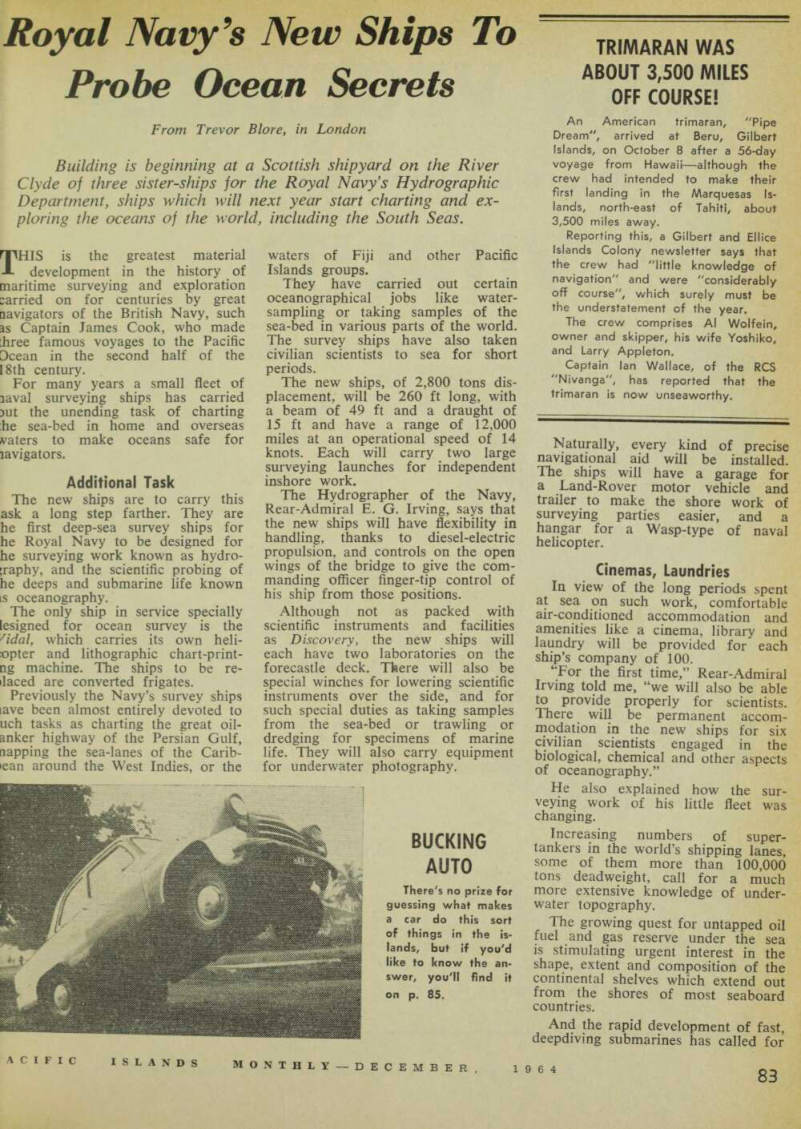
Bucking
Auto
There's no prize for guessing what makes a car do this sort of things in the is lands, but if you'd like to know the an swer, you'll find it on p. 85.
iter exploration of the ocean ths in which they operate, he increased scope of the Hydro )hic Department activities has nt a re-shaping of its traditional srn of surveying work, and Rear liral Irving recently made a world to foster working liaisons and note increased co-operation with ign and Commonwealth hydro 'hic offices, so spreading the load ased on the Royal Navy’s ssarily limited manpower, money facilities. he actual surveying at sea is the start of the Hydrographic artment’s present work. From the 5 a steady flow of information ties the chartmaking section in arth London suburb, hen new charts have been ared there, or old ones corrected, vork passes to a printing section /estern England for publication distribution to the mariners of world, ;arly 1,500,000 of these charts sold every year.
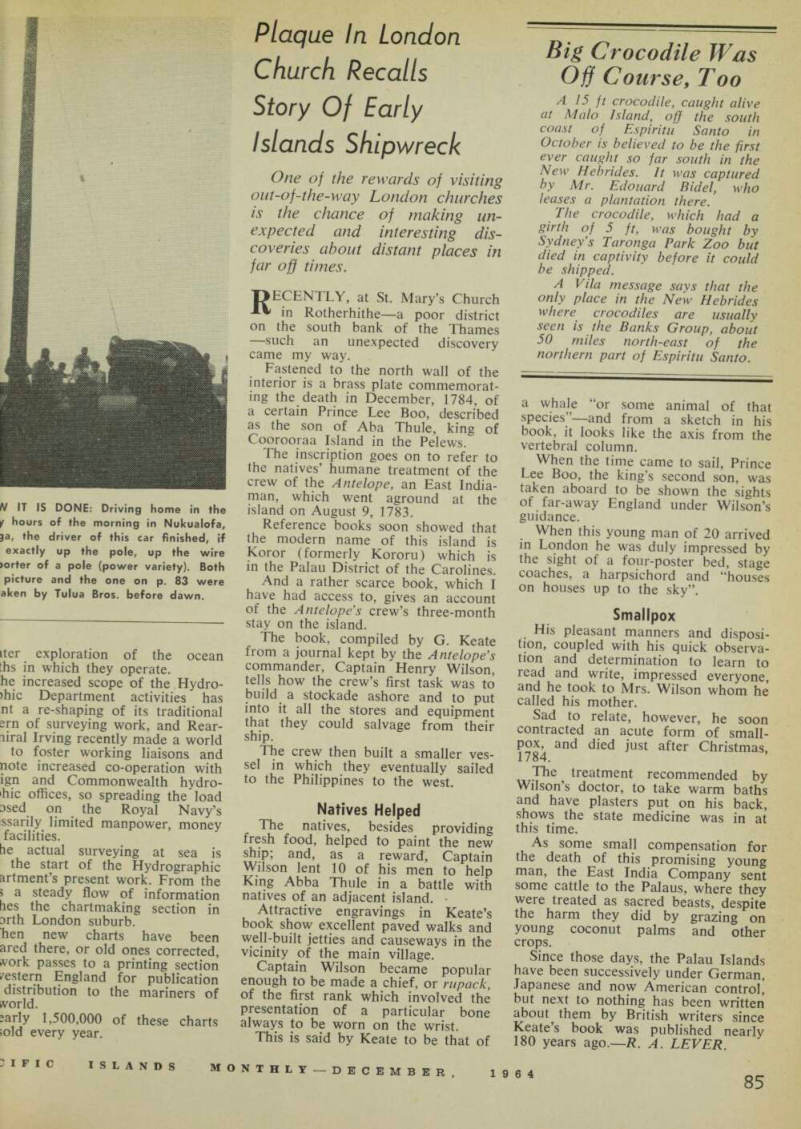
[?] IT IS DONE: Driving home in the [?] hours of the morning in Nukualofa, [?]ga, the driver of this car finished, if exactly up the pole, up the wire [?]orter of a pole (power variety). Both picture and the one on p. 83 were [?]aken by Tulua Bros, before dawn.