Tariff Snags
pp. 69-71 · Read in the full issue
Fiji Rep. Finds
In Australia
By a Staff Writer
Fiji’s representative in Austra
lia, Col. W. B. Rogers, has run into a few tariff problems in his efforts to build up the Colony’s trade with Australia. These affect
chiefly the small Fiji exporters.
THE basis of the trouble is that Fiji seems to fall into an un favourable place in the Australian tariff structure as a result of the British Commonwealth Economic conference in Ottawa in 1932. Fiji’s future as a manufacturing territory was not foreseen at that time.
While Australian goods pay the lowest rate in Fiji—the Common wealth rate Fiji goods entering Australia normally pay the “most favoured nation” rate, which in fact is much less advantageous. The situation has become even worse in recent years because Australia has made extra concessions for a number of places notably Papua-New Guinea and New Zealand—but Fiji has missed out.
Studying the Australian Customs tariffs Col. Rogers has found that rates are particularly hard on Fiji people planning to export Fiji handicrafts to Australia.
Women’s scuffs, valued at 2/9, carry a duty of 7/6 plus 25 per cent.
By the time they get into Australian shops they are about 400 per cent, dearer than the original cost.
Beach hats worth 3/9 each carry
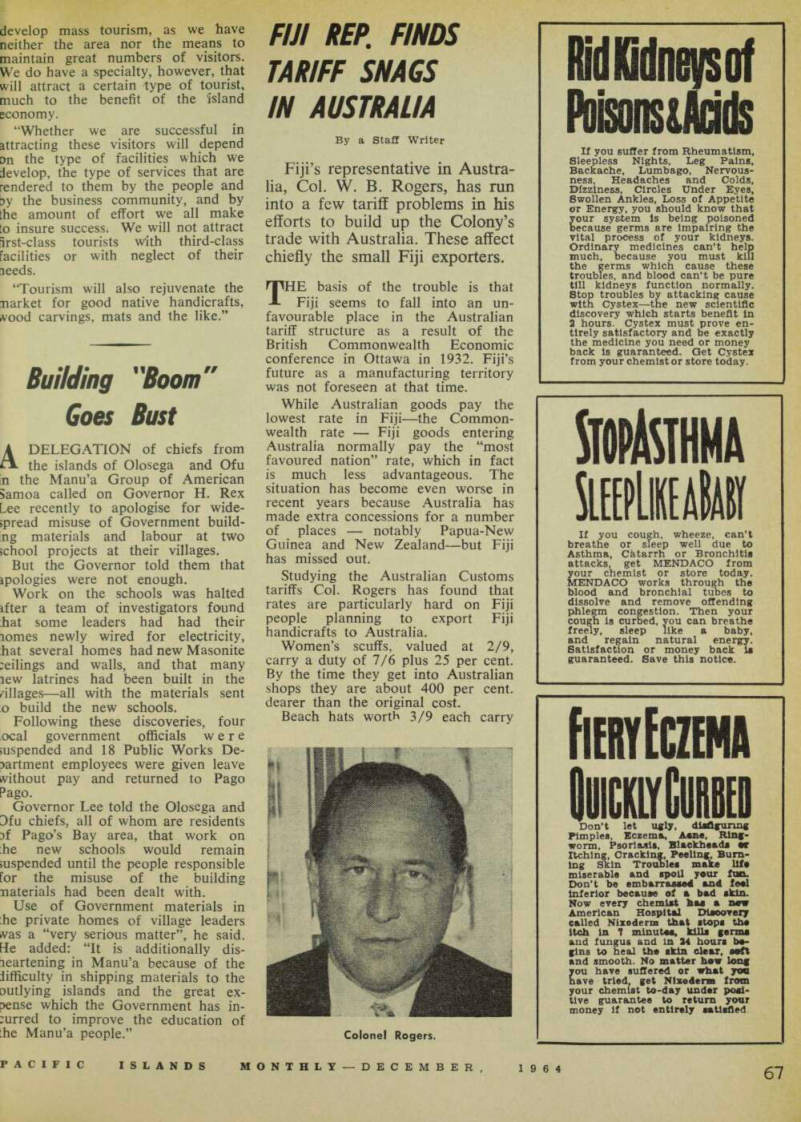
Colonel Rogers.
duty of £2/5/- a dozen—exactly 100 per cent; while tapa bags, pearl shell brooches and native dolls all attract a duty of 45 per cent, ad valorem (at value).
These items mean little in the Australian economy, but the small amount of revenue they would earn would mean something to the islander if he could get them to Australia at a reasonable rate.
The tariff on passionfruit pulp and juice of 8/3 a gallon in Aus tralia could pose a problem for Fiji.
At the moment all Fiji’s passionfruit exports go to Canada and America, but this might not always be the situation.
Ironically, the present passionfruit processing factory in Sigatoka is owned by Mangrove Mountains Ltd., of Australia. Another Australian concern, Coffee’s, is also expected to set up a processing plant at Sigatoka.
Col. Rogers has found that passion fruit syrup containing not less than 25 per cent, sugar is allowed in to Australia at 1/3 per gallon instead of 8/3 but there is no definition of syrup and there are technical problems in ascertaining the amount of sugar—all of which could mean that the Fiji exporter could have his product declared a pulp or a juice.
Timber There are many similar problems that are now being looked at by Col.
Rogers—who has the job, at this late stage, of trying to get around them.
One important problem concerns timber, where Fiji again is in an unhappy position compared with New Zealand and P-NG.
Taking sizes less than 7 in. by 2i in., the duty works out as follows: P-NG, free; NZ, 10/-; British
Preferential (which includes Fiji), 22/-; Most Favoured Nation, 23/-; General, 25/-.
Only in the timber tariff has Fiji been moved from the MFN column to the BP column and thus been saved 1/-.
Col. Rogers is drawing attention to these matters as they arise in the hope that Australia can do some thing.