But Indonesia Makes An Effort
pp. 47-51 · Read in the full issue

West New Guinea Life Is Not What It Was, But Indonesia Makes An Effort
Prom a Port Moresby Correspondent.
New Guinea newsman Geoffrey Luck, back from an ex tensive tour of West New Guinea, reports that Indonesia is making a sincere effort to develop the country taken from the Dutch and that it is probably achieving more there than it is in other parts of the Indonesian Republic.
[E says that although their efforts L are not always realistic or suc sful by Western standards, they luld not be decried. In some fields h as education, he says, “they re been able to make dramatic igress at every level —something t Australia has not been able to lieve in Papua-New Guinea”. jeoffrey Luck, who directs the C news services in Papua-New inea, was especially interesterd making his West New Guinea r so he could decide how real re the official Indonesian claims t they were doing more in West w Guinea than the Dutch had. .uck told me: ‘The difficulties that confronted Dutch in West New Guinea— >r natural resources, shocking ■ain, scattered populations further ided ethnically and linguistically ire all well known. ‘These problems didn’t evaporate :rnight with the advent of Indo ian administration, and it was dly surprising to find that no ctacular breakthrough in economic elopment had been achieved in 16 months since May ’63.
Efficient Public Service What the Indonesians have done ;o set up quite an efficient public /ice that has maintained the status > of governmental organisation, wily re-organised the educational tern, and laid extensive and quite rough plans for a wide range basic development in the fields of nmunications, agriculture, health, estry, and training.
I would say that it probably taken the Indonesians longer do this than it would have taken Western country—their pace is ver, and they feel the emphasis s on different things.” an example of this, Luck said t during the period of Indepen
dence Day celebrations this year— from Friday, August 14, until Tuesday 18—practically everything stopped in Sukarnapura, the capital, (named Hollandia in Dutch times).
A Dutch merchantman with urgently needed cargo from Australia arrived in the harbour on the 15th and rode at anchor for seven days before it got a berth and discharged.
An Australian freighter, the Taranui, which had started to unload in the same period, was moved away from the only serviceable wharf in Sukarna pura to make way for two frigates calling for the celebrations.
Luck said the celebrations them selves involved a non-stop round of
official and social functions, all ex tremely informal and friendly, and which the Indonesians obviously enjoyed very much.
But he felt they were also escapes from the very tiring business of trying to uplift an extremely primitive country within the stag geringly, impossibly short time of a three-year plan. This plan, providing the main surge of development to jerk the area from the Stone Age to the Atom Age overnight, as one planner put it to Luck, will be financed jointly by Indonesia and the UN—about 50-50.
The plan covers 27 projects, and the United Nations Development Fund for West New Guinea is to put in SUS2B million, or £Al2i mil lion. Simultaneously, Indonesia is to provide the equivalent of £AII million in what is termed “counter part” finance. So far none of these projects is under way, although the first, the purchase of some light
aircraft will be fulfilled about 1 end of the year.
Luck said he felt some impatiei over delays was discernible in gove: ment levels in Sukarnapura, wh< planners were well aware that ra] economic progress was necessary achieve the political support of 1 population.
“There is no doubt to a visit that Indonesia lacks this support present in the coastal areas of 1 Territory,” said Luck. “Partly 1 cause life isn’t as easy now, par because they see the goal of se determination held out by the Dul fading, the Papuans are resentful a cautiously hostile to the new regin There is much wild talk of revc gaining the support of the Unit Nations in moves for independer and so on. One man said to n ‘The Indonesians are just like t Dutch—we’ve just got a diffen man behind the gun.’ This is natic alism speaking.”
Pine For The Old Days In little things—the way Papua would go out of their way to best< little courtesies on the visiti European, such as carrying bags a cameras, giving rides in their b: tered cars and so on—Luck felt tl the people were reaching out to t to make contact again with a w of life they had known and lost.
And sometimes the people thn caution to the winds to show th( dislike for Indonesia. One day Lu was sitting with a group listening the local radio station on a portal radio. “Ini Radio Republik Indone: —Studio Sukarnapura,” said t announcer—“ This is Radio Repub Indonesia, broadcasting from studio in Sukarnapura”. A m beside Luck spat out in Malay.- “It’s not Sukarnapura! It’s H( landia!”
Luck put this situation to M Hamid, the Director of Informath in West New Guinea, and receivi fair and clear replies.
Mr. Hamid explained that tl people in West New Guinea we still influenced by the Dutch ai still talked about the Papuan Stal “Most of the people who we in the government had to suppo the Dutch and be anti-Indonesian i get a job,” Hamid told Luck. “\A are still working with these peopl but we have to let them learn the are now Indonesians, and that v have no hard feelings.
“There are always people workir to do something against our struj gle, but let them. We will coi centrate on doing things, and if tt
>ple know we are doing things their sake, they will follow. In iverting the human mind, we rifice the older people who try keep their vested interests —they 1 die anyway. We are better to icentrate on the students and show m the way. ‘I am optimistic that the people West Irian will come to think of mselves as citizens of Indonesia, t it is not easy to build a nation 15 months!”
Dver everything in West Irian igs the question mark of the ure the plebiscite by 1969, iranteed under the agreement ween the Netherlands and Indo ia of August 1962, ratified by the ited Nations General Assembly. -uck found that the subject is r er mentioned openly by the mans, and the Indonesians speak y when directly questioned about When or how will it be held? sy are vague and evasive, and the cial viewpoint is that the plebiscite 5 only a device of the departing tch, a sort of time-bomb that, it 5 hoped, would go off when Indo ia had West New Guinea in its ids. \s recently as six months ago, re were active campaigns against plebiscite in West New Guinea, there is less of this now. The
licy> as outlined b y General Sutjipto, Secretary-Co-ordinator of w e st j r j an a jj a j; rs and responsible only to Dr. Subandrio for the province, is “leave it to the people themselves to say”.
A courteous, and ever-smilling man, the general gave Luck an interview, late at night, that lasted almost an hour. But despite questions from every direction on the taking of the freedom of choice, he would not say more than that the will of the people was that they do not want
to be separated from their brothers in Indonesia.
Says Luck: “There is no doubt that the Indonesians are in West Irian to stay. To be honest, they have never made any secret of it, and the question of the plebiscite is quite obviously regarded as a problem in their administration, not the possible end to it. Some Papuans realise this, but there are not many of them.”
One Papuan put it this way to Luck: “It doesn’t matter what the Netherlands thinks or what Austra lia thinks—all that matters is the reality of the situation. And the reality is that this is part of Indo nesia, that we are now all Indo nesians, and there is nothing to do but accept it, or revolt.”
Luck had this to say on a number of matters: DEFENCE. Indonesia has 6,000 soldiers stationed in West New Guinea, a very small naval shore unit, and an air force unit at Biak.
At the time of Luck’s visit, there was none of the Mig 17s and 21s normally stationed at Biak—they were off on a navigational exercise at Morotai. There are no bombers at Biak at present.
NG BORDER. There is little interest in the border with P-NG— quite obviously this is not regarded as an important problem, and few people seemed to know much about the border. There are no military
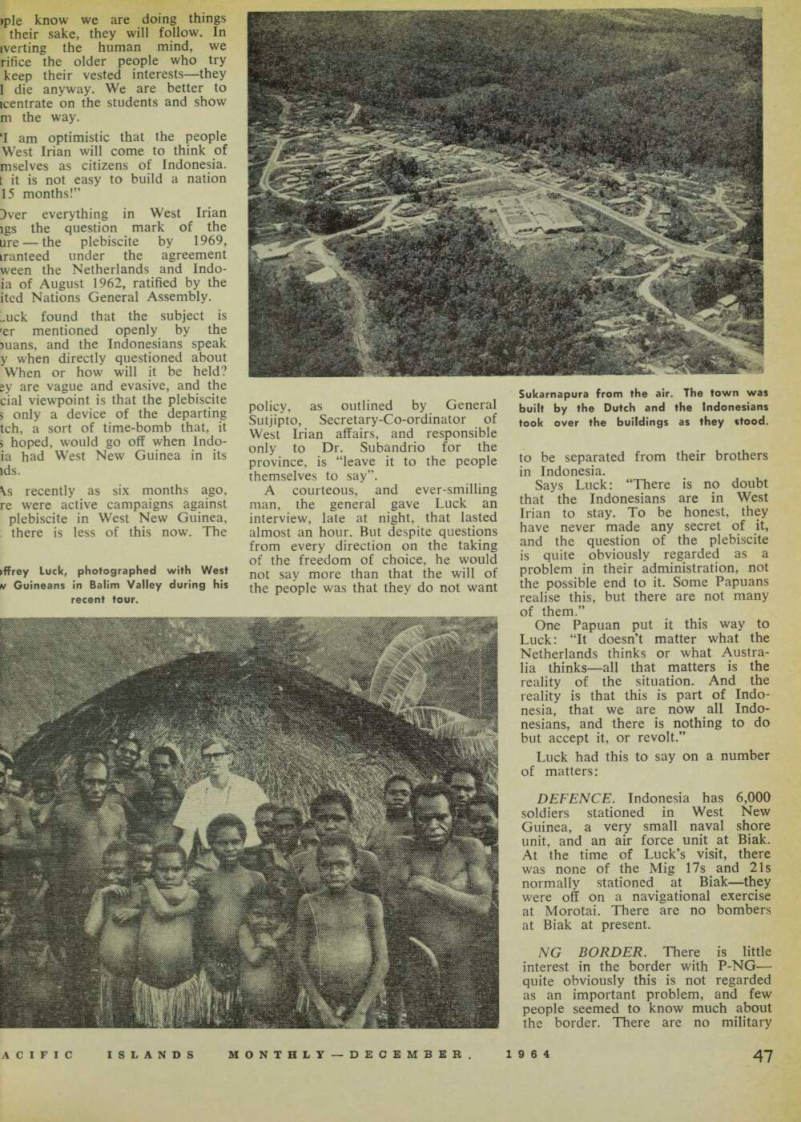
[?]ffrey Luck, photographed with West [?]w Guineans in Balim Valley during his recent tour.
Sukarnapura from the air. The town was built by the Dutch and the Indonesians took over the buildings as they stood.
patrols in border areas. Nobody in Sukarnapura knew anything of the plans for a joint border survey, drawn up at a conference in Djakarta, EDUCATION. Has gone ahead tremendously. Primary school en rolments are up from 50,000 to 60,000, 900 new teachers have been brought in from other parts of Indonesia, and it’s hoped to achieve compulsory primary education in all areas under government control by 1969. The primary schooling is being extended from a three-year to a six year course. English, not Dutch, is the main foreign language taught in secondary schools.
TRANSPORT. The major obstacle to development of the interior. The Indonesian Air Force uses Hercules to air-drop supplies to Highlands centres. Luck flew on two of their missions, and found the crews highly efficient and accurate. The Force has dropped more than 700 tons of sup plies from Hercules transports in the last year, achieving a 92 per cent, recovery rate of foodstuffs and build ing materials.
MISSIONS. They continue their work unhindered under the Indo nesian policy of religious freedom.
All missionaries spoke of good co operation with the government, but were aware of the need to work to set up indigenous churches. No
deadlines have been set, but foreign European missionaries (i.e. who are not Indonesian citizens) will not be there for ever. This has introduced some tension for the missions, as their futures have become uncertain.
All had considered the creation of national churches, with their own trained leaders, a very long job, but clearly this will have to be done more quickly now.
While Luck was in West New Guinea he was able to report the dramatic decline in West New Guinea trade with Australia. While he was there, government policy directed the Bank of Indonesia to refuse to establish letters of credit in Australia for importers of Australian goods.
All purchases had to be on the basis of “shipment before payment”.
Trade Goes To Japan This was a direct result of Indo nesian antagonism to Australia’s involvement with Malaysia, and ap parently the first time that West New Guinea had been involved as a result of foreign policy decisions.
West New Guinea is a special area, with its own currency, stamps, Customs duties, tax rates, and import licensing system, and up till then had not been affected by questions of international relations.
Luck thinks there are signs that the bulk of trade with West New Guinea will swing towards Japan.
Australia had been supplying up to 32 per cent, of all imports, including most of its food, and important items such as outboard motors.
He found that the Indonesian PIT (Posts, Telephones, Telegraph) Service moved cables efficiently.
Sukarnapura has circuits to Djakarta, Sydney and Manila, and he had no difficulty in transmitting Press messages direct to Sydney through Djakarta and Hong Kong.
Luck added: “The Indonesians were all friendly, helpful and exteremely charming, even if a little surprised to see an Australian in their midst. There was widespread interest in Australia, and in what was being done in Papua-New Guinea, but this was always overhadowed by pride in their own country, which is very strong and very real. Indonesia is making a sincere effort in West New Guinea.” ® Judge Frost, QC, a Country Court Judge of Victoria, in Novem ber was appointed a Judge of the Supreme Court of Papua and New Guinea, to replace Mr. Justice Smithers, who resigned. His wife and family will join him in Port Moresby at the end of the year.