[?]ew British
pp. 39-41 · Read in the full issue

[?]vernment [?]eassures GEIC
Britain assured the econo ;ally-weak Gilbert and Ellice mds Colony in November that would stick by her financially pite any constitutional nges that might come. The tish assurance, from the new
)our Government, followed
ch talk in the Colony about GEIC’s future.
IE Labour Government’s message was read to the third meeting the GEIC Advisory Council in awa on November 2. he message was authorised by Secretary of State for Colonial iirs, Mr. Anthony Greenwood, was read by the Resident Com iioner, Mr. V. J. Andersen. rhe British Government,” the iment said, “are well aware of economic difficulties that must easingly face the Colony. They lot, of course, undertake now provide any specific level of tidal assistance to the Colony to 1 in overcoming these difficulties he years to come.
Slevertheless, the people of the any can rest assured that the ish Government’s concern for r well-being and its willingness provide such financial assistance
as may be agreed to be necessary in the future would not be affected by constitutional change in the Colony.
“At the same time, the British Government will naturally expect the people of the Colony to help themselves to overcome the economic difficulties which circumstances unfortunately imposed on them.”
Mr. Andersen read this statement after saying that he had heard many opinions expressed during the previous 12 months on the political future of the Colony.
Some people, he said, believed that existing councils in the GEIC represented over-rapid progress for the people of the Colony; while others, including outside critics of British policy, thought that the Government should move faster.
A Council member, Mr. R. K.
Bowman, who moved an address of thanks to the Resident Commis sioner, said that self-help was essential in all fields of development in a colony facing economic difficulties.
Mr. Reuben Uatioa, who seconded the motion, said that while further steps might be taken towards re presentative government, the people of the Colony were not going to be forced into self-government by any one who knew nothing about the Gilbert and Ellice Islands and their conditions, In a debate on the motion, Mr, E. H. G. Blacklock, an LMS mis sionary, said that immediate steps for self-determination were not essential.
“As is seen in other territories
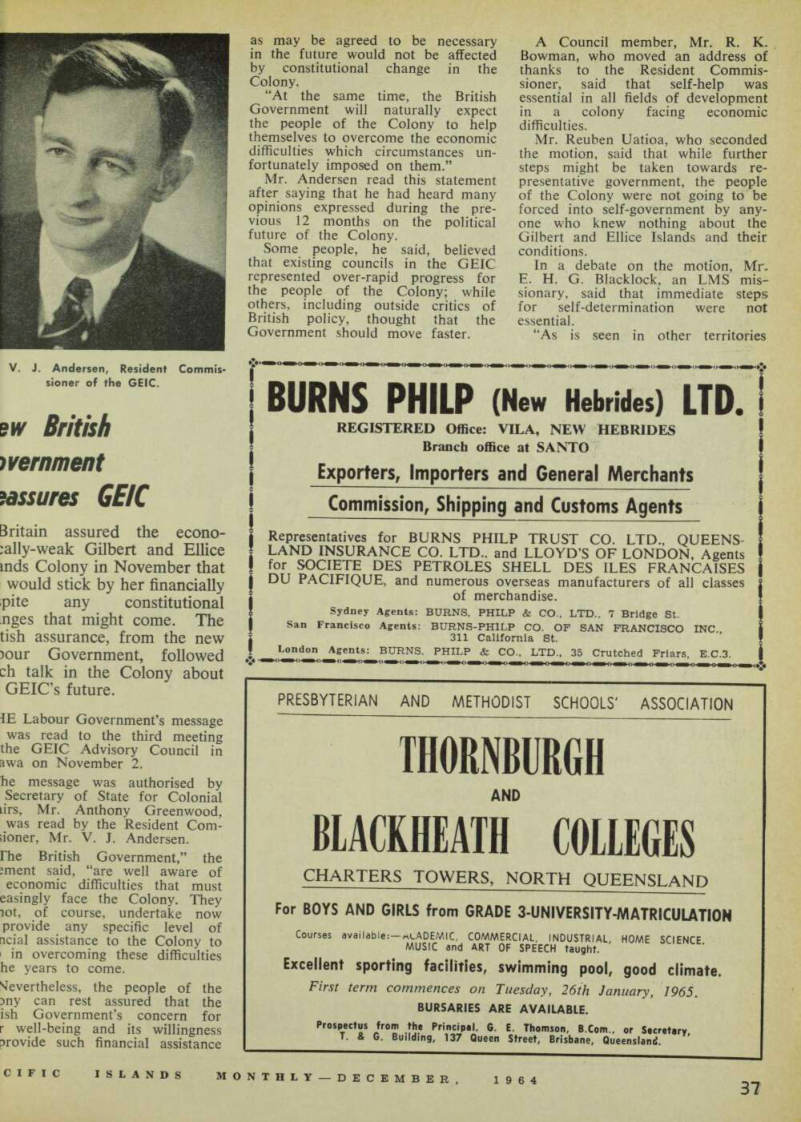
V. J. Andersen, Resident Commis sioner of the GEIC.
/hich were given full independence, hey gain nothing but disaster,” he dded.
In subsequent debates, members mphasised the need for increased opra production and increased in ustry.
Problems Discussed A couple of weeks earlier, the financial Secretary of the Western ’acific High Commission, Mr. L. M. >avies, visited Tarawa to discuss evelopment projects and economic roblems of the Colony.
These talks covered methods by /hich employment might be found ar Gilbertese in overseas territories, s well as possible resettlement chemes.
Full details of the recent census in he Colony are not yet available, ut Mr. Davies said on his return a Honiara that on present indica ions, the population of the islands robably numbers about 50,000, and n existing projections, it might each 75,000 in 15 years.
Mr. Davies said there was a grow ag interest in sponsoring tourist icilities in the GEIC. Investment i hotels had been suggested to him s the first requirement.