Tropicalities
pp. 21-23 · Read in the full issue
The war between rival aviation interests over control of internal air transport in the New Hebrides has been blowing hot and cold for some time. Lately, it has been going through one of its warmer periods.
rHE two interests concerned are New Hebrides Airways, a British :ompany with New Hebridean share tolders, headed by Mr. Bob Paul, of fanna; and Hebridair, a French ompany, run largely by Mr. Marti ict, head of the New Caledonian irline, Transpac.
A recent significant development a the air war has been the active ntry into it of the big French firm, 'omptoirs Francais des Nouvelles lebrides (CFNH) as an ally of lebridair, CFNH has been helping to build irstrips in the northern islands of le Group, and, we hear from ongoa, it has been attempting to ifluence New Hebrideans to travel y Hebridair rather than by NHA, The Rev. J. R. Hyslop, a Presby
terian missionary, who has been stationed at Tongoa since 1957, and whose letter on New Hebrides aviation was published last month (p. 51), now tells us (November 6); “This week Comptoirs Francais des Nouvelles-Hebrides, which, if not a principal shareholder in Hebridair, is apparently vitally interested in its future, sent up here a Tongoan chief and member of the local council, who happens to be working for it in Vila at the moment, with an ulti matum to the chiefs and council.
Emissaries bent on similar missions from CFNH have been many this year, but this was the first one with an ultimatum.
“The ultimatum was that if Tongoans continue to refuse to travel by Hebridair, then CFNH will dis miss all Tongoans who are employed by the firm in Vila and elsewhere.
CFNH is the largest employer of Tongoans in the New Hebrides, and, as you probably know, is the largest commercial firm also.
Disdain “As nobody here is directed to travel by any one airline, the chiefs treated this threat with the disdain it deserved, adding a dark hint that this sort of thing could boomerang, as CFNH has a large trading busi ness here that depends on the good will of the people to survive, “There can be little doubt about which airline’s resources are biggest, but there would seem to be plenty of doubt as to which are best, most desirable and most effective.”
Two other—widely divergent— views on internal aviation in the New Hebrides were expressed re cently by the New Hebrides Chamber of Commerce, Industry and Agricul ture, and by Mr. Bob Paul, of
Nha.
The Chamber of Commerce (which has eight French members to four British) expressed its view at its quarterly meeting in Santo on October 6. This was that the “activities of the aviation companies
operating in the archipelago should be co-ordinated” with a view to im proving the Condominium’s air ser vices.
Mr. Paul’s view appeared in an interview published by The Fiji Times on October 9.
He said his company had built seven airstrips in the New Hebrides with its own resources and without official backing, and now the French had convinced the British Adminis
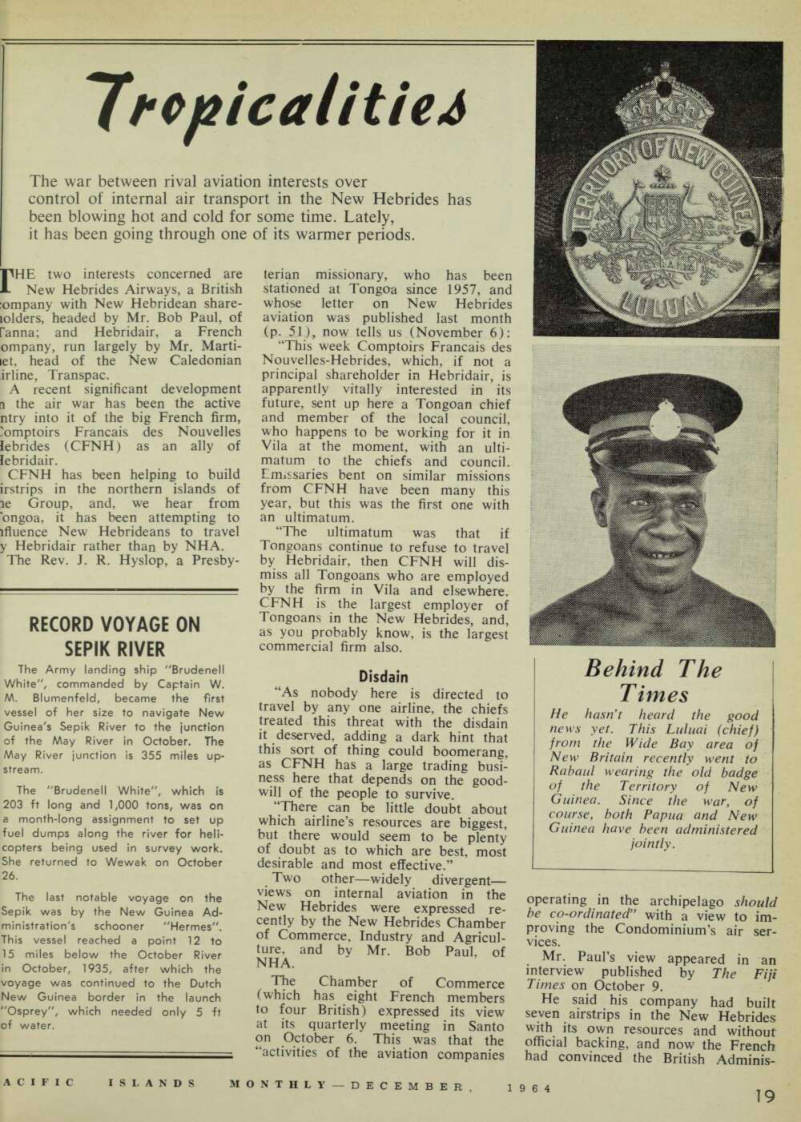
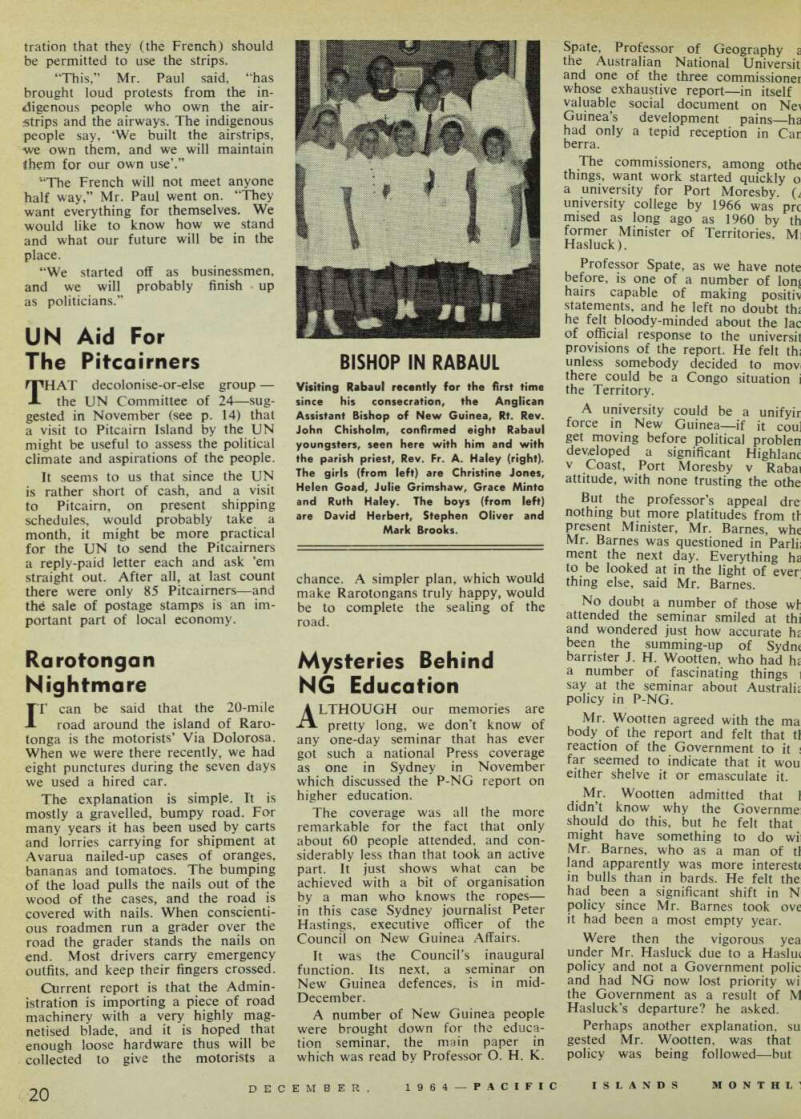
Behind The
Times
He hasn’t heard the good news yet. This Luluai (chief) from the Wide Bay area of New Britain recently went to Rabaul wearing the old badge of the Territory of New Guinea. Since the war, of course, both Papua and New Guinea have been administered jointly.
tration that they (the French) should be permitted to use the strips.
“This,” Mr. Paul said, “has brought loud protests from the in digenous people who own the air strips and the airways. The indigenous people say, ‘We built the airstrips, we own them, and we will maintain them for our own use’.”
'“The French will not meet anyone half way,” Mr. Paul went on. “They want everything for themselves. We would like to know how we stand and what our future will be in the place.
“We started off as businessmen, and we will probably finish up as politicians.”
UN Aid For
The Pitcairners
THAT decolonise-or-else group the UN Committee of 24—sug gested in November (see p. 14) that a visit to Pitcairn Island by the UN might be useful to assess the political climate and aspirations of the people.
It seems to us that since the UN is rather short of cash, and a visit to Pitcairn, on present shipping schedules, would probably take a month, it might be more practical for the UN to send the Pitcairners a reply-paid letter each and ask ’em straight out. After all, at last count there were only 85 Pitcairners—and thd sale of postage stamps is an im portant part of local economy.
Rarotongan
Nightmare
IT can be said that the 20-mile road around the island of Raro tonga is the motorists’ Via Dolorosa.
When we were there recently, we had eight punctures during the seven days we used a hired car.
The explanation is simple. It is mostly a gravelled, bumpy road. For many years it has been used by carts and lorries carrying for shipment at Avarua nailed-up cases of oranges, bananas and tomatoes. The bumping of the load pulls the nails out of the wood of the cases, and the road is covered with nails. When conscienti ous roadmen run a grader over the road the grader stands the nails on end. Most drivers carry emergency outfits, and keep their fingers crossed.
Current report is that the Admin istration is importing a piece of road machinery with a very highly mag netised blade, and it is hoped that enough loose hardware thus will be collected to give the motorists a
chance. A simpler plan, which would make Rarotongans truly happy, would be to complete the sealing of the road.
Mysteries Behind
NG Education
ALTHOUGH our memories are pretty long, we don’t know of any one-day seminar that has ever got such a national Press coverage as one in Sydney in November which discussed the P-NG report on higher education.
The coverage was all the more remarkable for the fact that only about 60 people attended, and con siderably less than that took an active part. It just shows what can be achieved with a bit of organisation by a man who knows the ropes— in this case Sydney journalist Peter Hastings, executive officer of the Council on New Guinea Affairs.
It was the Council’s inaugural function. Its next, a seminar on New Guinea defences, is in mid- December.
A number of New Guinea people were brought down for the educa tion seminar, the main paper in which was read by Professor O. H. K.
Spate, Professor of Geography a the Australian National Universit and one of the three commissioner whose exhaustive report—in itself valuable social document on Ne> Guinea’s development pains—ha had only a tepid reception in Car berra.
The commissioners, among othe things, want work started quickly o a university for Port Moresby. (i university college by 1966 was prc mised as long ago as 1960 by th former Minister of Territories, Mi Hasluck), Professor Spate, as we have note before, is one of a number of long hairs capable of making positiv statements, and he left no doubt th; he felt bloody-minded about the lac of official response to the universit provisions of the report. He felt th; unless somebody decided to movi there could be a Congo situation i the Territory.
A university could be a unifyir force in New Guinea—if it cou] get moving before political problen developed a significant Highlanc v Coast, Port Moresby v Rabai attitude, with none trusting the othe But the professor’s appeal dre nothing but more platitudes from tl present Minister, Mr. Barnes, whe Mr. Barnes was questioned in Parli; ment the next day. Everything ha to be looked at in the light of ever thing else, said Mr. Barnes.
No doubt a number of those wh attended the seminar smiled at thi and wondered just how accurate he been the summing-up of Sydn* barrister J. H. Wootten, who had he a number of fascinating things I say at the seminar about Australia policy in P-NG.
Mr. Wootten agreed with the ma body of the report and felt that tl reaction of the Government to it < far seemed to indicate that it wou either shelve it or emasculate it.
Mr. Wootten admitted that 1 didn’t know why the Governmei should do this, but he felt that might have something to do wii Mr. Barnes, who as a man of tl land apparently was more interest* in bulls than in bards. He felt the had been a significant shift in N policy since Mr. Barnes took ove it had been a most empty year.
Were then the vigorous yea under Mr. Hasluck due to a Haslu* policy and not a Government polic and had NG now lost priority wi the Government as a result of M Hasluck’s departure? he asked.
Perhaps another explanation, su gested Mr. Wootten. was that policy was being followed—but
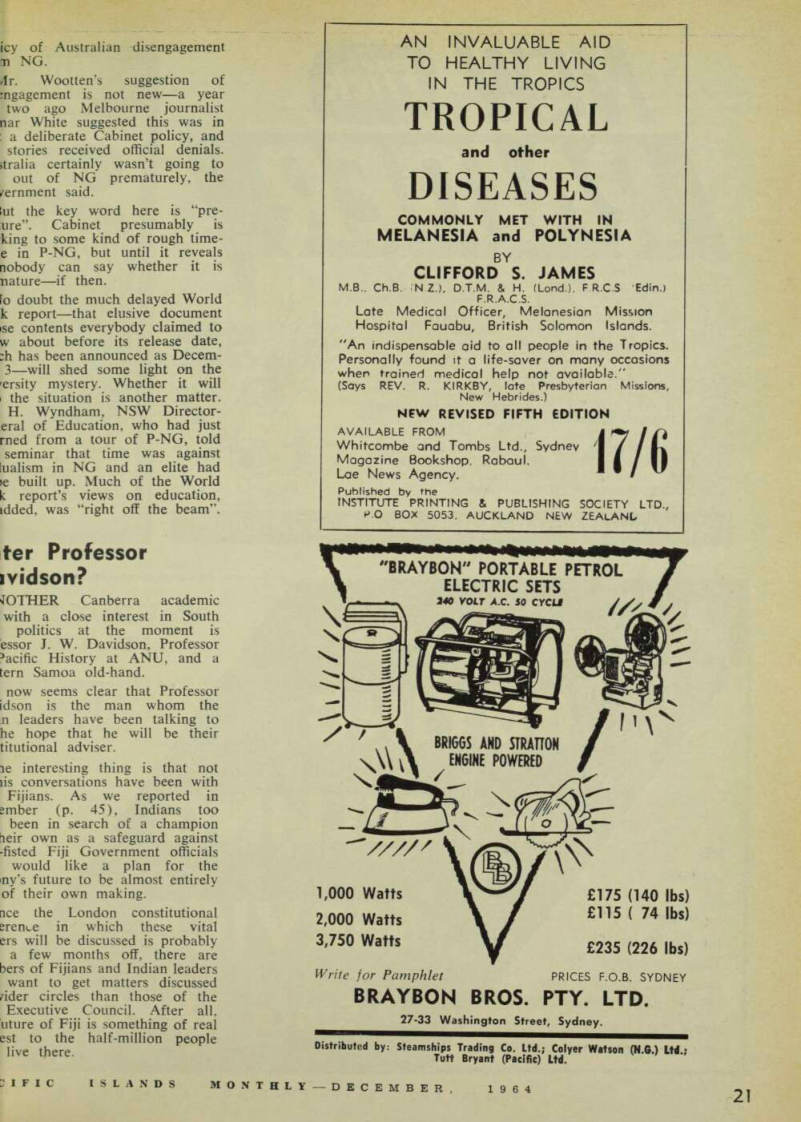
Bishop In Rabaul
Visiting Rabaul recently for the first time since his consecration, the Anglican Assistant Bishop of New Guinea, Rt. Rev.
John Chisholm, confirmed eight Rabaul youngsters, seen here with him and with the parish priest, Rev. Fr. A. Haley (right).
The girls (from left) are Christine Jones, Helen Goad, Julie Grimshaw, Grace Minto and Ruth Haley. The boys (from left) are David Herbert, Stephen Oliver and Mark Brooks.
Icy of Australian disengagement u NG. dr. Wootten’s suggestion of mgagement is not new—a year two ago Melbourne journalist nar White suggested this was in : a deliberate Cabinet policy, and stories received official denials, rtralia certainly wasn’t going to out of NG prematurely, the said. lut the key word here is “pre ore”. Cabinet presumably is king to some kind of rough time e in P-NG, but until it reveals nobody can say whether it is nature—if then. lo doubt the much delayed World k report—that elusive document •se contents everybody claimed to w about before its release date, :h has been announced as Decem 3—will shed some light on the r ersity mystery. Whether it will i the situation is another matter.
H, Wyndham, NSW Director eral of Education, who had just rned from a tour of P-NG, told seminar that time was against lualism in NG and an elite had >e built up. Much of the World k report’s views on education, idded, was “right off the beam”.
ter Professor
ividson?
MOTHER Canberra academic with a close interest in South politics at the moment is essor J. W. Davidson, Professor s acific History at ANU, and a tern Samoa old-hand. now seems clear that Professor idson is the man whom the n leaders have been talking to he hope that he will be their titutional adviser. le interesting thing is that not lis conversations have been with Fijians. As we reported in ember (p. 45), Indians too been in search of a champion heir own as a safeguard against -fisted Fiji Government officials would like a plan for the ny’s future to be almost entirely of their own making. ace the London constitutional erence in which these vital ers will be discussed is probably a few months off, there are bers of Fijians and Indian leaders want to get matters discussed dder circles than those of the Executive Council. After all, uture of Fiji is something of real est to the half-million people live there.