Without Apologies
pp. 17-18 · Read in the full issue
Nauru Digs In Its , Without Apologies
By Stuart Inder
The long period of testing the temperature of the water on the Nauruan question is now over. The temperature of the water is warmish, and a new phase has started in which the Nauruans are for the first time quietly on the offensive.
WE feel that our point of view is not listened to, although we are xpected to understand Australia’s ioint of view. Naturally, we want »ur views understood,” Head Chief lammer Deßoburt explained to me a Sydney, in November, where he rrived for discussions on the new ihase.
The Nauruans are buying the ser ices of a group of economics ex erts to advise them on the best way if obtaining a better deal on Nauruan phosphate deposits. It is ikely that the experts will brief enior legal counsel to press the Nauruans’ case for increased phos ihate royalties before the British ffiosphate Commissioners. The Com nissioners represent Australia, New Zealand and UK Government owner hip of the Nauru phosphate de »osits.
The Nauruans want an increase rom the present total of 7/- to 14/8 i ton. Another conference on oyalties and other matters affecting 4auru is likely to be held in Can ierra early in 1965.
To Remain On Nauru After the last conference, in kugust, the Nauruans announced that ince Australia had refused to grant hem sovereignty of Curtis Island, off Queensland, as a new home, they vould not proceed with resettlement proposals. They would remain on They asked that they be given in dependence by 1967 and that the ffiosphate ships returning to Nauru n ballast be allowed to carry soil ;o as to rehabilitate denuded Nauru.
They asked that the phosphate in lustry be transferred to them.
The Government replied that it considered Nauru’s political advance nent was closely tied up with a re settlement scheme, and it would dis cuss this with NZ and the UK. It would not agree to transfer the phosphate industry. It made no de cision on the soil plan.
Hammer Deßoburt, a sound and intelligent leader whose determina
tion to do what is right for his own people has never been questioned, says Nauru is united on the decision to stay put.
No Nauruan wanted to lose his national identity, and it was un necessary and unwanted paternalism for any government to suggest that it knew better than the Nauruans what was best for them.
“We have lived there a long time, and in those seas near the Equator there are other islands with popula tions no greater who manage to live happily enough with less than we’ve got now and a great deal less money than we are likely to have,” said Deßoburt. “We can grow coconuts, we can fish,”
He said the fact that the Nauruan Council had not yet worked out the details of such an existence did not mean that they couldn’t work them out, or that such a life would be impossible or even difficult for what, after all, were Islands people.
But the vital fact of the matter, he
stressed, was the Nauruans wanted to do it this way and they deserved and expected support from Australia and its trusteeship partners, NZ and the UK. Life should not be made more difficult merely because Nauru carried great phosphate deposits.
The Nauruan leader said he would expect that some young people might like to go to Australia in time, but he felt they would not be many and they * would not create any large problem. No doubt some of them would be sending money home, as many Cook Islanders did who lived in NZ, or GEIC people in Fiji.
Deßoburt is aware that the Nauruans can’t get what they feel is a fair go merely by applying to the Australian people, which is why the Nauruan Council is willing to spend money on legal help to tackle (over)
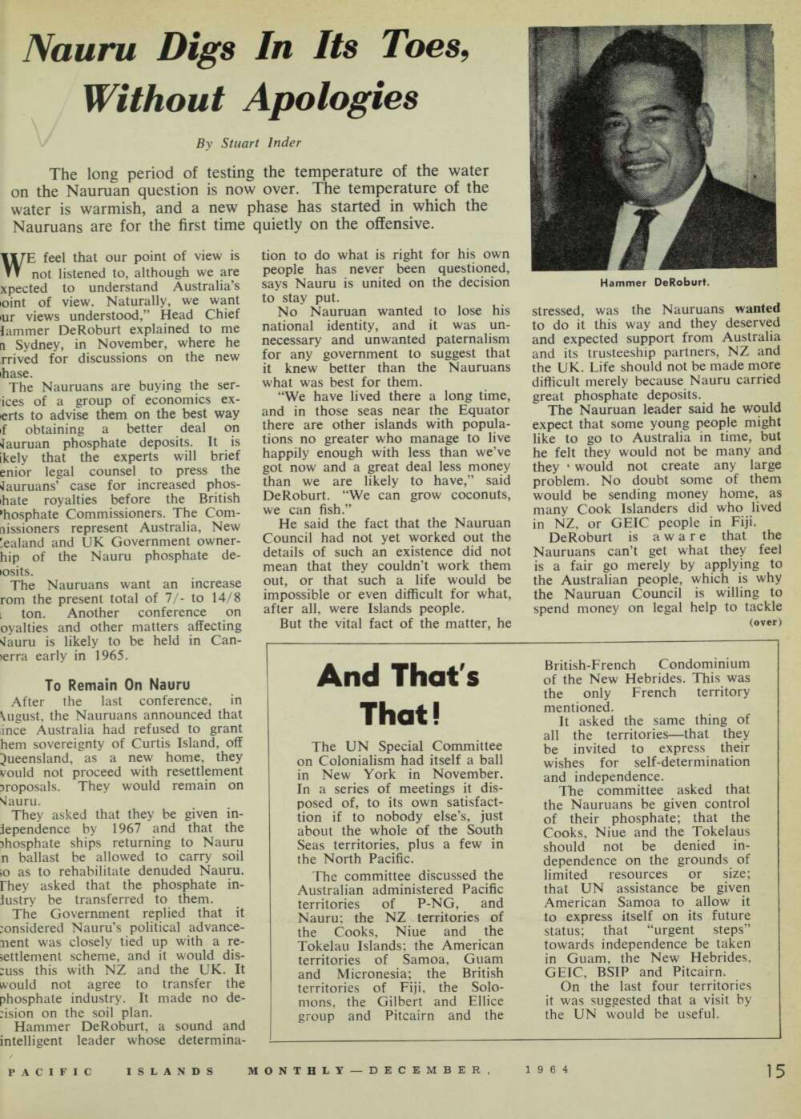
Hammer DeRoburt.
the phosphate problem at its source— the BPC.
But he does feel, personally, that the Nauruans could do with some specialised public relations help to get their sentiments across to the Aus tralian public.
He feels Australians don’t realise that Nauruans have the same national pride as themselves, and that they are willing to be closely connected with Australia but not to be swallowed up.
He doesn’t see why Nauru can’t
have a Treaty of Friendship with Australia as Western Samoa has with NZ.
While in Sydney this trip Deßoburt will be making inquiries about the possibilities of getting a public re lations organisation to look at Nauru’s problem.
As far as Hammer Deßoburt is concerned, Nauru’s 2,500 people are not talking pie-in-the-sky. They are talking in terms of nationalism—• Nauruan nationalism, and they make no apologies for it.