New Guinea Key Air
pp. 13-153 · Read in the full issue
Link To S.E. Asia
By a Staff Writer
The defence of Papua-New Guinea became a prominent issue in Australia in November after Prime Minister Sir Robert Menzies shed his usual urbane and diplomatic approach to describe President Soekarno as “truculent”. He suggested that Indonesia probably wouldn’t have too many doubts about infil trating from West New Guinea to the Australian side of the border “if she thought it were profitable”.
HE accompanied his words with an announcement of a stepped-up defence programme, aimed at putting better airfields and more troops in P-NG, improving the Australian armed services generally and intro ducing conscription for Australian youths.
Since all these things coincided with the opening of a political cam paign for Senate seats, Australia’s Labour opposition was quick to accuse the Government of thrusting diplomacy aside for political ends, and thereby of bringing Australia to the brink of war with Indonesia.
In Papua-New Guinea however, the Government announcements were generally greeted with satisfaction that at last something was being done for P-NG defence after years of Territory agitation.
And in Melbourne and in Can
(Continued on p. 151)
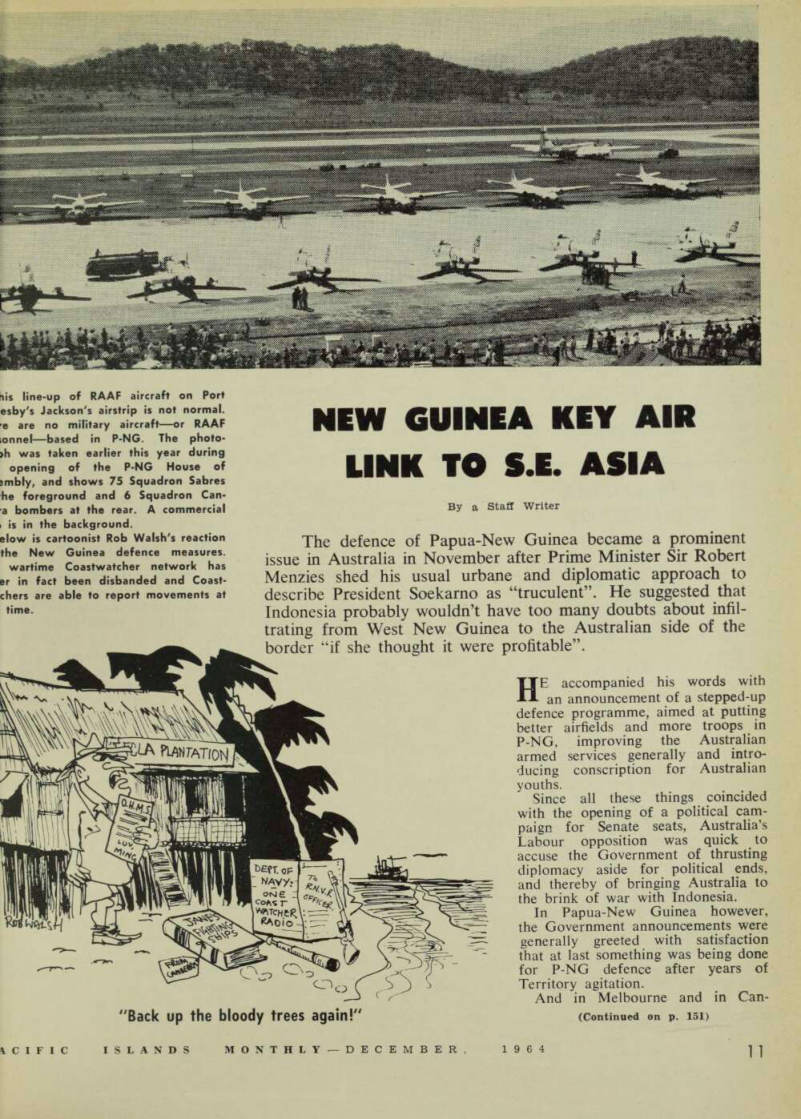
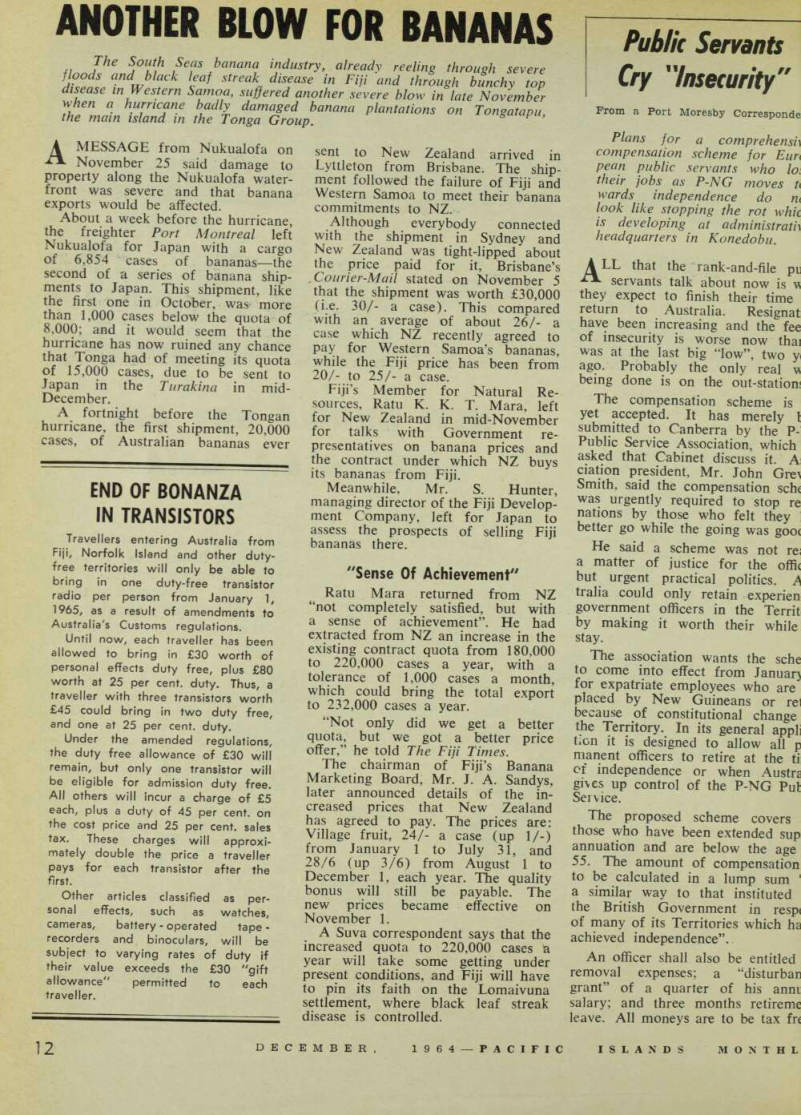
[?]is line-up of RAAF aircraft on Port [?]esby's Jackson's airstrip is not normal. [?]e are no military aircraft —or RAAF [?]onnel —based in P-NG. The photo [?]h was taken earlier this year during opening of the P-NG House of [?]mbly, and shows 75 Squadron Sabres [?]he foreground and 6 Squadron Can [?]a bombers at the rear. A commercial [?] is in the background. [?]elow is cartoonist Rob Walsh's reaction the New Guinea defence measures. wartime Coastwatcher network has [?]er in fact been disbanded and Coast chers are able to report movements at time.
"Back up the bloody trees again!"
a. there were moves behind the es to bring Port Moresby’s Jack -5 airstrip quickly to a standard nable Australian commercial jets iy north through New Guinea in of a shutdown by Indonesia of air space. lould Indonesian relations de bate to such an extent that Aus an aircraft are forbidden to fly h from Darwin, the New Guinea route will be the only one out, ddly enough, Qantas Airways ials pointed this out in 1960 n the airline was pushed out of G in preference to the domestic nes of TAA and Ansett, antas was then operating a twice- Idy service through Port Moresby he Far East, but it was forced ease it in 1961 because of lack raffle. The lack of support was to the fact that Qantas wasn’t nitted to carry passengers between tralia and P-NG—although they pointed out that the service dn’t be expected to be economic ts early years without them,
Moresby Strip
'antas wanted to keep their in ations in Port Moresby to operate enlarge this route, ort Moresby strip is capable of ng 707 aircraft now but it is re led as “marginal”. Fairly in snsive work in sealing the ends ild make it fully operational, but is unlikely that Qantas would le to go back without traffic rights the sealing work, t is likely that Qantas will be wed to return under these con ans now that the Government mers have seen the vital defence siderations. f this happens it would mean that v Guinea people would benefit i a faster service than the present ibling DC6 aircraft operated by domestic airlines, ir Robert Menzies’ announce it on New Guinea defences in led an expansion of the Pacific nds Regiment to three battalions 1 supporting units totalling 3,500 June, 1968; formation of a stal security force of patrol craft adquarters in Port Moresby); Iding of Army housing and bar ks in various P-NG centres to the ue of about £l2 million; improve nt in airfields at Boram (near
Wewak); rehabilitation of the old wartime airfield at Nadzab, near Lae, for ferrying purposes; and general improvement of smaller airstrips near the West New Guinea border includ ing Daru.
There is nothing new in any of these schemes. Some of them have been planned for more than 12 months, but it seems they will at last get moving.
The Wewak strip would be de signed as a front line defence strip, for use in conjunction with the one at Port Moresby. The marine base at Port Moresby will be for the Army, will cost about £400,000 and will be finished by June, 1966.
Most of the money in Army in stallations will be spent in barracks at Lae, and the Port Moresby area, including the Goldie River, which is about 16 miles from Moresby. The Goldie camp is for recruit training but a lot of New Guinea men with local Army experience say the area is a poor choice as a recruit camp because the sparse gum country is not typical of territory conditions.
The plan is to build up each of the Army installations in the Port Moresby area Murray Barracks, Taurama Barracks and Goldie River Barracks —as a self-contained com plex. But all these installations are for the permanent military forces, and meanwhile there is still a great
deal of resentment in some areas of the Territory because the militia unit, the PGNVR, has still been given no proper role in Territory defence.
With the recent announcement that New Guineans could join there was a great rush of would-be recruits but enlistments are pegged at about 500, and hundreds of New Guineans are thus on the waiting list.
There is in New Guinea resent ment that not enough use has been made of the wonderful PNGVR potential, which proved itself behind the lines in World War II. Rightly or wrongly this is blamed on “a two Army complex”—that is, regular Army men are accused of “just tolerating” the CMF in New Guinea.
Properly organised, detachments of signals, medical, intelligence, and transport experts could be formed from the PNGVR to provide a nucleus of specialist units that one day may be needed—if Sir Robert Menzies’ views on Indonesia are correct.
Meanwhile, following pressure from the RSL, the P-NG Adminis tration has announced the appoint ment of Mr. R. I. Skinner as Con troller of Civil Defence and Emer gency Services in P-NG. He will organise a volunteer defence and emergency service in the Territory.
Mr. Skinner, currently District Com missioner of the Southern Highlands, was a wartime New Guinea Coast watcher with the rank of major. • See also, “Indonesia Makes an Effort in West New Guinea”, p. 45.