Pacific Commerce and Produce
pp. 133-135 · Read in the full issue
Headaches Ahead In South Seas Over Decimal Currency
By a Staff Writer
Except for American Samoa, all English-speaking South Paci fic territories will face a major problem in 1966 and 1967 when Australia and New Zealand change over to decimal currency.
Australia’s change will be made in February, 1966, and New Zealand’s in July, 1967.
IF the South Pacific territories change over to decimal currency themselves, they will have to educate their people to accept it and bear the tremendous expense and incon venience of converting ledger systems, cash registers, etc., etc.
And if they don’t change over, they will have to put up with the difficulty of handling pound?, shillings and pence side by side v/ith the decimal currency of either Australia and New Zealand.
At present, all English-speaking South Pacific territories, except American Samoa, use Australian or New Zealand currency either offici ally or as a matter of convenience.
Eight of these territories—Norfolk Island, Nauru, Papua-New Guinea, the Cook Islands, Tokelaus, Niue, and Western Samoa—will definitely change to decimal currency.
In the remaining five—Tonga, Fiji, New Hebrides, the British Solomon Islands Protectorate and the Gilbert and Ellice Islands Colony—no de finite decisions have been made, al though it looks very much as if they will change over to decimals.
The Australian dollar will be equal
to the present 10/-. A 50 cent piece will be equal to 5/-, a 20 cent piece equal to 2/-, 10 cents will be equal to 1/- and there will be 5 cent (6d), 2 cent and 1 cent pieces.
New Zealand has not yet made a decision on its coins.
In anticipation of the changeover, half-crowns will gradually be with drawn from circulation in New Zealand. Australia does not have them. For a time both decimal and regular currencies will be circulated side by side.
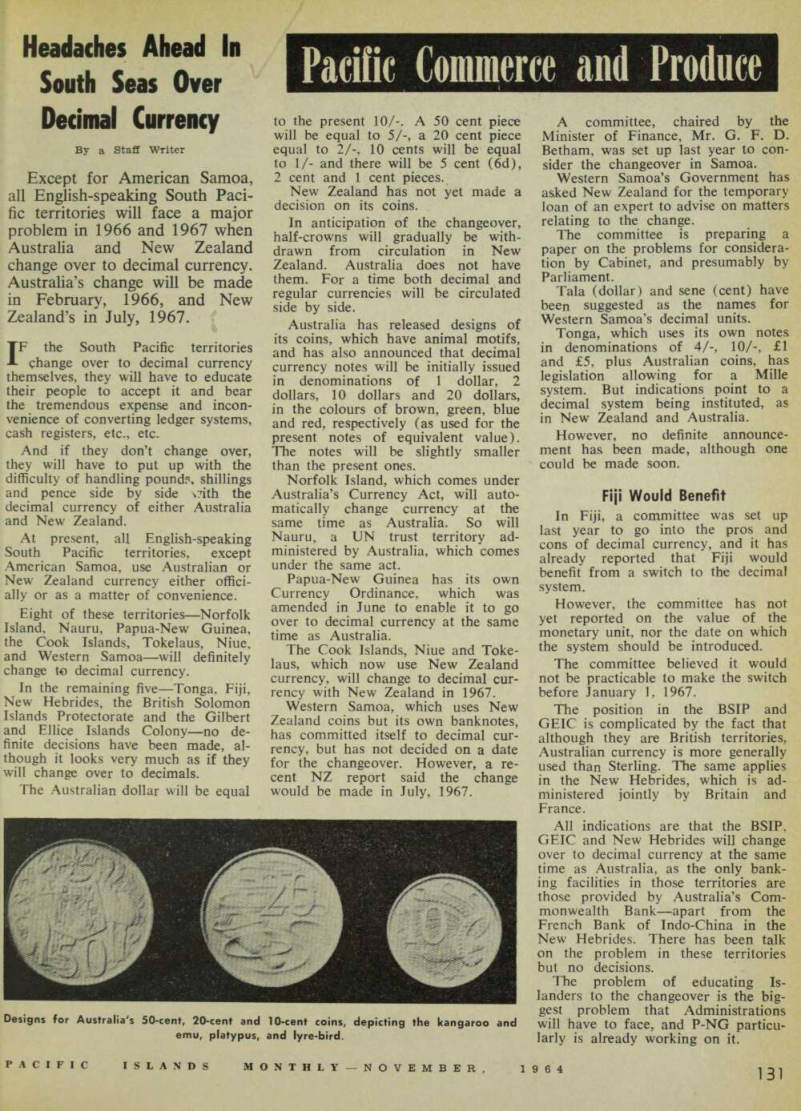
Australia has released designs of its coins, which have animal motifs, and has also announced that decimal currency notes will be initially issued in denominations of 1 dollar, 2 dollars, 10 dollars and 20 dollars, in the colours of brown, green, blue and red, respectively (as used for the present notes of equivalent value).
The notes will be slightly smaller than the present ones.
Norfolk Island, which comes under Australia’s Currency Act, will auto matically change currency at the same time as Australia. So will Nauru, a UN trust territory ad ministered by Australia, which comes under the same act.
Papua-New Guinea has its own Currency Ordinance, which was amended in June to enable it to go over to decimal currency at the same time as Australia.
The Cook Islands, Niue and Toke laus, which now use New Zealand currency, will change to decimal cur rency with New Zealand in 1967, Western Samoa, which uses New Zealand coins but its own banknotes, has committed itself to decimal cur rency, but has not decided on a date for the changeover. However, a re cent NZ report said the change would be made in July, 1967.
A committee, chaired by the Minister of Finance, Mr. G. F. D.
Betham, was set up last year to con sider the changeover in Samoa.
Western Samoa’s Government has asked New Zealand for the temporary loan of an expert to advise on matters relating to the change.
The committee is preparing a paper on the problems for considera tion by Cabinet, and presumably by Parliament.
Tala (dollar) and sene (cent) have been suggested as the names for Western Samoa’s decimal units.
Tonga, which uses its own notes in denominations of 4/-, 10/-, £1 and £5, plus Australian coins, has legislation allowing for a Mille system. But indications point to a decimal system being instituted, as in New Zealand and Australia, However, no definite announce ment has been made, although one could be made soon.
Fiji Would Benefit In Fiji, a committee was set up last year to go into the pros and cons of decimal currency, and it has already reported that Fiji would benefit from a switch to the decimal system.
However, the committee has not yet reported on the value of the monetary unit, nor the date on which the system should be introduced.
The committee believed it would not be practicable to make the switch before January 1, 1967.
The position in the BSIP and GEIC is complicated by the fact that although they are British territories, Australian currency is more generally used than Sterling. The same applies in the New Hebrides, which is ad ministered jointly by Britain and France.
All indications are that the BSIP.
GEIC and New Hebrides will change over to decimal currency at the same time as Australia, as the only bank ing facilities in those territories are those provided by Australia’s Com monwealth Bank—apart from the French Bank of Indo-China in the New Hebrides. There has been talk on the problem in these territories but no decisions.
The problem of educating Is landers to the changeover is the big gest problem that Administrations will have to face, and PNG particu larly is already working on it.
Designs for Australia's 50-cent, 20-cent and 10-cent coins, depicting the kangaroo and emu, platypus, and lyre-bird.
New Companies
Registered In Fiji
THREE new companies were registered at Suva recently, one of them with share capital of £1 million.
The £1 million company is the Akhil Gold Mining Company, promoted by Mr. Hari Charan Akhil, of Lautoka, main exploiter of Fiji’s manganese deposits, and a successful owner of race horses which have from time to time carried many an Australian shirt.
Mr. Akhil, who had a quarter of a million pound court tussle in Fiji with Banno Oceania, the Japanese company which bought some of his manganese mines, is apparently liquidating the company which manages his manganese, and he is turning to the search for gold.
The other companies registered recently are two by Mr. and Mrs.
Wesley Barrett of Cathay Hotel (Fiji) Ltd.
The companies are Barrett Invest ments, Ltd., with share capital of £lO,OOO, and South Pacific Cinemas Ltd., with a share capital of £5,000.
The former, state the articles of association, will carry on the busi ness of capitalists, financiers, con cessionaires and merchants, and the latter’s business is as the title suggests.
Scheme To Aid
P-NG Cottle Industry
THE introduction of a restricted freight subsidy scheme for the importation of stallions and brood mares into Papua-New Guinea has been approved by Australia’s Minister for Territories, Mr. C. E. Barnes.
The scheme is to assist the de velopment of the cattle industry by
improving the quality of station horses.
A maximum subsidy of £lOO will be paid for stallions and £6O for brood mares.
The subsidy is primarily intended to help meet the cost of freighting animals between Australia and the Territory. It can also be applied to veterinary fees and handling charges and to certain other costs incurred in moving the animals in Australia.
The concession will be granted for thoroughbred, quarter-horse or Arab stallions, provided that registration certificates can be produced.
Registered thoroughbred, quarter horse or Arab mares, and above average, unregistered mares of the same type will also qualify.
Only owners of cattle properties will be eligible for the subsidy.
The subsidy will be paid on a maximum of one brood mare for every 100 head of cattle carried, and on one stallion for every 20 brood mares on the applicant’s property.
Oil Palms Produce
First Nuts
A TYPE of oil palm which pro duces more than twice as much oil an acre as coconuts is being grown in a 20-acre experimental plot and seed garden at Bereina in the Central District of Papua-New Guinea.
The Chief of the P-NG Division of Plant Industry, Mr. A. W. Charles, said recently the palms were now producing their first crop of nuts.
The young palms were grown from seed imported from the Chemara Plantations in Malaya three years ago.
The production of palm oil could become an important industry for the Territory if sufficient acreage was planted to warrant the capital investment in establishing oil extrac tion factories.
Each factory would cost around £500,000, and one would be neces sary in every oil palm area, as the nuts had to be processed within a day or so of picking. These might be built by commercial companies which could then also handle the out put from village oil palm groves.
Mr. Charles said oil from the nuts was of a very high quality and was used commercially in the manufac ture of vegetable oil products and soap—the same as coconut oil.
He said that Bereina had been chosen for the first seed producing plot as the climate was dry and this made it easier to cross-pollinate by
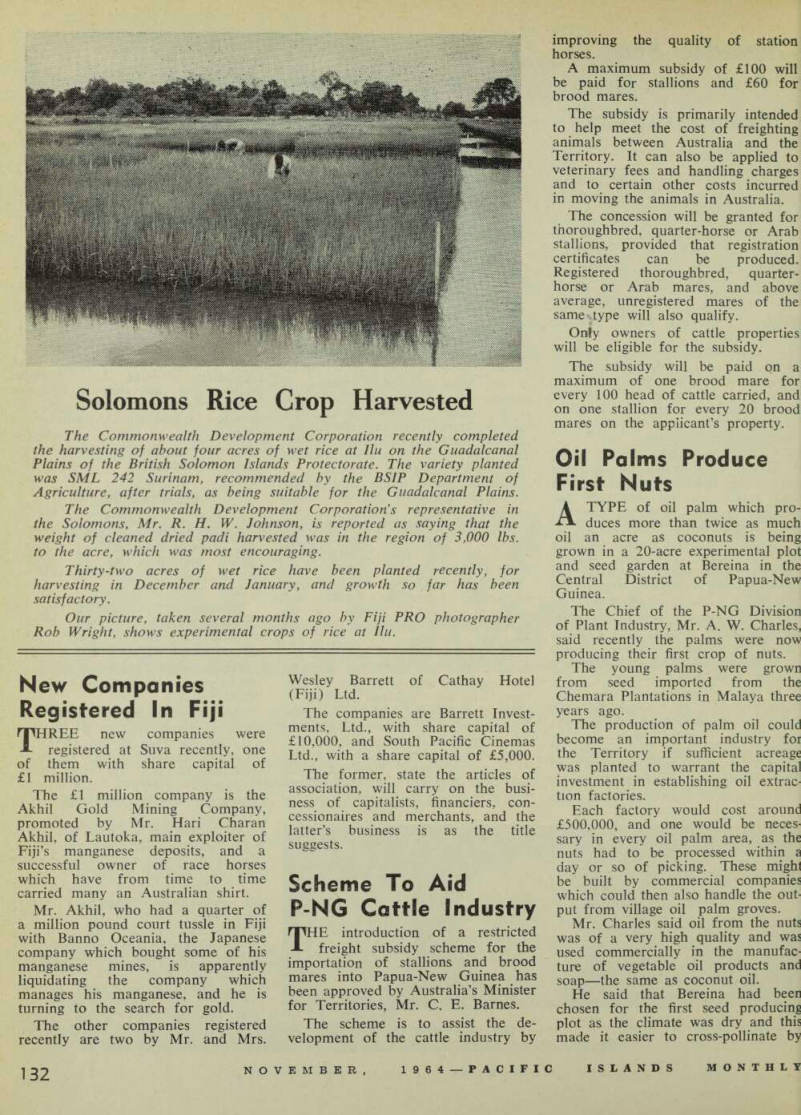
Solomons Rice Crop Harvested
The Commonwealth Development Corporation recently completed the harvesting of about four acres of wet rice at Ilu on the Guadalcanal Plains of the British Solomon Islands Protectorate. The variety planted was SML 242 Surinam, recommended by the BSIP Department of Agriculture, after trials, as being suitable for the Guadalcanal Plains.
The Commonwealth Development Corporation’s representative in the Solomons, Mr. R. H. W. Johnson, is reported as saying that the weight of cleaned dried padi harvested was in the region of 3,000 lbs. to the acre, which was most encouraging.
Thirty -two acres of wet rice have been planted recently, for harvesting in December and January, and growth so far has been satisfactory.
Our picture, taken several months ago by Fiji PRO photographer Rob Wright, shows experimental crops of rice at Ilu.
and —this being essential to pro iice seed of the best genetic con itution.
However, Bereina was too dry for igh yields in commercial produc on.
Best results were obtained in sgions with an annual rainfall of ound 100 inches, and on soils hich were not too alkaline.
It seems likely that oil palms ould do well in the Naganai area i the north coast of New Britain, id in Bougainville.
Sood Year For
lackshalls
lACKSHALLS LTD., Sydney based bread manufacturer, flour-miller id investor, had a net profit of : 128,745 for the year ended June 30, )64. Hackshalls own three companies Fiji—the Pacific Biscuit Co. Ltd., acific Soaps Ltd., and Union Soaps ty. Ltd.
The directors say their Pacific lands interests have benefited from iproved economic conditions in Fiji.
Important additions had been made i the plant at Suva with the recent stallation of a new soap manufactur g unit, which enabled the highest anufacturing standards to be :hieved.
The directors say the overall finan al position of the company is rong, and they expect earnings to ; maintained during the current year.
The company paid a final dividend : 7i per cent., making it 15 per cent. >r the full year.