Territories TALK-TALK
pp. 119-123 · Read in the full issue
With Tolala
“Better late than never” is the usual excuse from the procrastinator; and it seems a pity that the phrase has to be used by Australian museums in describing their belated action in making an organised effort to assemble New Guinea artifacts for future presentation, as described in a Sydney journal.
P.I.M. has repeatedly pointed out the laissez faire attitude in our own museums towards New Guinea “curios” compared with the diligence shown by museums from other countries—principally Germany and America. (It was recently stated that a native drum costing a quid in NG was selling in San Francisco for 375 dollars!).
Pioneer German anthropologists cum-ethnologists made a good job of taking back artifacts to their museums and in the one in Hamburg there are some real collector’s pieces.
Perhaps the best collection in Europe of New Guinea arts and crafts is in the Vatican at Rome.
Roman Catholic missionaries, wherever they may be, always make a point of sending back local arts from each new point penetrated for mission work.
Britain has been almost as casual
as Australia about New Guinea.
Certainly, in the 1920 s Eichorn was up the Sepik collecting entomolo gical specimens for the Rothschild museum in Buckinghamshire and J. H. L. Waterhouse (later school teacher at Nodup) was down in the Buin area sending back botanical specimens to Kew Gardens.
During the early days of Aus tralia’s occupation of New Guinea the item most sought after and souvenired by the Aussies was the bird-of-paradise plume, which later adorned the headgear of both the colonel’s lady and Judy O’Grady, particularly in Sydney Town. So much so in fact that it became a prohibited export.
Wholesale export of artifacts, — mostly to America—in the early 1930 s brought about a government regulation requiring export permits for all ethnological objects, the idea being to prevent the export of any artifacts of which the Administration did not have a specimen in its museum in Rabaul.
Too Late There was a good collection of native arts and crafts there . . . . and then the Japs came in ... . and, who worries about Sepik carvings (even if they are obscene) or Mount Hagen axes at such a time?
Good luck to the searchers for artifacts for the Sydney Museum.
Good hunting for them. At the same time I greatly fear they have missed the bus insofar as obtaining the best of native craftmanship.
Progress has arrived in New Guinea and progress these days means mass-production, assembly line and automation, and it applies to artifacts just as much as anything else. They might also be on the alert to see that somewhere in an un obtrusive spot, the “genuine Sepik statue” does not bear the tag “Made in Japan.”
But then, on second thoughts, perhaps by the time these artifacts are collected, housed and viewed
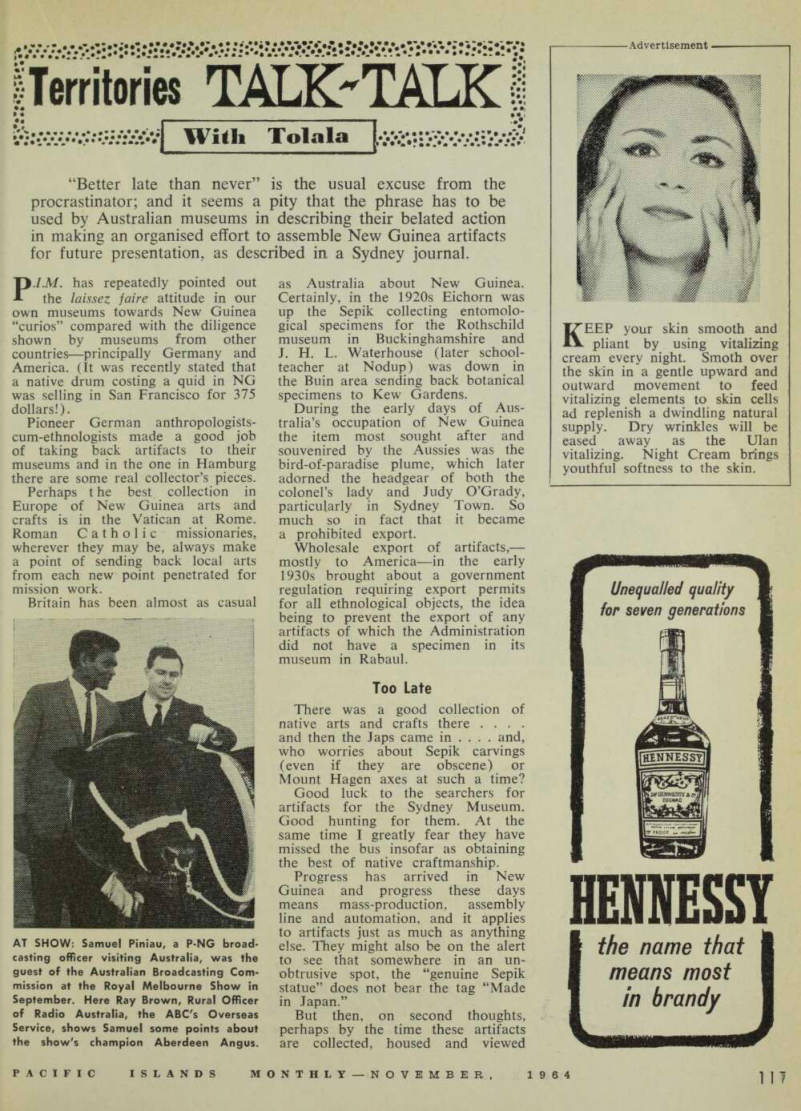
AT SHOW: Samuel Piniau, a P-NG broad casting officer visiting Australia, was the guest of the Australian Broadcasting Com mission at the Royal Melbourne Show in September. Here Ray Brown, Rural Officer of Radio Australia, the ABC's Overseas Service, shows Samuel some points about the show's champion Aberdeen Angus.
by the Sydney public, the place of origin—whether Angoram or Osaka —won’t make a particle of difference if the public’s taste for artifacts is as discriminating as it is for Art (capital A, please) as exemplified in the winner of the recent Blake Prize: (A few bolts and screws and pieces of metal and it is called “The Last Supper.”)
Historic Links
I would like to make some comment on an appeal, made some months ago by the New Britain District Commissioner, for informa tion concerning “any old significant or historical building in Rabaul.”
The New Guinea Times-Courier has made some suggestions, including “an old house in Malaguna Road, Malaguna, which is believed to be the only private house to have survived War II.”
This was Mrs. Cassel’s house on a little knoll on the right-hand side of the road as you left Rabaul.
There need be no provisional “believed to be” in the description.
It was the only building that sur vived the intense bombing of those 1943-44 years by Allied aircraft.
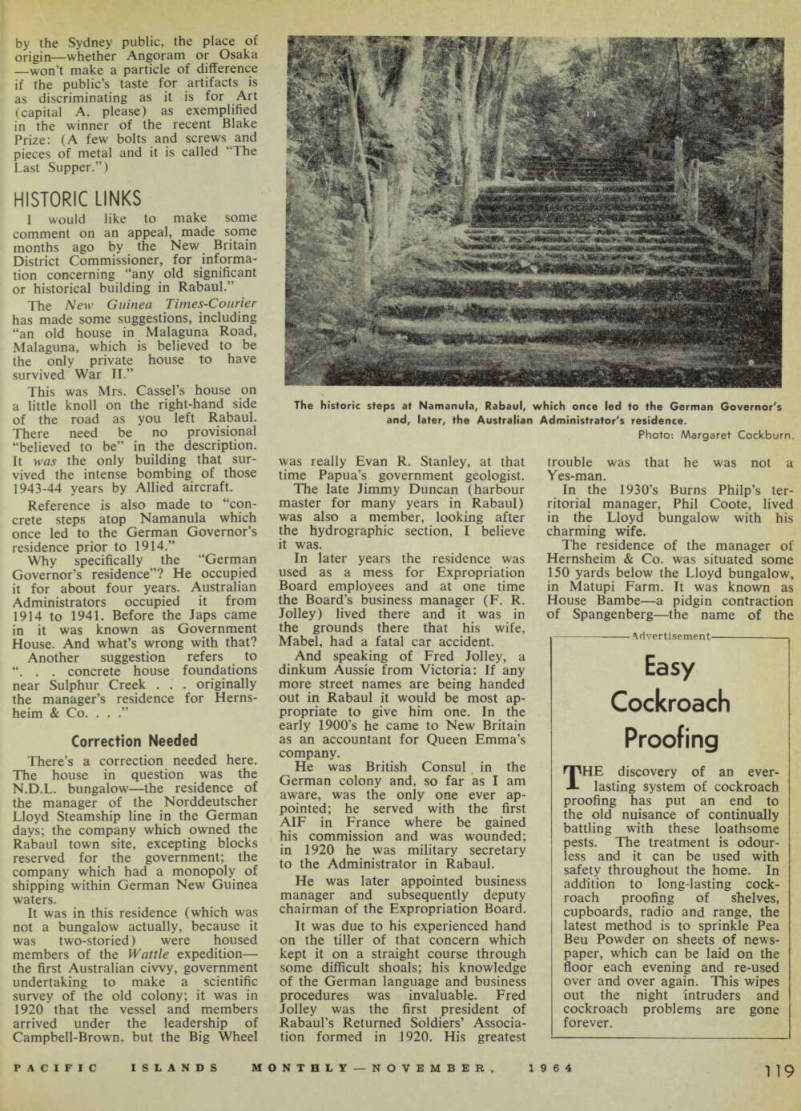
Reference is also made to “con crete steps atop Namanula which once led to the German Governor’s residence prior to 1914.”
Why specifically the “German Governor’s residence”? He occupied it for about four years. Australian Administrators occupied it from 1914 to 1941. Before the Japs came in it was known as Government House. And what’s wrong with that?
Another suggestion refers to “. . . concrete house foundations near Sulphur Creek . . . originally the manager’s residence for Herns heim & Co. . . .”
Correction Needed There’s a correction needed here.
The house in question was the N.D.L. bungalow—the residence of the manager of the Norddeutscher Lloyd Steamship line in the German days; the company which owned the Rabaul town site, excepting blocks reserved for the government; the company which had a monopoly of shipping within German New Guinea waters.
It was in this residence (which was not a bungalow actually, because it was two-storied) were housed members of the Wattle expedition— the first Australian civvy, government undertaking to make a scientific survey of the old colony; it was in 1920 that the vessel and members arrived under the leadership of Campbell-Brown, but the Big Wheel
was really Evan R. Stanley, at that time Papua’s government geologist.
The late Jimmy Duncan (harbour master for many years in Rabaul) was also a member, looking after the hydrographic section, I believe it was.
In later years the residence was used as a mess for Expropriation Board employees and at one time the Board’s business manager (F. R.
Jolley) lived there and it was in the grounds there that his wife, Mabel, had a fatal car accident.
And speaking of Fred Jolley, a dinkum Aussie from Victoria: If any more street names are being handed out in Rabaul it would be most ap propriate to give him one. In the early 1900’s he came to New Britain as an accountant for Queen Emma’s company.
He was British Consul in the German colony and, so far as I am aware, was the only one ever ap pointed; he served with the first AIF in France where be gained his commission and was wounded; in 1920 he was military secretary to the Administrator in Rabaul.
He was later appointed business manager and subsequently deputy chairman of the Expropriation Board.
It was due to his experienced hand on the tiller of that concern which kept it on a straight course through some difficult shoals; his knowledge of the German language and business procedures was invaluable. Fred Jolley was the first president of Rabaul’s Returned Soldiers’ Associa tion formed in 1920. His greatest
trouble was that he was not a Yes-man.
In the 1930’s Burns Philp’s ter ritorial manager, Phil Coote, lived in the Lloyd bungalow with his charming wife.
The residence of the manager of Hernsheim & Co. was situated some 150 yards below the Lloyd bungalow, in Matupi Farm. It was known as House Bambe—a pidgin contraction of Spangenberg—the name of the
The historic steps at Namanula, Rabaul, which once led to the German Governor's and, later, the Australian Administrator's residence.
Photo: Margaret Cockburn.
lager. I lived there for several rs in the twenties, t is good to see this official in st in Things Historic; it seems indicate a change in Konedobu’s tude towards the days before the . Becoming more mature, per s?
10 Was Fead?
atest quiz to hand: After whom the Fead Island Group named? it could be spelt FAED, as it ears on a tombstone in the :opo area. Would anyone with loritative information get in touch i me, please?
Ey Pass On
usually keep a wary eye out notices about old pals passing and whose demise is usually •rded on the back page of the ney Morning Herald. However, issed one, that of Keith Trangmar in, familiarly known as “K.T.” his old cobbers of the days when was on the east coast of New md some 40 years ago. is late, but never too late, to a tribute to an old pioneer and is exactly what “K.T.” was. He on February 24 last, remember his arrival in Rabaul 1921 when he joined the Ex )oard as a plantation overseer; ng got a taste of island life i his term as assistant purser on old B.P. Morinda. t first he was on Lamussong tation (on the east coast of New md) and formed one of the ;nt Six” crowd who were well d for their joyful peregrinations g the old Bulominski Road, nted on their Red Indian motor ;s. hey were a happy crowd—those ;ers only recently returned from Id War I—all searching about the surest road that led to Civvy
Street, after so many years of Army life. There was Bill Watson, Herk Braddon, Tom Prince, “Bluey”
Allan (K.T.’s brother) and (I think) Tony Edgell, or perhaps it was Ben Mocatta who, with “K.T.” made up the half-dozen. And, of course, sitting up there in Kavieng, keeping a critical eye on the “mob”, yet bowed down with the authoritative atmosphere of the District Superintendent’s office, was Frank Veal Saunders.
It was during this period that “K.T.” endeared himself to all those with whom he came in contact.
Later he made one of the East Coast Trading Syndicate; then he
spent some time on the Morobe goldfields with Bill Watson and Tom Prince; came a period of managing Muschau plantation for Dad Forsyth, then he purchased Patiawai plantation on New Hanover, but bad health sent him to Australia and he bought the “Sterling” property near Inverell
(Nsw).
In World War I he served with the 20th Bn. AIF and was invalided home after being badly shell shocked. In World War II he joined ANGAU, obtained his commission and after Finschhafen was invalided out and classed TPI.
He leaves a widow, a son and a daughter.