Cruising Yachts
pp. 101-111 · Read in the full issue
Pacific Shipping And
Grounded Ship's Officer Of Watch Had No Certificate
At a preliminary inquiry in October into the grounding of the inter-island trader Ratanui at Savusavu on September 6, the Fiji Marine Board found that an uncertificated ship’s clerk had been acting as officer of the watch while the ship was pro ceeding at an unknown “full speed” in poor visibility and in a main shipping route.
rHE RATANUI is the biggest in the Fiji inter-island trade and 5 owned by Burns Philp (SS) Co.
Ad.
She went aground at Lesiceva *oint, Savusavu, about 4.50 a.m. n September 6.
Captain Charles Flood, the master, aid at the inquiry that he had set le course, and had told the second late when he came on duty to tell ic third mate to alter course at .30 a.m. The ship was running at all speed.
He had left instructions that he to be called at 5 a.m. when
he estimated the Ratanui would be two miles from the reef. Visibility was poor.
The third officer had been with him for six months and did not have a certificate.
Captain Flood said he was satisfied that the course was changed at the time he directed because the second mate told him.
Usaia Biu, third mate, on duty at the time of the grounding, said the second mate had told him the course, and that he was to change.
He had also been told to call the master at 5 a.m., but the instructions were not written down.
He said he did not know the laws of preventing a collision at sea. The captain was standing beside him when the ship hit the reef.
Usaia said he had decided to awaken the captain at 4.40 a.m. because he could not see anything.
The ship was going full speed at the time.
The Marine Board decided that a formal inquiry was necessary. This means an inquiry by a marine court, presided over by a magistrate, as sisted by assessors.
Overloading
A few days earlier, the Marine Board drew attention to the absence of regulations relating to overload ing of ships in Fiji.
They embodied this comment in their finding after an inquiry into the foundering of the auxiliary cutter Fijian Princess in Nasoata Passage on August 13.
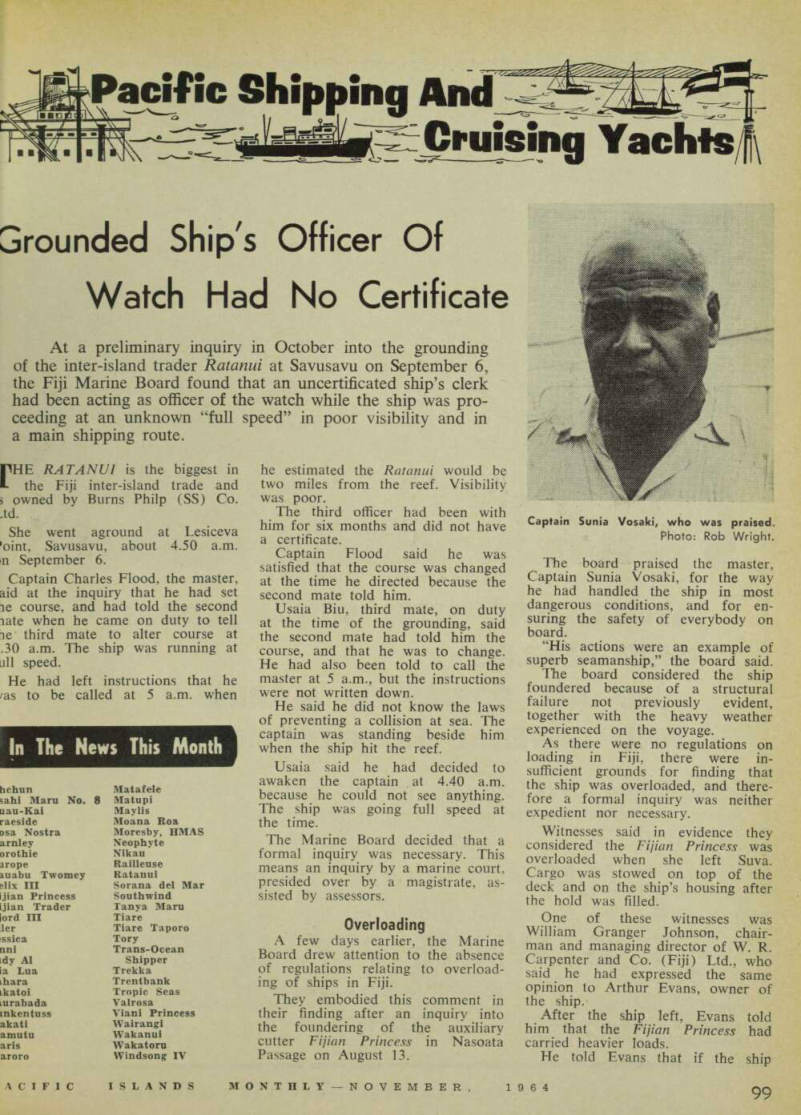
The board praised the master, Captain Sunia Vosaki, for the way he had handled the ship in most dangerous conditions, and for en suring the safety of everybody on board.
“His actions were an example of superb seamanship,” the board said.
The board considered the ship foundered because of a structural failure not previously evident, together with the heavy weather experienced on the voyage.
As there were no regulations on loading in Fiji, there were in sufficient grounds for finding that the ship was overloaded, and there fore a formal inquiry was neither expedient nor necessary.
Witnesses said in evidence they considered the Fijian Princess was overloaded when she left Suva.
Cargo was stowed on top of the deck and on the ship’s housing after the hold was filled.
One of these witnesses was William Granger Johnson, chair man and managing director of W. R.
Carpenter and Co. (Fiji) Ltd., who said he had expressed the same opinion to Arthur Evans, owner of the ship.
After the ship left, Evans told him that the Fijian Princess had carried heavier loads.
He told Evans that if the ship
Captain Sunia Vosaki, who was praised.
Photo: Rob Wright.
went against rough seas timber on board would move and smash the deckhouse.
George Houng Lee, Tukana Palato and Benjamin Thomas also said they thought the ship was overloaded.
Captain Sunia, after describing how he took the ship into calmer waters inside the reef, said that if he thought there was too much cargo he would tell Evans, who would take some out.
He did not have anything to do with the loading of the ship. He left that to Evans and the mate.
Hoodoo On P-Ng
Salvage Job
A hoodoo seems to be hanging over attempts to salvage the cargo, valued at £lO,OOO, of the British trader Dorothie which ran aground on a reef in Jomard Passage, off the eastern end of New Guinea, on July 12 ( PIM, Aug., p. 103).
In mid-October, when the freighter Fijian Trader began a salvage at tempt, she, too, became stuck fast on the reef, almost alongside the Dorothie.
Earlier, a vessel sent to prevent natives pilfering the Dorothie’s cargo, ran aground on the reef, but was not seriously damaged; and sub sequently another salvage ship from Port Moresby also hit the reef.
First Filipino Ship
In Eastern Pacific
The Trans-Ocean Shipper, the first Philippines ship to visit the Eastern Pacific, called at Tahiti and Raro tonga in October en route from North America to New Zealand with a cargo of timber. A small part of the cargo was unloaded in Tahiti.
The Trans-Ocean Shipper is of 9,345 tons and is owned by the Magsaysay Line. She was built in Japan in 1961, has a speed of 14 knots, and carries a crew of 55 Filipinos.
Ship Sinks Near Suez
With P-Ng Cargo
The 6,000-ton Bank Line vessel Trent bank sank near Port Said in late September after colliding with another ship. The Trentbank was carrying a cargo of Papua-New Guinea produce, including 3,200 tons of copra. Her last port of call in P-NG was Madang.
The deputy chairman of the P-NG Copra Marketing Board, Mr. K. G.
Oliver, said in his monthly report after the collision that the board would sustain no loss as a result of
the sinking, as the copra was fully insured and proceeds were already in hand.
Mr. Oliver said the loss might in volve insurers in a loss of about £2 million sterling.
However, the possibility of salvage was being investigated as the Trent bank sank in only nine fathoms of water.
"Braeside" Transferred
To New Guinea Run
Burns Philp’s 5,867-ton freighter Braeside has been transferred from the Australia-Singapore run to the Australia-Papua-New Guinea run.
Her first voyage began in Mel bourne on October 10.
The Braeside, which is one of the biggest freighters serving New Guinea, will call regularly at Sydney, Brisbane, Port Moresby, Rabaul, Madang, and Lae, returning to Sydney and Melbourne.
The freighter has passenger ac commodation for 12 in single-berth cabins, each with toilet and bath room. Her speed is 13 knots.
Better Deal Wanted
For Northern Cooks
The Cook Islands Legislative Assembly passed a resolution in October to ask the New Zealand Government for an assurance that the Government vessel Moana Roa would be made available two or three times a year “to uplift copra, coconuts and other products” from the northern islands of the Group.
The resolution was passed, despite a statement by the Assembly
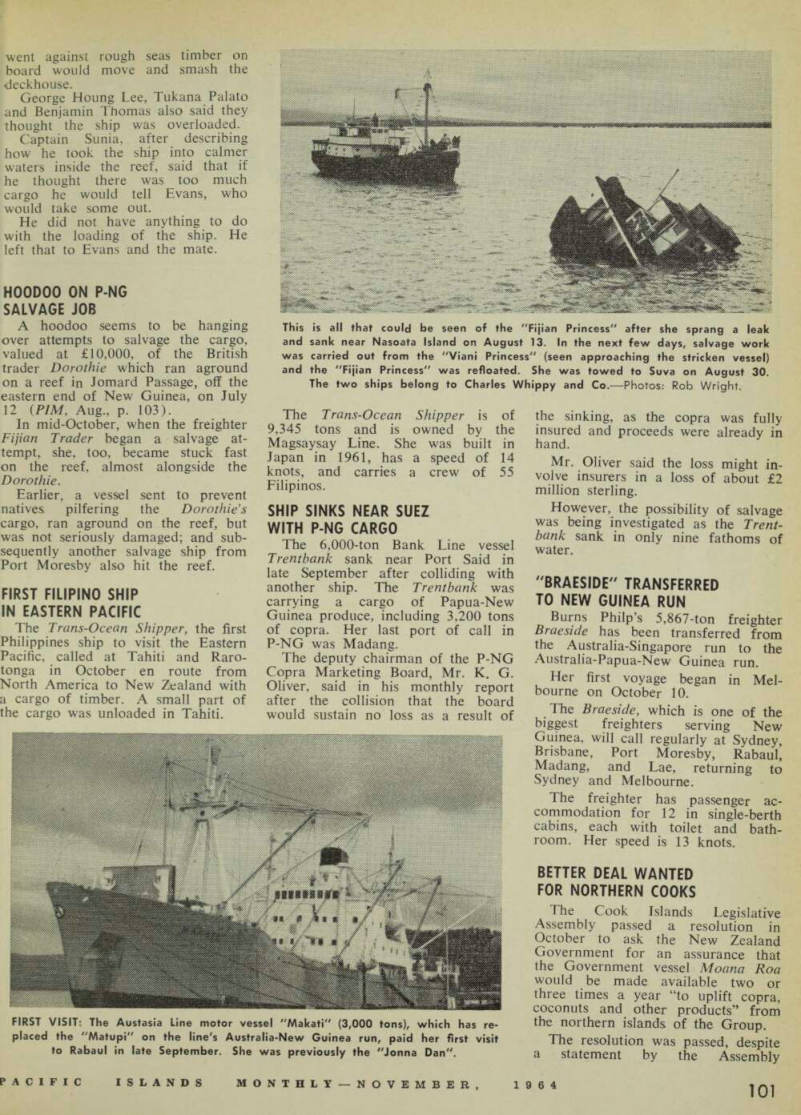
FIRST VISIT: The Austasia Line motor vessel "Makati" (3,000 tons), which has re placed the "Matupi" on the line's Australia-New Guinea run, paid her first visit to Rabaul in late September. She was previously the "Jonna Dan".
This is all that could be seen of the "Fijian Princess" after she sprang a leak and sank near Nasoata Island on August 13. In the next few days, salvage work was carried out from the "Viani Princess" (seen approaching the stricken vessel) and the "Fijian Princess" was refloated. She was towed to Suva on August 30.
The two ships belong to Charles Whippy and Co, — Photos: Rob Wright.
president, Mr. Hegan, that the Moana Roa already made a loss of £lOO,OOO a year, and that this loss would be increased if the ship called at the Northern Group.
T. Temu, who moved the re solution, told the Assembly that the Moana Roa was built for the whole of the Cook Group, but was only carrying cargoes from the southern islands. The ship had made only one visit to the northern islands.
He added that the people of Manihiki, Rakahanga and Pukapuka could prepare up to 100 tons of copra each for each visit of the Moana Roa.
Replying, Mr. Hegan, said: “Last year a similar motion was passed by the Assembly asking the Minister of Island Territories to approve two annual trips by the Moana Roa to the northern islands to uplift copra and pearl shell.
“While I sympathise with the Northern Group people, the Moana Roa appears to be fully committed on its present run from New Zealand to the lower group islands.
“Even though the ship carries a full cargo on nearly all trips at present, it has been impossible to run the ship at a profit. When you take into account insurance and depreciation costs, the annual loss on the Moana Roa is over £lOO,OOO a year.
“The New Zealand taxpayer is not very happy about this. It costs about £BOO a day to run this vessel,
and if we run it up to the Northern Group on one or two trips a year, there are going to be extra days when there is no actual earning power.”
Refloated Japanese
Ship Sold
Fiji businessman Barry Philp has sold the former Japanese fishing ship, Asahi Maru No. 8. to Captain Athol Rusden, of the New Hebrides, for a reported £13,000.
Mr. Philp headed a syndicate which bought the ship for £1,600 after it grounded on a reef near Sigatoka, Fiji, in February, 1962.
A year later, after several unsuccess ful attempts, the ship was refloated.
Captain Rusden will retain the present name of the ship, which he will use to carry general cargo and copra between Santo, Vila and Tanna.
He will alter one of the four refrigerated holds to carry cargo.
The addition to the Asahi Maru will bring to four the number of ships under Captain Rusden’s con trol.
The others are the Nikau, formerly owned by Burns Philp (SS) Co.
Ltd. at Suva, the Darnley, and the former French naval ship, Tiare. (Over)
"Asahi Maru No. 8", which has been bought by Captain Athol Rusden, of the New Hebrides.
Another ship belonging to Captain Rusden, the Sorana del Mar, was destroyed by fire near Espiritu Santo on July 14 (PIM, August, P- 5).
Delay On Honiara
Wharf
The Hornibrook Construction •Company will not be able to start work on the deep-water wharf at Point Cruz for several months, according to a recent BSIP Govern ment news bulletin. This is because •of unexpected delays in the delivery of piles and other steel-work from the United Kingdom.
The Honiara agent for Hornibrook, Mr. E. V. Lawson, has been informed that the steel is not now expected to arrive in Honiara until December.
Port Of Noumea Conditions
Strongly Criticised
Conditions in the port of Noumea were strongly criticised recently in an article in a Noumea newspaper.
The paper said the maximum depth of water in the harbour was only 27 ft, that there had been no serious dredging of the port for 25 years, that there was no tug service to aid vessels when strong westerly winds were blowing, and that the present Customs sheds were far too small.
A most serious aspect was that only two large ships could berth at the wharf at once, so that one frequently had to wait.
This was often the case when ships arrived to load ore on the coast.
Some of these ships had to wait 24 to 48 hours.
The article suggested that the huge dredge now working in Papeete could be brought to Noumea follow ing completion of the work in Tahiti.
It added that port charges could easily pay for a huge programme of essential work on Noumea’s port.
Master "Acted Wisely"
The acting master of the Fiji ketch Maroro, Captain S. F. Smith, acted wisely in seeking a tow back to Suva when she was wallowing helplessly in heavy seas off Nasilai Point on September 6, according to the Fiji Marine Board which inquired into the incident in October.
The board found that the need for the tow was the result of a fracture of the reduction gear shaft because of metal fatigue, followed by a series of mishaps due, in the first place, to the rudder being largely
ineffective when the ship was under sail alone.
The board decided that a formal inquiry was unnecessary.
The Maroro had 34 Boy Scouts on board, bound from Suva to Matuku in the Lau Group, when she got into difficulties (P/M, Oct., p. 97).
Four-Day Ordeal
In Small Punt
A 65-year-old Fijian struggled ashore at the small island of Wakaya on October 12 after drifting help lessly in a small punt for four days.
The man, Inoke Dakunivosa, of ;he village of Draubuta in the south ;ast of the main island of Viti Levu vent fishing in the punt on October S. His anchor rope broke and he Irifted out to sea, having on board only one oar, but no rowlock, and i teapot full of fresh water.
He drifted almost to the island of 3eqa, then almost to Kadavu, back oast the south-eastern tip of Viti and finally to Wakaya—nearly >OO miles.
At one time wind and waves sprang up and capsized the punt, hie managed to right it, but lost lis teapot of water.
On October 12, currents carried lim towards Wakaya where he nanaged to paddle the punt to shore.
Weak, hungry and thirsty he daggered to the home of Mr. Julian Jeddoes where he was put to bed ind fed on baby food. He was ater taken to hospital at Levuka for reatment for exposure and exhaustion.
Facht Marina
Proposed For Suva
Suva may have Fiji’s first yachting narina by the end of next year. The British Petroleum Company has ipplied for a foreshore lease on the •Valu Bay inlet, near the Suva Wharf, and could have the marina :ompleted six months after obtain ng the lease.
Wrecked Mission Ship
Refloated
Mr, C. G. Francis, of Rere Point Plantation, Guadalcanal, refloated he Melanesian Mission ship Fauabu Fwomey on September 23 and towed t to the peaceful waters opposite his lome. The Fauabu Twomey went iground on a reef in Sealark Channel ast December, and was written off ly all concerned.
Mr. Francis, who bought the wreck ‘or a small sum, found that the salvage job was reasonably simple, md he was amazed to find that the lull was 90 per cent, intact. The
only real damage he found was a jagged hole about 6 ft by 4 ft which is easily repairable.
“Only a ship built of kauri could have stood up to the buffeting it had on the reef for about nine months,” he says.
Mr. Francis has not yet decided what to do with his “prize”. He may sell the hull as it is, after repairs, or he may buy the engine, masts, etc. from the Melanesian Mission and put it up for sale as a complete unit, ready for work.
The ship is 50 ft long and has a capacity of about 25 tons.
Trust Territory
Boatyard Opened
A boatyard on the island of Koror in the Palau District of the United States Trust Territory of the Pacific Islands (Micronesia) was officially opened in September.
The boatyard, a Trust Territory economic venture, will produce wooden vessels of up to 125 ft both to tap ocean products and to
rovide needed sea transportation iroughout the territory.
The keel for a 75 ft fishing ;ssel, the first tuna boat to be jilt in Palau since the war, is ready being put together.
The boatyard will be able to •ovide service to the Van Camp na fishing operation in Palau.
The Trust Territory Government ans to train Micronesians as ship lilders.
5'S World War Ii
Upping Casualties
Mr. L. S. Dexter, of Ukuna Estate, jbuna, Papua, takes issue with a dement on New Guinea wartime ipping casualties by Australia’s inister for the Navy, Mr. F. C. laney, which we quoted in our ptember issue (p. 101).
Mr, Dexter says: “Mr. Chaney otes the Mamutu as having been ok off Port Moresby with the loss seven lives, when in fact, the amutu was owned by Burns Philp d. and was sunk by shellfire from Japanese submarine off Bramble ly, en route to Daru.
“The Mamutu carried 101 personnel her last trip, including Rev. atthews, Port Moresby’s C. of E. dre of fond memory, who was on trip to visit his son Adrian, at
Dam. On board were nearly 90 mixed blood people, including a large number of women and children, families of most of the Papuan mixed blood families. Only one survivor, Billy Griffin, was rescued.
I did the interrogation of Billy Griffin after rescue.
“A RAAF flying-boat went to land at the scene of the sinking vessel and crashed. The co-pilot was killed and Billy Griffin was saved in the rubber dinghy belonging to the crashed aircraft.
“Mr. Chaney in his list made no mention of the Matafele, lost between Queensland ports and Moresby, the Lakatoi, lost off the Solomons, the Ahchun (I think that was her name) sunk at Milne Bay and used in the wartime GiliGili wharf construction.”
That Japanese Wreck
At Lae
A correspondent in Madang, who signs himself “Ex-NGVR”, has written to us about the Tanya Maru wreck still to be seen off the airstrip at Lae that Mrs. Stephenson asked about ( PIM, July, p. 62).
He says: “I always understood that the Tanya Maru was hit by an Australian Hudson twin-engine bomber when the first Japs landed at Lae, and that it was so badly damaged that it went ashore there.
“I was not there myself, being up the Sepik River. But later, after joirting up with my unit, the NGVR at Madang, what was left of us walked through to Wau.
“Passing through Aiyura on October 14, 1942, on that trip, I saw a Hudson wreck and was told that it had taken part, on the occasion mentioned and that hit, and out of petrol, it had crash-landed there. I understand the crew escaped.
“Later, I and another member of the Madang NGVR served for 13 weeks on the Lae observation post from Christmas, 1942, to April 1, 1943, and daily gazed on the said wreck. Interestingly, some of Air Force pilots attached to Lae during that period reported that the Japs had an ackack gun on that wreck.
But this was not so.”
LITTLE FOR TOURISTS: Shipping lines with cruise ships are thinking of deleting Rabaul from their schedules because of the town's lack of facilities for tourists, according to a Rabaul correspondent. The waterfront stall, seen here, was the only one to welcome tourists from the liner "Fairsky" recently. The only other attractions were day tours by car and a flower show.