Pitcairn And
p. 97 · Read in the full issue
The Languages Of
Norfolk Island
One day in April, 1950, Pro
fessor A. S. C. Ross, Professor
of Linguistics at Birmingham
University, noticed a report in The Times of London which said that the people of Pitcairn Island had developed a form of spoken shorthand.
“T KAWA,” meaning “I cannot tell 1 you anything about that” was quoted as an example.
To Professor Ross, the idea of spoken shorthand was so interesting and deserving of study that he im mediately took steps to get in touch with someone who could tell him more about it.
The result was that two years later, Mr. A. W. Moverley, who had just completed a term as Education Officer on Pitcairn and who had made a study of the Pitcairnese language, went to Birmingham on a scholarship to work under Profes sor Ross’s direction and write a Ph.
D. thesis on Pitcairnese.
Other Features A year later, Mr. Moverley died without having completed his thesis, but Professor Ross continued work ing on his material, and now, at last, he has published a fascinating book called The Pitcairnese Language.
The title of the book, however, does not do full justice to the con tents for it is not only a study of the hybrid language spoken by the Pitcairn descendants of the Bounty mutineers and their Polynesian wives.
Other features of the book include a study of the language of Norfolk Island (the other Bounty island) by E. H. Flint, Lecturer in English at the University of Queensland; a chapter entitled “Pitcairn Island Today” by E. Schubert, a former Education Officer on Pitcairn; a chapter on “Norfolk Island Today” by Alaric Maude, Reader in Geography at the University of Tasmania; an admirable history of Pictairn Island in 50 pages by Alaric’s father, Mr. H. E. Maude, of the School of Pacific Studies at the National University, Canberra; and a 12-page history of Norfolk Island by Alaric Maude.
All in all, The Pitcairnese Language is easily the most valuable book on Pitcairn and Norfolk Island to be published since the Rev. C. C. Elcum revised the Rev. T. B, Murray’s classic book on Pitcairn more than half a century ago.—RL.
(The Pitcairnese Language.
Andre Deutsch Ltd., 105 Great Russell Street, London, WCI. 45/- Stg.).
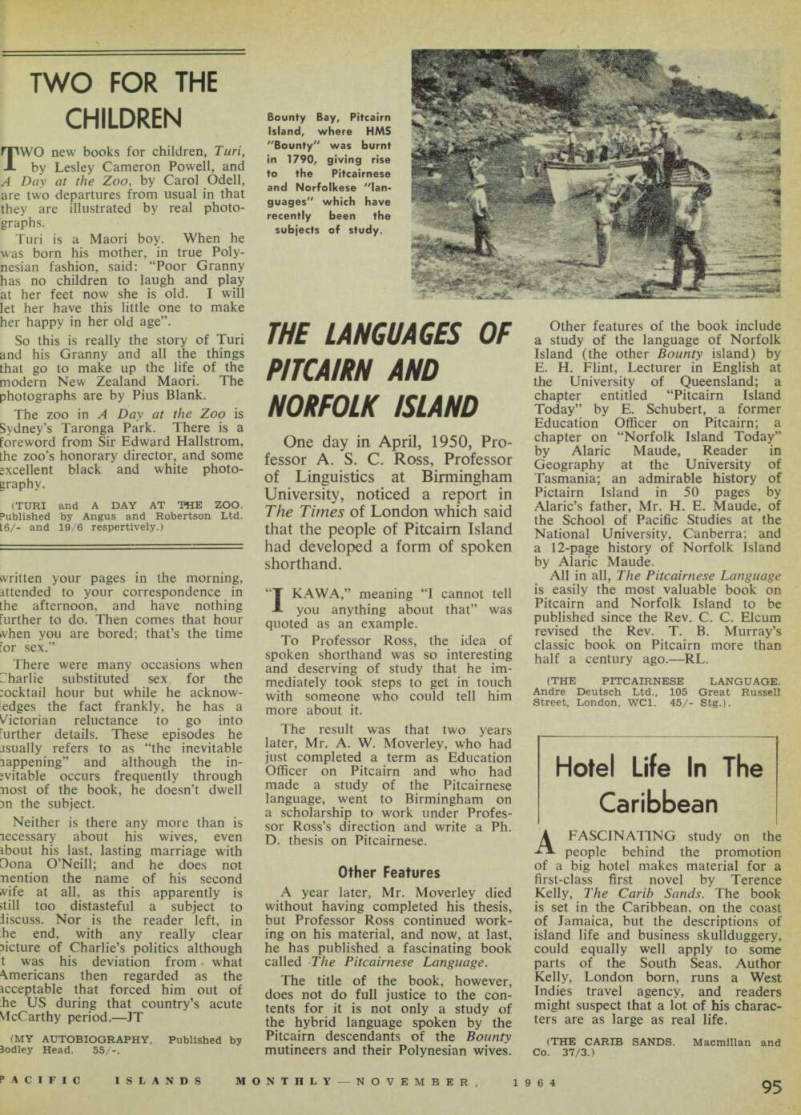
Bounty Bay, Pitcairn Island, where HMS "Bounty" was burnt in 1790, giving rise to the Pitcairnese and Norfolkese "lan guages" which have recently been the subjects of study.