Australia "Seeks To Destroy
pp. 75-78 · Read in the full issue
Both Sides Of The Nauru Debate
Australia "Seeks To Destroy Nauruans As A People"
By a Staff Writer
Australia gave a solemn pledge to develop the Nauruans and now after years of neglect it shamelessly seeks to destroy them as a people. This is the view of an Australian, Mr. H. E.
Hurst, a long-time friend of the Nauruans.
sf a letter to PIM commenting on the article on Nauruan resettle ;nt published in September (which, says, was “founded on fact”) Mr. irst says that absolutely no iuruan would jump at the chance resettlement in Australia, even if proached individually.
He continues: “I know this because for 30 years lave, in an honorary capacity, been ?aged in helping the education of my young Nauruans from my me in Geelong, and have some ;h me now. The three who carried t the recent negotiations with the nister lived with me as students e and even the VIP treatment of nberra failed to sway them away m their duty to safeguard the in ests of their people. ‘Many young Nauruans have met h moderate educational success in elong, and three have completed srenticeships here. Some have done illy well and one recently obtained Diploma of Civil Engineering and
a job on the Snowy River electrical project.
“Despite this, none has shown the slightest desire for a life in Australia and all have returned to Nauru by the very first opportunity.
“They like to take all the progress and convenience that Australia has to offer, but, like the Maori, they are not prepared to give up the many desirable things of their own culture, and I hope they never will.
“This, of course, is in accordance with Australia’s pledged word, the very mention of which we ruthlessly avoid. As a proud and loyal Aus tralian I became painfully aware of this because of my friendship for the hereditary Nauruan chiefs of long ago, and of our first Administrator, the late General Tom Griffiths.
“The Griffiths administration was a wise and successful one. It produced an administrative plan which went astray because of the inefficient political appointments which were to follow him, and the complete lack
of administrative continuity which persists today.
“I did what little I could to get the Griffiths’ plan back on the rails and in doing so became branded as the trouble maker which I still am sup posed to be. (As regards that, I would say that I received a decora tion personally from Her Majesty the Queen for doing what little I have for my country.) “I feel shame, however, when I re call how Australia gave a solemn pledge to develop the Nauruans and now after all these neglected years we shamelessly seek to destroy them as a people.”
Mr. Hurst wrote his letter from Geelong, Victoria.
Details Of The Talks The talks between the Nauruans and the Australian Government took place in Canberra in August.
The Nauruans were led by the Head Chief, Hammer Deßoburt and the talks covered five subjects—resettle ment on Curtis Island, a Legislative Council and self-government for Nauru, rock phosphate royalties, ownership of the phosphate deposits and the rate of extraction of the phosphates ( PIM, September, p. 9).
The negotiations broke down without a settlement being reached
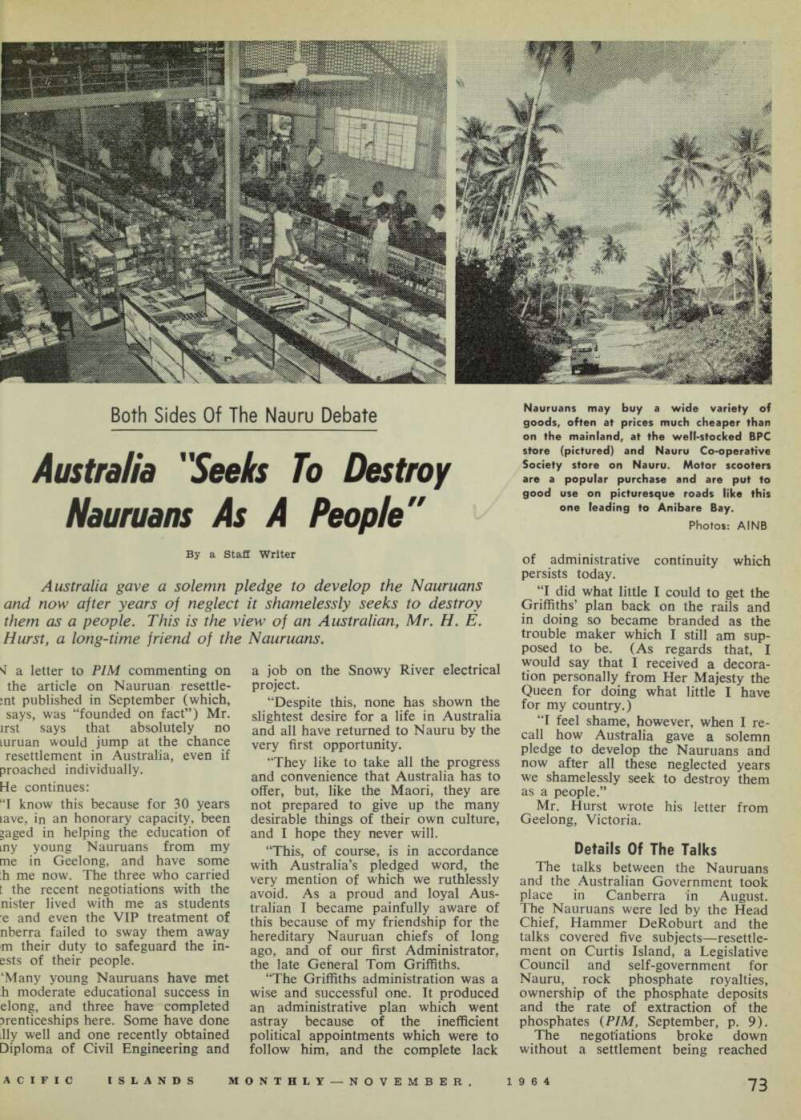
Nauruans may buy a wide variety of goods, often at prices much cheaper than on the mainland, at the well-stocked BPC store (pictured) and Nauru Co-operative Society store on Nauru. Motor scooters are a popular purchase and are put to good use on picturesque roads like this one leading to Anibare Bay.
Photos: AINB
Dn the future of the Nauruans, but lecisions were made on several of the jther matters.
The Australian Government has iince announced that it will continue ts negotiations for acquisition of Curtis Island, Queensland, as a new lome for the Nauruans.
At the end of the talks the Aus xalian Government issued a long nammary of the points made by Doth sides. Mr. Deßoburt also re eased a long Press statement on Dehalf of the Nauruans, and at the jame time he made available a report on all the points and arguments which the Nauruans took nto the conference room with them.
The following report is distilled Torn the three statements, which vere made available to PIM by Mr.
Oeßoburt.
Sovereignty
The Nauruan delegation refused :o accept Australia’s proposals for he resettlement of their people on Curtis Island mainly because they vould not be given sovereignty over he island and would probably lose ;heir national identity.
The Nauruans were prepared to :oncede that Australia should have control over defence and civil aviation, and that it should represent he Nauruans in international affairs when necessary.
They also agreed that Australian quarantine laws should apply on ‘New Naur u”, and that the quarantine officers should be Aus tralians.
But they felt that the degree of autonomy proposed by the Aus tralian Government on Curtis Island would be smaller than what they now enjoy on Nauru.
The Nauruans also maintained that the degree of control over right of entry into Curtis Island was not clear.
They pointed out that rutile rights on the island had been sold to a private firm, and that the Aus tralian Government had said it would not be convenient to revoke this arrangement.
However, the Nauruans could join the rutile firm in partnership, and if the firm did any mining, it would restore the surfaces mined.
“This is a situation with which we are already familiar,” the Nauruans said.
The Nauruans said the Govern ment was avoiding the real issue in saying it was sympathetic to their desire to retain their distinctive identity, as they could not see their future as Nauruans if they accepted
the Government’s offer to make them Australian citizens.
If they accepted Australian citizen ship, it would then be their duty and that of their children to give undivided loyalty to Australia, just as European immigrants ceased to be nationals of another country once they accepted Australian citizenship.
“We wish to be bound by a per manent treaty of friendship to Aus tralia, but we are Nauruans and we want to remain Nauruans,” the Nauruans said.
The Nauruans also claimed that there was hostility to their settle ment on Curtis Island on racial grounds, that the Australian Govern ment had “pushed” them to accept Curtis, and that it had never made a “proper and formal reply” to their request to settle on uninhabited Fraser Island.
They added that although most Australians believed that the need for resettlement elsewhere was due to over-population and “would-be sophistication of the younger Nauruan generation,” the real reason was the physical destruction of Nauru and its attendant problems.
“Four-fifths of our island is phosphate-bearing, and therefore in the end that much will be destroyed,” they said.
Despite this, and because the Australian Government’s resettlement proposals for Curtis Island were unacceptable, the Nauruans said that they had “no option” but to look to their own island for a permanent future and they would not now proceed with resettlement pro posals.
They therefore proposed that the three Governments concerned in the
exploitation of Nauruan phosphate (Australia, New Zealand and Great Britain) should make an immediate start on the rehabilitation of the lands that had been denuded of their natural soil.
Rock phosphate ships which now go to Nauru in ballast could be used to carry soil, they said.
The Australian Government made no decision on this.
On the question of self-govern ment, the Nauruans said they had been seeking the establishment of a legislative council since 1959, and they felt this should no longer be delayed.
After two years of Australian guidance in a legislative council, they felt they would be capable of running their own island, and there fore they asked for independence by January, 1967.
Royalties
In asking for higher rock phos phate royalties, the Nauruans said that the price of Nauruan phosphate was somewhere between a third and a half of the price at which it could be sold on the open market, that the United Nations Missions to Nauru had commented on its cheapness, and that they were receiving “a very small proportion of this cheap price as royalties.”
They added: “We believe that we have been subsidising the cost of rock phosphate in the past, and we do not feel that we should be asked to do so in the future for such wealthy countries as Australia and New Zealand.”
The Nauruans complained that the British Phosphate Commissioners had refused to negotiate with them “on a proper basis,” had refused to allow economic experts to advise them, had refused to discuss opera tional figures, and had refused to provide the United Nations with cost figures.
The Nauruans said the Australian and other Governments which had benefited for years from the phos phate taken from Nauru should be “very ready” to recognise the Nauruans’ right to full ownership of the phosphate deposits. They asked that the deposits be handed to them.
“We are sure it will not be denied,” they said, “that the land on which the phosphate deposits occur is owned by Nauruans, but we are, of course, aware that the Australian, New Zealand and United Kingdom Governments claim the legal right to work those deposits.
“This Tight’ is said to have been acquired from the Pacific Island Phosphate Company in the time of the German administration prior to the First World War.
“We suggest that the right to woi the only natural resource on th Island could only be effectivel granted by the Nauruan people. W believe that the German administrs tion granted the right to the Pacif Islands Phosphate Company to woi the deposits, but our people wei not a party to the original agre< ment, which is said to be the has of the Phosphate Commissioner present claim to be entitled to ow the deposits, a claim which illustrated by the Commissioner insistence that there is no obligatio on them to pay any royalties.”
The Nauruans said that the Au; tralian Government’s intention t increase the rate of extraction c phosphate on Nauru had “wide an serious implications” for their peoph They said they had requested the the rate of extraction should b reduced so that they would hav longer to prepare themselves fc the time when the natural resource of their island were exhausted.
“The Government surprised us b proposing instead that they wis to increase the rate of extraction t 2.5 million tons a year,” th Nauruans said. “This would reduc the life of the phosphate deposit to 25 years.
Agreement
“By contrast the British Phosphat Commissioners have made an agree ment with the Gilbert and Ellic Islands Administration to restric output on Ocean Island to 310,00' tons a year, and we understand tha this is to ensure that the phosphat deposits of Ocean Island will con tinue for as long as possible to con tribute to Gilbert and Ellice Island revenue.”
On the question of the Legislate Council, the Australian Governmen said it would examine “the possibili ties of greater participation by th( Nauruans in the Administration”, bu it considered the question of politica advancement was closely bound uj with the resettlement problem.
It would not agree that the phos phate industry should be transferret to the Naurans.
The three administering govern ments would consult together abou their future position in view of tht Nauruans’ decision not to perseven with resettlement.
The Government said it would in crease royalty payments into the long-term investment fund from 1/ to 3/- a ton and the general royalty rate from 2/8 to 4/- a ton, but woulc not agree to the Nauruan proposa for an increase to 14/8 a ton.