Crucial, Sensitive Moves
pp. 47-49 · Read in the full issue

On Fiji Political Scene
From a Suva Correspondent
The 90th anniversary of Fiji’s Cession Day —the day on which the Fijian people ceded Fiji to the Queen —has come and gone in an atmosphere of undercover political activity which might make it, in retrospect, the most significant anniversary ever. Things are certainly happening behind scenes in the Colony.
BY this time next year the political situation might be quite different, or in the interval there is likely to •e a constitutional conference in London to decide just where, and iow fast, the Crown Colony is going.
Although he had nothing specific o say about the London conference, he Member for Communications nd Works, Mr. John Falvey, ob iously had it in mind when he lade one of the major Cession Day peeches, delivered at the historic ild capital of Levuka, where the Session Deed was signed in 1874.
I believe his speech was framed /ith a great deal of care and not without advice from others.
Mr. Falvey is one of the accepted waders of the Colony and certainly he main body of Fijians would agree vith his views.
“Whether we look back on this lay with satisfaction, or with regret, rill depend on the shape of events a the months which lie immediately head,” he said.
He added: “The shaping of these
events must be, and will be, largely determined by the principles and the terms of the Deed of Cession.”
Referring to the Deed of Cession as a link between the Crown and Fiji, Mr. Falvey said it was “totally unthinkable to the Fijian people and to a huge majority of the Colony’s British inhabitants that this link should be weakened or severed by any constitutional experimenting”.
He stressed the insistence of the Fijian people that the initiative for any constitutional change should come from them.
“If there is to be any fundamental change in the Colony’s constitution, that will involve the negotiation of a new contract,” he said.
A new contract could only be drawn up if all three main races were represented at the conference table with the British Government.
He was optimistic, however, about the cause of unity. He thought it was well-favoured because “all the peoples of these islands share an abiding loyalty to the Throne”.
The principal speech at the Suva celebrations—to which 5,000 school children marched instead of the ex pected 8,000 —was the recorded voice of the Governor, Sir Derek Jake way, who was away in Noumea for a session of the South Pacific Commis sion. He told his listeners that he agreed entirely with the view that the country should hasten slowly over the business of constitutional change.
“Our progress should be step by step, each one carefully considered before it is taken,” said Sir Derek.
“We shall go on. I hope, moving forward, and expanding and develop ing existing institutions rather than replacing them by something new and untried,” he added.
Mr. Deoki's View Some might have been thinking, of course, that, as Britain has given independence to millions, indepen dence was hardly something untried.
One of the Indian representatives in the Legislative Council, the sensible and moderate Mr. Andrew Deoki, did not make a lengthy speech but what he said was prob ably more significant than anything said by anyone else that day. He said he believed that Britain had ful filled the promises laid down in the Deed of Cession. Fiji was now pass
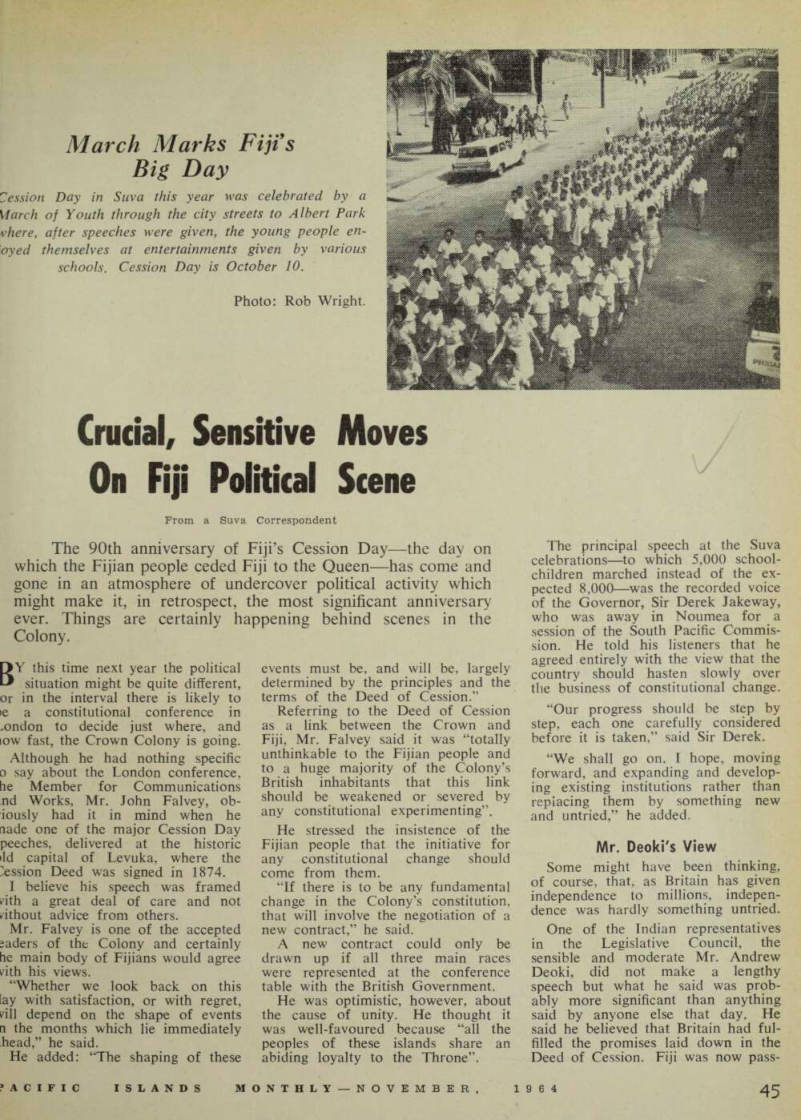
March Marks Fiji's
Big Day
Cession Day in Suva this year was celebrated by a March of Youth through the city streets to Albert Park Where, after speeches were given, the young people en eyed themselves at entertainments given by various schools. Cession Day is October 10.
Photo: Rob Wright.
ing through a phase in preparatioi for the second stage of progress, Fiji had grown up, and the pro gress which had been envisaged 9( years ago had been achieved, h( added.
Behind all this facade, the proces; of change is being worked out. Th< Member system is in operation am all three Members, Mr. Falvey Ratu Mara and Mr. A. D. Patel are peregrinating around the Colony All their journeyings—which lik< St. Paul’s are often—are faithfulh recorded by the Fiji Public Relation; Office in much more detail than an those of the Governor.
PRO Is "Selling"
Thousands of words pour out eacl week on who they meet, and why am where, until it has become obviou; that the Public Relations Office ha; been charged with the job of “sell ing” the Members to the public.
There are more straws in the wine than that.
There are more indications tha every endeavour is being made b} Government House to condition the people to the idea of coming change and the idea seems to embrace inde pendence.
Also, from out of the Public Re lations Office in recent months have poured articles on the variou: countries which have been given in dependence—all of them careful tc stress the rosier side of the picture not the difficulties.
Meanwhile, although we are ap preaching the end of 1964, nobod} officially has yet handed out an} more information about the com position or the timing of the con stitutional conference (which some people think may be next June).
Certainly it had been stated thai the outcome of the British elections (just concluded, with Labour taking over from the Conservatives) would affect these matters, but withoul doubt the Fiji Government has in its possession more information than il has released.
Fiji Has Plans There is evidence that the Govern ment is working on a plan of its own to be put before the conference, and at least one senior Government officer would no doubt like this plan to be the only plan considered.
The Governor himself might do well to say something at this stage and calm the apprehension abroad that the Government is doing some thing behind the scenes that might not be in everybody’s best interests.
This is a time that justice must
)t only be done but must appear be done. It is certainly not the Tie for any ham-fisted public ser mt to assume an attitude of ave-it-to-father, apparently in the isguided belief that he knows all e answers.
There should be no suggestion of conspiracy of official silence.
Adviser Needed The fact is that developments so r—or at least the painful lack of velopments—have sent some think g Fijians and Indians in search of champion of their own, who can ve them some sound constitutional [vice and make them independent ham-fisted official gentlemen.
It is quite possible there will be me announcement on this soon, rhaps by the Fijian Affairs Board.
The Fijians have not overlooked e lessons of Western Samoa and e Cook Islands, both of which we been greatly helped by con tutional advisers brought in from itside.
There is no reason why one ad >er cannot represent both Fijian d Indian—there is no reason why te single man cannot give sound vice applicable to Fijians, Indians, iropeans and the Fiji Government.
But the point is he must be a man 10 has the confidence of all parties, d no senior public servant—by his ry position in the Government mp—has much chance of being success at this job in the present ite of Fiji politics.
Destiny
In a community of mixed feelings d races, Fiji thus moves on to her stiny.
There are two Legislative Council eetings in November, but it is :ely that both will be concerned □re with finance—the second meet g will be the Budget one—and with e Council’s own domestic arrange snts as regulated in new Standing -ders which have yet to be ap oved.
One of the changes in Standing rders will give the Speaker, for the st time, powers to expel a mem r—the surest way of dealing with calcitrants in a Parliament.
Contrary to accepted belief, the >eaker has no power at present to pel any member. He can “name” m and presumably the Executive luncil would do the rest when it et.
Maybe that’s another straw in the nd. Who knows? Who knows any ing for sure any more?
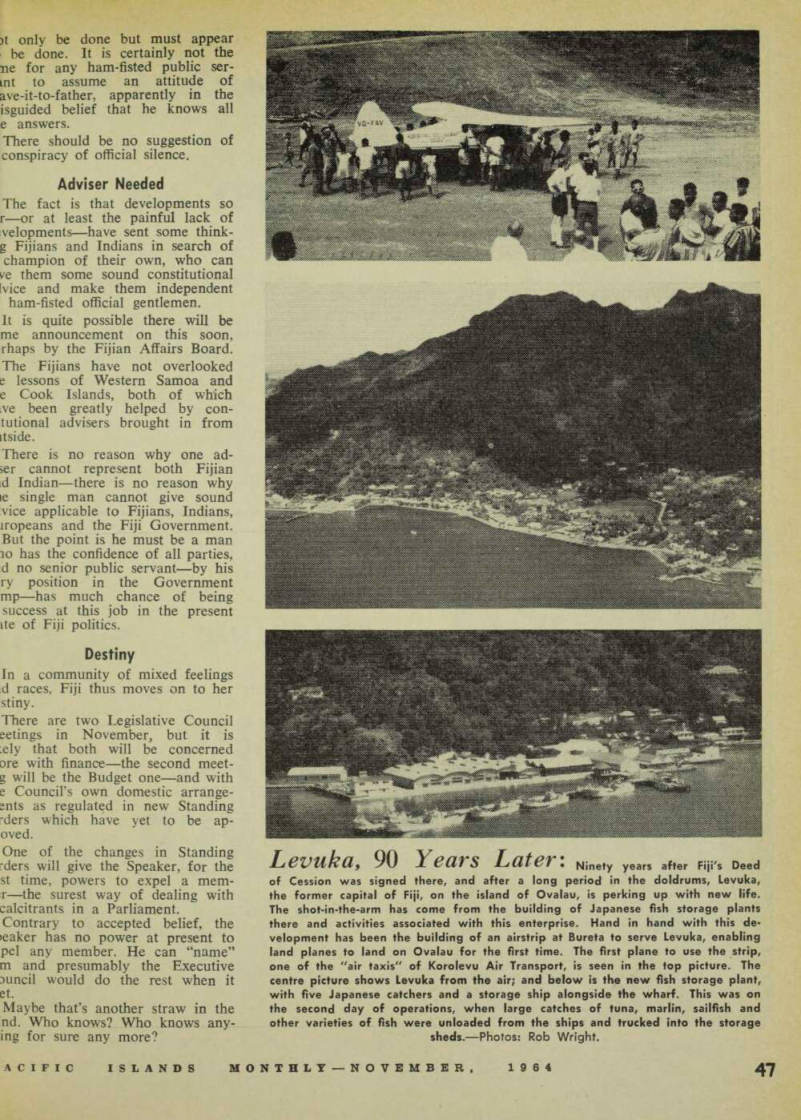
Levuka, 90 Years Later : Ninety years after fiJi's Deed of Cession was signed there, and after a long period in the doldrums, Levuka, the former capital of Fiji, on the island of Ovalau, is perking up with new life.
The shot-in-the-arm has come from the building of Japanese fish storage plants there and activities associated with this enterprise. Hand in hand with this de velopment has been the building of an airstrip at Bureta to serve Levuka, enabling land planes to land on Ovalau for the first time. The first plane to use the strip, one of the "air taxis" of Korolevu Air Transport, is seen in the top picture. The centre picture shows Levuka from the air; and below is the new fish storage plant, with five Japanese catchers and a storage ship alongside the wharf. This was on the second day of operations, when large catches of tuna, marlin, sailfish and other varieties of fish were unloaded from the ships and trucked into the storage sheds. — Photos; Rob Wright.