More Needs To Be Done
pp. 38-39 · Read in the full issue

On P-Ng Education
Probably the severest criticism levelled against the Admin istration from all sources has been on the score of education.
At the same time the World Bank has complained that too much emphasis has been placed on social development, including edu cation, and not enough on economic development.
IT appears that of the estimated 450,000 children of school age in the Territory only about 150,000 are at school. Millions of pounds have been spent by both the Administration and by Missions on educational facilities and training students, yet the output in terms of scholars capable of taking their place in a sophisticated environment has been negligible.
At its last meeting the United Nations Trusteeship Council in vestigated progress in education and resolved that more intensive efforts were needed to expand education and to ensure that a sufficient number of students acquires the professional, administrative, and technical qualifications essential to the Territory at its present stage of advancement.
As a result of these criticisms, the emphasis on educational development is being swung to secondary educational facilities which will absorb the wave of children now going through primary school.
For the time being, it seems, the requirements of thousands of primary school-age children in remote areas are to be neglected, although existing facilities will continue to be developed.
At the same time, this change in policy emphasises the need to speed up economic development so that jobs of a satisfying character will be available to the children who flow out of the secondary school system.
Beyond this still is the urgent need for education at tertiary level. New Guinea is already a State of 2 million people without a university. Firm proposals have been advanced for establishing a university in the Territory but so far the Govern ment has not acted, nor does it seem likely that it will act in the immediate future.
The need is small at this moment, but it is there. At March 31, 1964, there were only 3,504 pupils at secondary schools. On the same date, there were 12 New Guineans studying at higher education institu tions in Australia—four at univer sities, and eight at technical colleges.
Technical training is, perhaps, in a more satisfactory state in the Territory. It starts in the villages where community technical training is given aimed at making some specific improvement in living con ditions by co-operative effort using local materials and resources, as much as is possible.
There are seven junior technical schools which give training in such skills as brickmaking and laying, carpentry, plumbing, and car servic ing. Classes of this type are also held at the two main technical schools in Lae and Rabaul. At these higher-level schools, students take two years of general education after which they are eligible for ap prenticeship in a first class trade.
They then receive a further two years of training in those trades.
Training in business principles, typing, book-keeping, etc. is given at Port Moresby, and training is given in manual arts annexes at 10 other centres throughout the Territory.
Latest figures available show that there are over 700 students attend ing Administration and Mission technical schools.
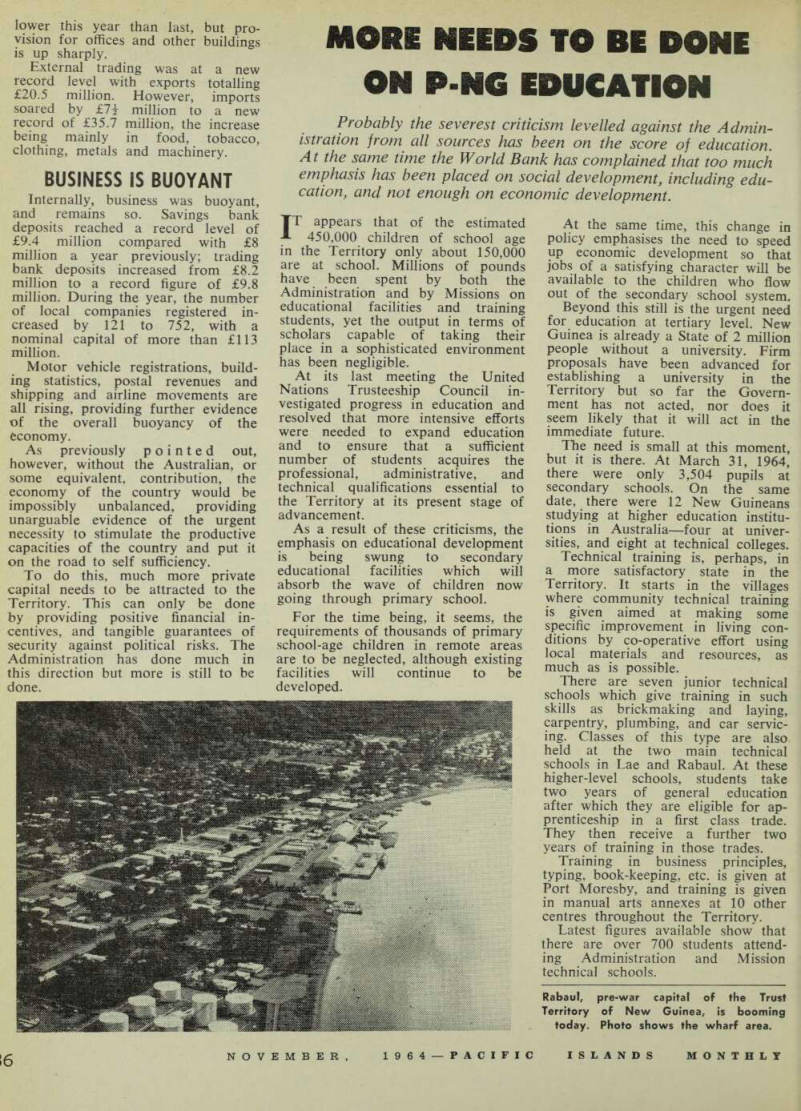
Rabaul, pre-war capital of the Trust Territory of New Guinea, is booming today. Photo shows the wharf area.
Overall, the figures on achieye its in education are not impressive m our long tenure in the Territory aken into account, rom a hard economic point of v, however, it is probably just as I that we have done no better in v of the similar failure to murage economic development would have provided jobs for iuating students.
Health
he Administration’s achievements the field of public health have led high praise from virtually juarters. Perhaps the only adverse ; is the opinion that we have dded facilities in health, as in :ation, that it would be impossible the State to maintain without itantial outside assistance, he UN Mission in 1962 said, no sphere of government activity there been a greater effort made more success achieved than in of public health”. Millions of tids have been spent on fine lern hospitals in every main area, infant and maternal welfare cs established total well in excess \OO.
B, malaria, yaws and other ases have been the subject of ly successful eradication cam ns, and the better health of the ve communities is already being cted in a decreasing mortality which is forecast to result in population being doubled within nprovement of the nutritional dards of native foods is also the ect of an intensive campaign, involves the introduction of new Is, new storage techniques, and supply of high-protein foods at present economically available.