Tropicalities
pp. 19-23 · Read in the full issue
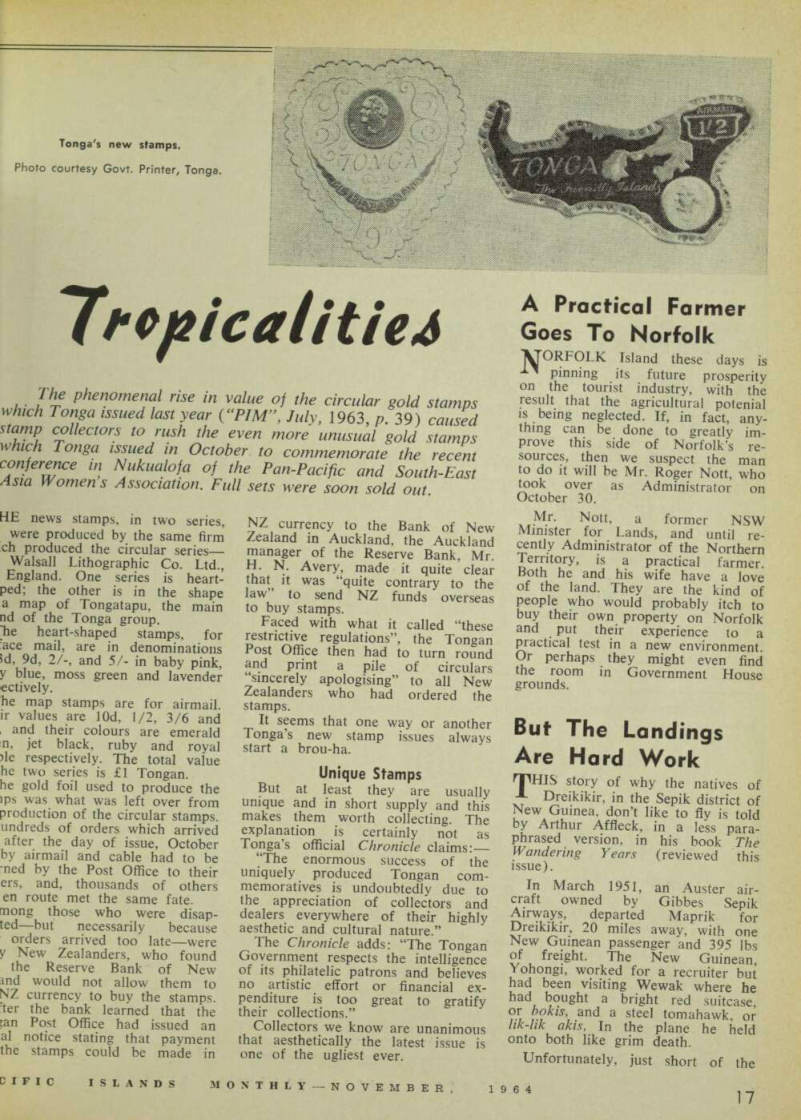
The phenomenal rise in value of the circular gold stamps which Tonga issued last year (" PIM ”, 1963, p. 39) caused stamp collectors to rush the even more unusual gold stamps which Tonga issued in October to commemorate the recent conference in Nukualofa of the Pan-Pacific and South-East Asia Womens Association. Full sets were soon sold out.
HE news stamps, in two series, were produced by the same firm ch produced the circular series— Walsall Lithographic Co. Ltd., England. One series is heart ped; the other is in the shape a map of Tongatapu, the main nd of the Tonga group, he heart-shaped stamps, for ace mail, are in denominations Id, 9d, 2/-, and 5/- in baby pink, y blue, moss green and lavender ectively. he map stamps are for airmail, ir values are lOd, 1/2, 3/6 and , and their colours are emerald n, jet black, ruby and royal )le respectively. The total value he two series is £1 Tongan. he gold foil used to produce the ips was what was left over from production of the circular stamps, undreds of orders which arrived after the day of issue, October by airmail and cable had to be ned by the Post Office to their ers, and, thousands of others en route met the same fate, tnong those who were disap ted—but necessarily because orders arrived too late—were y New Zealanders, who found the Reserve Bank of New and would not allow them to NZ currency to buy the stamps, ter the bank learned that the 'an Post Office had issued an al notice stating that payment the stamps could be made in
NZ currency to the Bank of New Zealand in Auckland, the Auckland manager of the Reserve Bank, Mr.
H. N. Avery, made it quite clear it was “quite contrary to the law to send NZ funds overseas to buy stamps.
Faced with what it called “these restrictive regulations”, the Tongan Post Office then had to turn round and print a pile of circulars sincerely apologising” to all New Zealanders who had ordered the stamps.
It seems that one way or another Tonga’s new stamp issues always start a brou-ha.
Unique Stamps
But at least they are usually unique and in short supply and this makes them worth collecting. The explanation is certainly not as Tonga’s official Chronicle claims:— “The enormous success of the uniquely produced Tongan com memoratives is undoubtedly due to the appreciation of collectors and dealers everywhere of their highly aesthetic and cultural nature.”
The Chronicle adds: “The Tongan Government respects the intelligence of its philatelic patrons and believes no artistic effort or financial ex penditure is too great to gratify their collections.”
Collectors we know are unanimous that aesthetically the latest issue is one of the ugliest ever.
A Practical Farmer
Goes To Norfolk
lsland these days is pinning its future prosperity on the tourist industry, with the result that the agricultural potenial is being neglected. If, in fact, any thing can be done to greatly im prove this side of Norfolk’s re sources, then we suspect the man to do it will be Mr. Roger Nott, who took over as Administrator on October 30.
Mr. Nott, a former NSW Minister for Lands, and until re cently Administrator of the Northern Territory, is a practical farmer.
Both he and his wife have a love of the land. They are the kind of people who would probably itch to buy their own property on Norfolk and put their experience to a practical test in a new environment.
Or perhaps they might even find the room in Government House grounds.
Buf The Landings
Are Hard Work
ffTHIS story of why the natives of Dreikikir, in the Sepik district of New Guinea, don’t like to fly is told by Arthur Affleck, in a less para phrased version, in his book The Wandering Years (reviewed this issue).
In March 1951, an Auster air craft owned by Gibbes Sepik Airways, departed Maprik for Dreikikir, 20 miles away, with one New Guinean passenger and 395 lbs of freight. The New Guinean, Yohongi, worked for a recruiter but had been visiting Wewak where he had bought a bright red suitcase or bokis, and a steel tomahawk, or hk-hk akis, In the plane he held onto both like grim death.
Unfortunately, just short of the
Tonga's new stamps.
Photo courtesy Govt. Printer, Tonga.
airstrip the single engine of the plane coughed its last and headed for a jungle-clad hill 700 yards from the strip.
When it became obvious that the aircraft must crash, and badly, the pilot decided that his passenger should be given some chance of living. He turned to Yohongi and instructed him to open the doorway and jump as soon as the plane hit the 100 ft tree that they were headi ng f or .
Yohongi unfastened the door and stood on the seat, still clutching his bokis and lik-lik akis, but was, naturally, reluctant to jump. The
pilot, therefore, took his foot off the rudder and gave Yohongi a push on the behind just as the tree came along and hit them. Yohongi, bokis and lik-lik akis, all disappeared from view and the pilot lost consciousness, A small party of Europeans rushed to the scene of the crash and dragged the pilot out. When he had partly recovered his senses he told them he had had a passenger, They rushed back to the tree and for hours every available person scoured the area for hundreds of yards around the wreckage, but not a sign of the New Guinean could they see. When it was dark they
concluded that the pilot had bee: hit on the head in the crash an wasn’t responsible for what he saic But when the recruiter who ha been one of the searchers went int his house he found Yohongi settin the table for dinner and as soon £ the boy saw him he burst int Pidgin in the longest speech he ha ever made, confirming everythin the pilot had said.
“Master,” he said, in effect, ‘ don’t like these aeroplanes. When was time to come down the pih kicked me in the backside. I had 1 climb down a tree to reach tl ground! I managed to hang on 1 my box. I want you to get me a ne tomahawk from the pilot. I lost mil when he pushed me out of tl aeroplane.”
Several months passed and othe of the tribe avoided air travel. B eventually a young woman becan very ill and had to be sent hospital in Wewak. When she w; convalescent she was sent back Dreikikir in another single-engin< plane. Over the kunai plains tl engine cut out and the pilot, known that the landing on a patch of rouj kunai was going to demolish tl undercarriage, turned to two polic boys who were passengers, and sa in Pidgin: “Jettison the door ai when the plane lands throw t girl out and jump yourselves.”
Adds Arthur Affleck: “It w several years before all the Dreikil people could be persuaded that tl was not the normal way of d embarking from an aeroplane. Th considered flying as purely ‘for t birds’.”
Another Moresby
Burns philp’s new 4,000 t cargo vessel for the N Guinea service, at present bei built in Newcastle, NSW, is to h£ a famous name — Moresby. Mores was the name of BP’s first vess and the name keeps up the < practice of having seven letters the names of BP ships. It had be planned to call the new ship E There is already an HMAS Mores —a new survey vessel.
New Guinea Counci
Gets Weaving
A SEMINAR on education in N Guinea, to be held in Sydi in November, will launch activities of the recently forn Council on New Guinea Affa Main speaker will be Professor O.
K. Spate, a member of the N Guinea education commission, v can be expected to have a few poin
liings to say about the delay in stablishing a university in the Terri- Dry—and the professor has proved imself no mean hand at saying what e means.
Meanwhile energetic Peter fastings, executive officer for the Council, is preparing to get under ay a widely circulated monthly ewsletter on New Guinea matters, id a half yearly magazine (eventu ly to be a quarterly) to be called he New Guinea Journal. Contri vers will be invited to discuss mtroversial New Guinea problems— id, goodness knows, there are enty of these about.
Vith The Castaways
|YDNEY-based author Olaf Ruhen (he’s really a New Zealander) id his wife Madeleine returned to 'dney in October after 102 days Tonga gathering material for a :w book on Tongan whaling. He also writing an article on it for the ational Geographic Magazine. lere is special significance in those >2 days. The crew of the Tongan cht Tuaikaepau were cast away 102 iys on Minerva Reef—the story of lich was so dramatically told by ihen in one of his books. Mr. and rs. Ruhen were special guests of me of the famous castaways in mga (See also p. 129).
Performing
Dolphins Next?
ONE of Jthese days, Suva might vie with Miami, Florida, as a place to see performing dolphins—and all because Suva identity Harold Storck used to keep a tankful of (orna mental) tropical fish at home for his own entertainment.
Mr. Storck, who with his brother Vince, operates tourist cruises out of Suva in the launches 00100100, Oooloolootoo, 00-la-la and Bimbo, has developed his hobby of keeping tropical fish to the stage where he now has a 36-tank aquarium open to the public, and he is exporting fish all over the world at the rate of 10,000 a year.
If this business continues to grow as Mr. Storck hopes, he foresees the day when dolphin and shark tanks might be installed at the aquarium site at Walu Bay, on land that could be reclaimed from the area.
Mr. Storck is one of only about eight people in the world who supply tropical fish to aquariums and hobby suppliers.
He got into this business after an American from a Matson liner saw his tank of fish on display in Suva, and offered to buy some.
When the American got back home, he told a dealer about his purchase, and the dealer came to
Suva to arrange for Mr. Storck to supply him with fish on request.
“We have now been shipping fish for y ears > and have been running ° Ur a S!^ lum for . two ’” Mr * Storck ? ays ‘ . a 9H arium was originally u l 8 in the heart of Suva, y u been bou B ht b V the CML. 11 has bee ” at Walu Ba y> ab °ut three quarters of a mile out of town, since 13e “ mber - Uur J usiness ha s now reached the stage . ere . the aquarium is self su PP or tmg in that even if no one COl ? es to look at the aquarium, we enough money from the export ot hsh to kee P 2t going, “The export business would probably have developed quicker if the airlines ha d been able to keep the fish warm, and so save the heavy losses in transit, which cost hundreds of dollars.
“However Oantas Havp •
sastsasss
he able tr. I “ footfng ” P * th 8 a be,ter When Mr. Storck dispatches an antibiotics, blows up the bag with
tss- k "=/• •• 1 /•?
sealed hch ,S com P ,etel y
senTt STS# *5 *
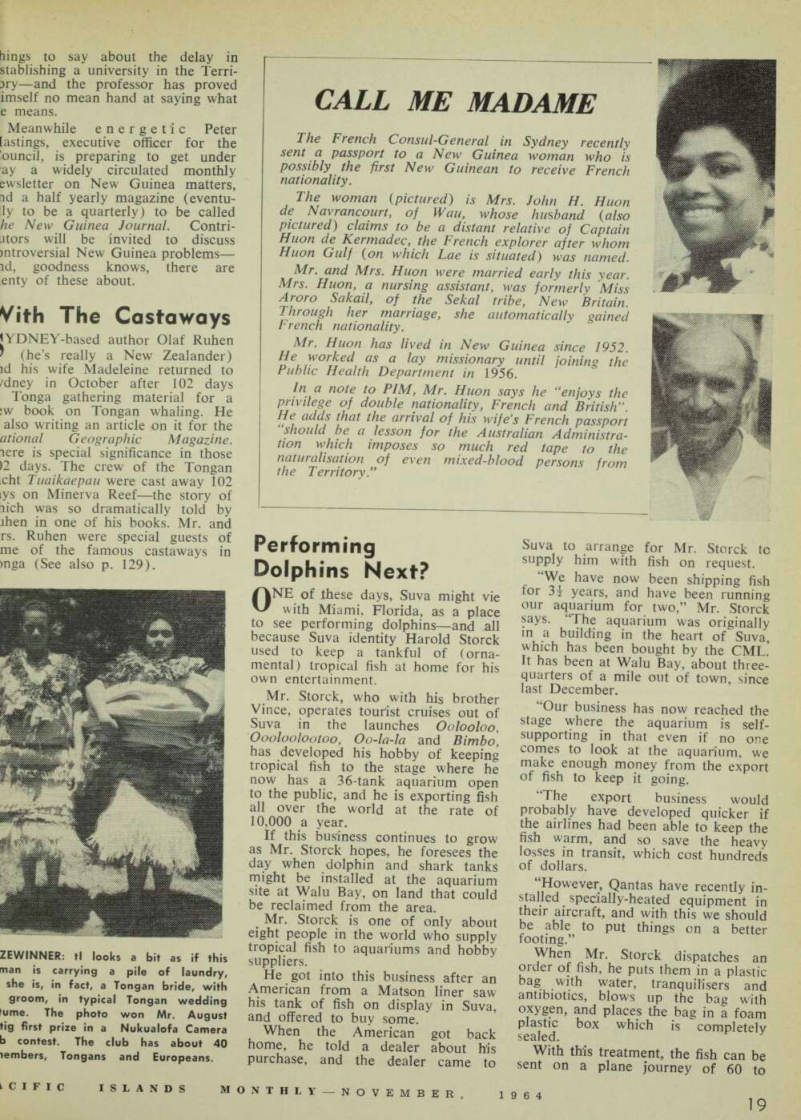
ZEWINNER: tl looks a bit as if this man is carrying a pile of laundry, she is, in fact, a Tongan bride, with groom, in typical Tongan wedding [?]ume. The photo won Mr. August tig first prize in a Nukualofa Camera b contest. The club has about 40 [?]embers, Tongans and Europeans.
70 hours with few losses, provide< they are kept warm.
Most of the fish that go oversea are caught for Mr. Storck by Fijians who know all the answers on ho\ and where to catch the differen varieties required.
Mr. Storck uses the Walu Ba aquarium as a holding station for hi overseas orders, as these must b filled quickly when received. Abor 400 varieties of fish have passe through the aquarium from time t time, and about 50 varieties are e? ported regularly.
Mr. Storck has also exporte almost every kind of cone shell t be found in Fiji waters, beside processed coral for use in aquarium; The Storcks, by the way, belon to one of the oldest Europea families in Fiji. The original Store arrived 104 years ago.
Britain's New
Men
BRITAIN’S new men in oversee affairs should help speed n independence around the world, an Fiji will get its share of the pre sures from within. Even Sir Hug Foot, as new Minister and permanei representative to the UN, will his influence.
But the colonies could have g< much worse than Mr. Anthor Greenwood as Secretary of State f< Colonial Affairs. Greenwood, 5 is a socialist, but he is certainly n way out —and those in the kno say he will bring some liberal vie\ to his new job.
Good-looking, Greenwood is i Oxford MA and a former Intelligence officer, who has travell widely. His wife is a prominent d; play designer.
Whither The
New Hebrides?
WHICH reminds us, Britain c be expected to want to take closer look at the protocol of t New Hebrides—the instrument whi allows France and Britain to joini govern the Condominium. It’s bac in need of an overhaul —as is t New Hebrides itself—and the ni Government will get things movii Some moves would have been ma earlier, but Princess Margaret £ noyed the French by cancelling I: Paris visit, and there was all tl trouble over the Common Mark so it was decided the time wasn’t c porfune for the entente cordiale.
\Z. Parliament
esses Cook Is.
Destitution Bill
The Cook Islands Constitution U, setting out the constitution r the Cook Islands when they
come self-governing early next
ar, was passed by the New
;aland Parliament in October.
HE Labour Opposition generally supported the bill, although the position’s spokesman on Islands lirs, Mr. J. Mathison, and several er Labour members had some •givings. -abour speakers said there was no dence that the Cook Islanders nted self-government or that, if y did, they were ready for it. fhey suggested a plebiscite be held find out what the Cook Islanders’ ws really were. They also main led that the residential requirement political office in the Cooks uld be less than the three years scribed in the bill.
Wishes Of The Cooks rhe Minister of Island Territories, J. R. Hanan, said he was sfied the bill represented the hes of most Cook Islanders, and Government thought the three r residential provision should re in because the present Cook nds Assembly wanted it that way. 4r. Hanan said the three-year vision had been part of the law :e 1958 and was aimed then at luding some “political oppor ists” who were willing to stay and k in the group only if their bid election were successful, t seemed to be for similar reasons ; the present Assembly wanted this
provision retained, even though it could be a hardship in some cases.
Mr. Hanan said there had been some discussion about the possibility of holding a referendum to get the Cook Islanders’ views on self government, but a delegation visiting NZ from the Cooks felt the concept would be fairly tested by the forth coming elections.
He added that the Constitution would not take effect until after the election had been held and after the new Cook Islands Assembly had met to consider it again.
The Under-Secretary for Finance, Mr. Muldoon said not too much notice should be taken of the sub missions of expatriate Cook Islanders.
One who hoped to be Prime Minister under certain circumstances next year, Mr. Albert Henry, had given evidence on the deprivation of the right of succession to family lands for those absent for three years and on the system of land tenure.
Under cross-examination, Mr.
Henry admitted there was nothing wrong with the law on land tenure, but only that it was not understood. • Port Moresby reports in late October indicated that the P-NG Administration might not go ahead with several large works contracts— including erection of a new teachers’ college at Goroka (see p. 124).
Four members of the Cook Islands Legis lative Assembly visited Wellington re cently for discussions with the New Zealand Government on the future con stitution and form of government of their islands. They are seen here with the NZ Prime Minister, Mr. Holyoake, Mrs. Holy oake, and the Minister of Island Terri tories, Mr. J. R. Hanan. The picture shows (from left) Mr. Hanan, Mr. Vainee Reve (Member for Atiu), Mrs. Holyoake, Mr.
Holyoake, Makea Nui Teremoana Ariki, Mr. David Hosking (Member for Raro tonga), and Mr. D. C. Brown (Leader of Government Business).
Photo: NZ Dept, of Island Territories.