A Sixpenny Pocket Fop
pp. 13-14 · Read in the full issue
Some Fun And Games
From a Suva Correspondent
Although it will be jour days after Great Britain and sundry members of her brood celebrate Guy Fawkes Night with the usual spectacular displays of fireworks, Fiji’s Legislative Council, which meets on November 9, is likely to have a grand display of political pyrotechnics all on its own—with a sixpenny rocket as the main attraction.
THE sixpenny rocket is the six penny basic tax which the Government proposes should be levied, as well as the ordinary in come tax, to bring in those people who, because of their low incomes, never pay tax.
Not everyone will pay it, and nothing will come out of the empty pockets of the near-destitute.
The whole scheme, thought out by the Fiscal Review Committee, is incorporated in a new bill to amend the Income Tax Ordinance which will be the main bone of contention for chewing by the Legislative Council.
The fireworks are likely to come from the Indian members, who have been opposed to the sixpenny tax from the beginning, but the 64 dollar question is “Who will light the sixpenny rocket? Will it be the Member for Social Services, Mr.
A. D. Patel?”
If he does, then Fiji’s new, much-
vaunted Member System will hit the rocks, for, if Mr. Patel decides to rebel against the Government, he would have to resign.
So bitter was his opposition against the sixpence that Mr. Patel, as a member of the Fiscal Review Com mittee, wrote his own minority report opposing it tooth and nail.
He proposed instead that such things as kerosene and certain foods should be taxed—a move which would have penalised the poorer classes much more than the new basic tax.
Mr. Patel’s lieutenant, Mr. S. M.
Koya, has been stumping the country side among the cane farmers of the North-West, inveighing against the sixpence. His propaganda has even brought a reaction from the Govern ment.
A Revolt?
They have composed a reply and an explanation of the new measure and are following in Mr. Koya’s footsteps with their propaganda.
Doubtless, Mr. Patel and his other lieutenant, Mr. James Madhavan, who is a Member of the Executive Council without a portfolio, put up a wordy struggle against the bill behind the closed doors of the executive council meeting.
The Government has given in on one or two points in an attempt to meet some of Mr. Patel’s objections, but the tanner tax remains.
If Mr. Patel does not oppose it in the Legislative Council meeting, as a member of the Government he supports it and swallows the six pence, a fact which will be seized on eagerly by his political op ponents.
There have been rumours among the Indian community that Mr. Patel is going to stage a grandstand revolt against the Government, and a spectacular resignation in the council chamber. The truth of this will be known no doubt by the time this is in print.
But, the constitutional conference will be taking place in London some
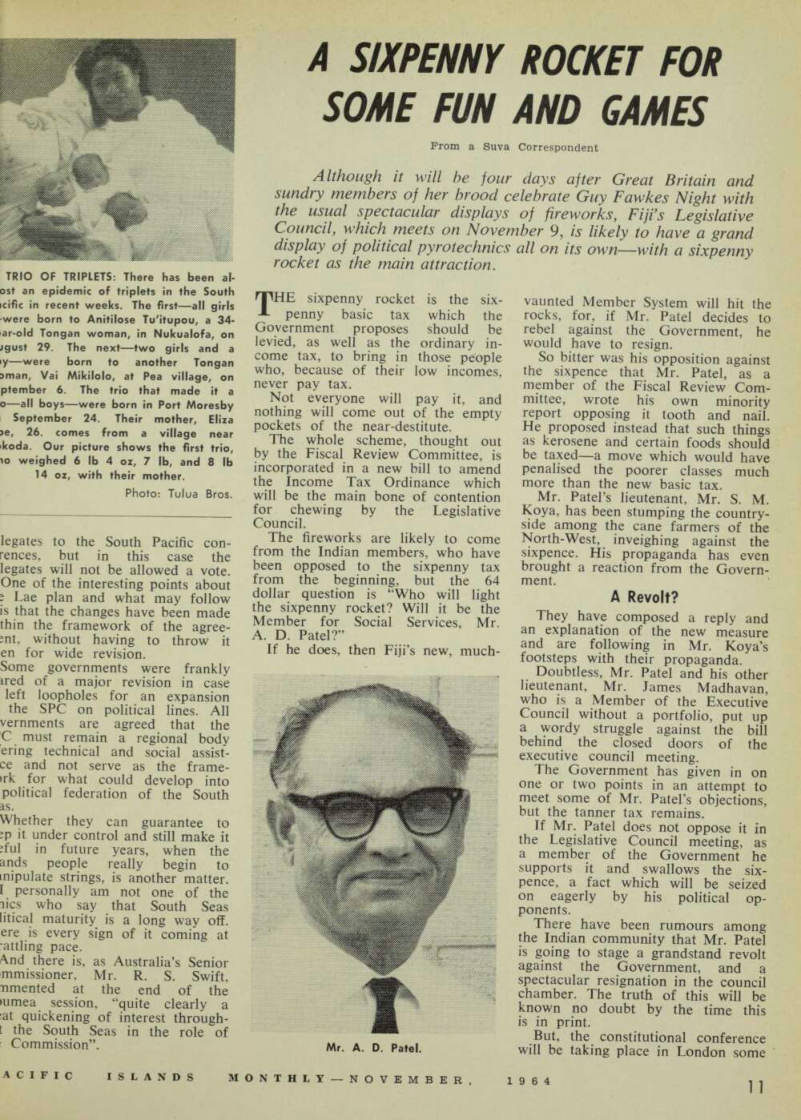
Mr. A. D. Patel.
time early next year and Mr. Patel will certainly want to be there. He’ll rate higher at the conference table as the Member for Social Services than as Mr. Patel, elected member for the Western Constituency.
The concessions made by the Government may give Mr. Patel the ladder he might want to climb off the twin horns of the dilemma that he’s on.
However, if he manages to have his cake and eat it, his opponents will certainly take the icing off the top.
New Taxes Another new impost proposed is a dividend tax of 5 per cent., whether paid to a person or a company.
Company tax under the new law will be cut from 6/3 in the £ to 5/9.
There are several other concessions for wage and salary earners.
It is proposed to increase tax free allowances to £320 each for man and wife (previously £2OO for tax payer and £250 for wife), and the child allowance from £5O to £65.
The surtax rates on taxable in comes over £l,OOO will be on a new basis, and represent a reduction.
The previous rates were 1/3 in the £, rising in stages by 1/3 to 10/in the £ on incomes over £30.000.
The new law envisages a surtax of 1/- in the £ starting at £2,000 of the chargeable income, and rising by 1/- stages to a maximum of 6/at £20,000.
At the time of writing, the Govern ment had not made up its mind whether to place the new Police Bill on the order paper for the meeting. As it proposes giving near dictatorial powers to the Commis sioner of Police, it is likely to be an extremely controversial subject.
It will certainly light a few extra fireworks, but will it cause any resignations from the Government?
That’s hardly likely, though The Fiji Times, in a leader vehemently attacking the bill, challenged the six Unofficials who are in the Govern ment.
The job of opposing the bill “rests squarely on the shoulders of the remaining unofficial members of the Legislative Council,” it said.
Maybe one of the unofficials on the Government side of the chamber might think his shoulders should also take the weight, in which case he also would have to resign.
The smoke of battle will have hardly cleared away at the end of the council meeting before the members will be back again.
The Budget meeting will open on November 27. If the Government is sticking to the recommendations of the Fiscal Review Committee it is
likely there will be proposals to lighten the burden of those who pay the largest share of the taxes.
That will bring more opposition from those who purport to speak for the people in the lowest income brackets.
November promises to be an in teresting month on Fiji’s political front.
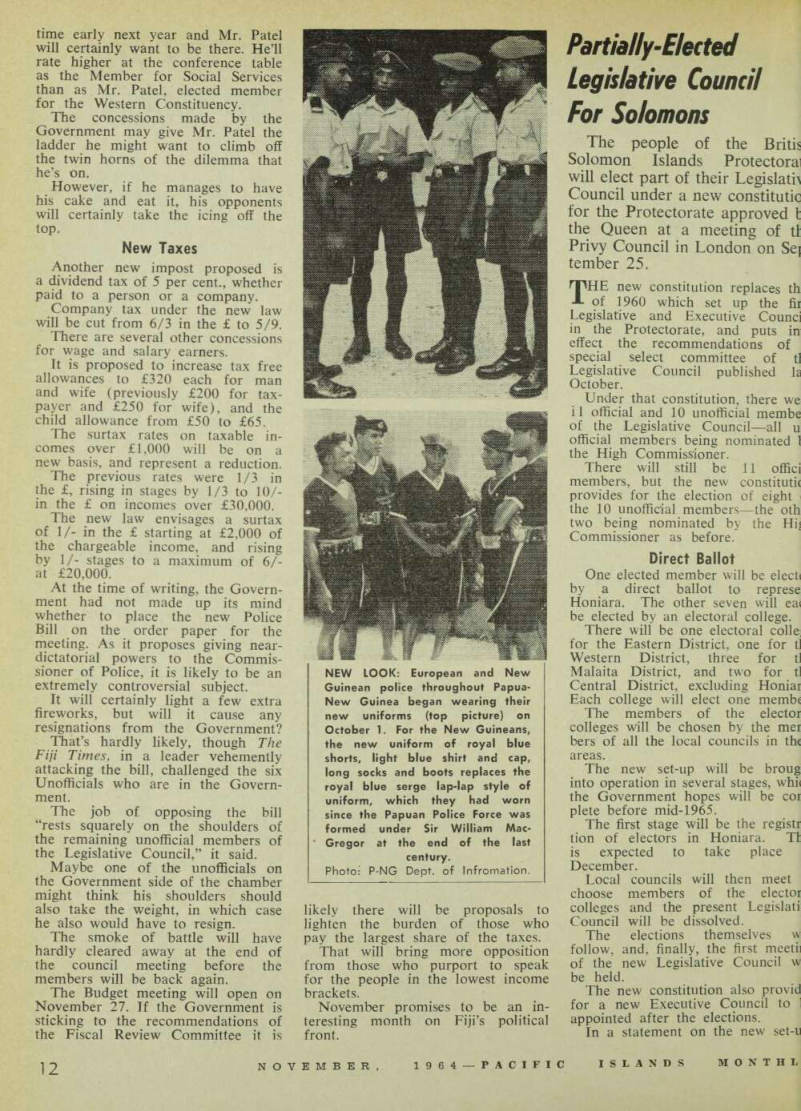
NEW LOOK: European and New Guinean police throughout Papua- New Guinea began wearing their new uniforms (top picture) on October 1. For the New Guineans, the new uniform of royal blue shorts, light blue shirt and cap, long socks and boots replaces the
royal blue serge lap-lap style of
uniform, which they had worn since the Papuan Police Force was formed under Sir William Mac- Gregor at the end of the last century.
Photo: P-NG Dept, of Infromation.