Seen As Threat To
pp. 11-136 · Read in the full issue
Diseases And Australians
Slands Banana Markets
A Special PIM Review
The South Seas were in an uproar in October over their traditional banana market with New Zealand.
AUSTRALIAN banana growers had broken into the New ialand market for the first time, id South Seas growers were con rned that this was the thin edge the wedge. They feared that ueensland and Northern New South ales growers would attempt to idercut their prices and establish emselves firmly in New Zealand, mana exports were vital to Islands onomy.
The Australian growers were able ship to New Zealand because Dwers in Fiji and Western Samoa :re unable to meet their New aland quota for November and ;w Zealand had to turn elsewhere.
Fiji’s growers have been hard hit a result of the severe floods of arch and April, and by an out ;ak of a fungus disease known as ick leaf streak. Western Samoa’s lana plantations have been ravaged a virus called bunchy top.
Meanwhile, no large supplies are iilable from Tonga (which has commitments in Japan) nor in Cook Islands (which are not ired to large scale banana pro ton at present).
Fruit Distributors Ltd., the
main buyer of bananas for NZ, found the Australian growers only £r^nS P tL t 0 Q S t I i PP - ly the - marke J gathermg of I )i an d Western Samoan growers ! * a w li me when there was an over-supply of bananas in Australia.
The initial order was for 15,000 bushel cases from NSW and 5,000 cartons from Queensland, to be loaded in the Indian Reefer in Snsbane eaHy in November.
Lhe NSW bananas are packed in fingers, and each bushel case weighs about 53 lb, while the Queensland 36 r T S each PaCked ha " dS ° f ab ° Ut Mr v Hnoi' oonoroi f the M NSW Banana Growers’ plderation, at Murwillumbah on the far north coast of NSW, told PIM that the November shipment was a trial shipment and that he did not know about future prospects.
But he said a regular trade with New Zealand would be of great advantage to the Australian industry as Australia had been “heavily supplied in bananas in the last few vears ” y ' Price A Secret He forecast that the growers would get “pretty close”—within 1,000 cases—of meeting New Zealand’s orc * er ii Glt^er r ’ nor C. R.
Walker, general manager of NZ Fruit Distributors, would reveal the price of the Australian fruit. But the fact that bananas which would be rejected for export in Fiji were selling from Sydney barrows at 3d each may be some sort of clue.
There doesn’t seem much doubt that
the Australian bananas were more expensive to NZ than Islands fruit.
Mr - Walker told the NZ Press in m id-October that no great improve ment j n t he supp iy G f bananas from Fiji or Samoa was expected in November or December.
He added: “If the shortage of supplies from the Islands continues, it may be necessary to arrange another shipment of bananas from Australia to provide our Christmas requirements.” He considered the Australian supply a temporary ar rsngement Meanwhile, there is a feeling of gloom in some of the Islands about ~be, ,be fu . ture of ( . ,he ba " ana in f d “ str V there irrespective of this new threat I , n Fl ?’ S en eraHy growers are still t!, r ,°S p blow delivered las "’“‘h b y, Mr ; Robert Leach, a plant pathologist from the Cambridge Sch ° ol . ° K f Agriculture, . was
fnve^ffg^ lea^diseas^n 6 the
* t dl J® ase th C a? y ? b £ plantations. t u Mr .- Leach said m ®. re P or , t $ f at the disease was spreading steadily through the Colony and that measures to combat it were so ex pensive that in scattered, unorganised plantations, it might make banana growing uneconomic, In Tonga, black leaf streak does n °t Yet appear to be a threat but there is growing concern over bunchy top, particularly as many growers have no idea what it looks like.
At a meeting of Tonga’s Agri cultural Council in October, the European trading community’s re presentative, Mr. Bill Wight, success fully moved a motion seeking forth
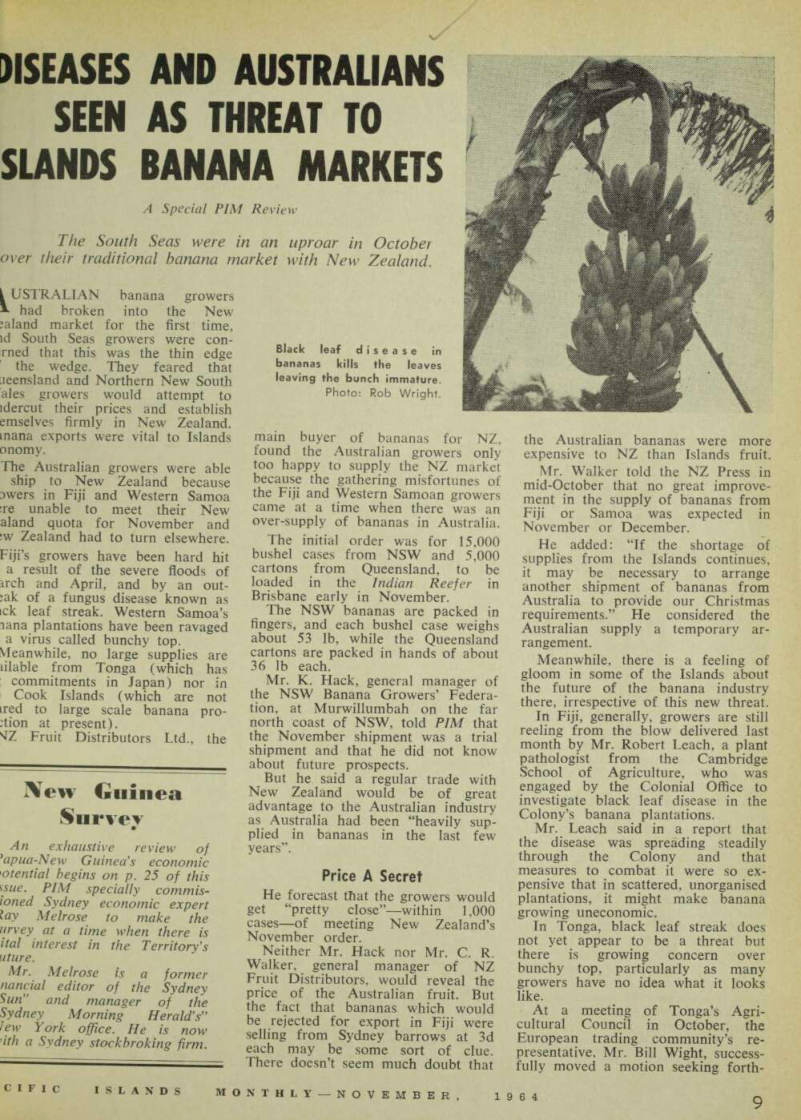
Black leaf disease in bananas kills the leaves leaving the bunch immature.
Photo: Rob Wright.
right Government action on the disease.
A few days before this discussion took place, the New Zealand Ship ping Company vessel Turakina, under charter to the Crusader Shipping Line, left Nukualofa for Japan with 6,975 cases of Tongan bananas—the first of a series of shipments to be made over five months. The shipment was 1,025 cases short of the prescribed quota.
Mr. Adolf Johansson, manager of the Tonga Produce Board, said that the shortage was mainly due to the fact that some growers did not carry out the recommendations of the Agri culture Department on spraying their fruit with DDT.
In mid-November, Tonga has to ship 8,000 cases to Japan in the Port Montreal, and a further 15,000 cases are due to go in the Turakina in December.
Samoan Situation In Western Samoa, where bunchy top is now reported to be so serious that the banana export industry may be wiped out within a decade unless something drastic is done (see p. 57), there was some relief for growers in October when Fruit Distributors Ltd. finally agreed to a long sought after price increase, following personal representations by Prime Minister Mataafa, who made an official visit to NZ early in the month.
The increase, which averages about 2/- a case, brings the FOB price up to 24/- a case from January to July and 28/- a case from August to December.
Of the 2/- only 1/- is being passed on to the grower. The balance is being taken up in increased freight rates, to recoup losses being made by Western Samoa’s Marketing Board, and to pay for the bunchy top campaign estimated to cost about £20,000 a year. The increase takes effect from October 31.
Western Samoa’s export ship ment’s showed a steady decline through September and October, with the Tofua sailing in mid-October with 9,995 cases. The allocation was 15,000 cases.
The price may be a bigger factor in the recent fall off in exports than bunchy-top although the latter could be lethal in its long-term results.
Bunchy-top has been known to exist in certain districts of Upolu for at least five years, where it was sup posed to have been introduced through experimental imporations of manila-hemp, which is of the same family as bananas.
Before then no one in Samoa
(Continued on page 134)
knew what bunchy-top looked like, either, but when they did know they did nothing about it, with the result that it has now spread from what was an isolated area and is causing the present panic.
Fiji, for one reason or another, has not been able to meet its NZ quotas for some years, although about 1958, when they could meet them, they were shocked to have them cut by NZ. The opinion amongst many people there at present is that the days of the erratic Fijian planting along the Wainibuka River and related river systems, in traditional village enterprise using shiftingcultivation methods, are coming to an end.
Many who have studied the Fiji situation are convinced that only properly planted banana estates, with regular systems of cultivation, manuring and, above all, systematic spraying for diseases, will put the Fiji industry back on its feet.
In other words, it looks as though the banana industry has come full circle—back to the so-called bad old days when the industry was in
the hands of large-scale European planters. It is interesting to note that in 1914, long before it became a wholly Fijian industry and at a time when Australia was still in the market for Fiji bananas, the Colony exported no less than 800,000 cases in that one year.
Cook Islands The subject of bananas was a lively topic in the Cook Islands Legislative Assembly in October, particularly in view of the Australian contract to supply the New Zealand market.
The bananas produced in Raro tonga and elsewhere in the Cooks are probably the best in the South Pacific and so far have managed to escape any of the currently fashion able diseases. But here again the price paid for the product—about 22/6 NZ FOB Rarotonga per case in comparison with about 32/6 NZ for the same quantity of oranges— is the main factor in the poor export figures. Cook Islands Maoris don’t think they are getting enough and a large slice of the time in the recent
long-drawn out meeting of tl Assembly was spent in discussing t subject.
New Zealand is providing finand assistance for plantings in the Coo and there has been a large increa in the number of banana plants p in but there has been no increase exports.
The increased production is simp being fed to the local pigs, co sumed locally or sent by relativ to the several thousand Cook Islan Maoris now living permanently the Dominion. A very small amou of local bananas is used by way an ingredient in the fruit-sal; canned by the NZ fruit-processii firm in Rarotonga.
The banana industry was a natur one for the islands of the Pacil that have ready access to the Ne Zealand market. It is particular ironic that part of that market nc seems likely to be taken away 1 Australia, the country where £ of the islands concerned have tri< for years to get a token market f< their own bananas.
Part of this situation can 1 attributed to bad luck; a lot of can be attributed to the Islande themselves who generally learned new styled politics very wt but have not yet grasped the fact th to compete in the tough world ( international commerce it is nece sary to toil, have organising kno\ how and the ability to sprir smartly off the collective bottom.
BSIP Copra
Changes
The BSIP has been worried aboi a reduction in first grade copi production, and in an effort 1 counteract the trend, the pric differentials of grades will be change on January 1, 1965.
The Copra Board has now decide that whatever the fixed price fc first grade copra may be, the pric of second grade will be £l/107ton lower (the present differential' but the third grade price will fc £6 lower than the first grade pric* At present the third grade pric is £4 a ton lower than first grade.
If, after a trial period, th differentials have little effect i decreasing the amount of third grad copra offered for sale, the boar will consider introducing a pric differential of even more than £6.
In giving ample notice the boar considers growers have been give sufficient time to buy Kukum drier and spares, or build Ceylon driers By getting rid of smoke driers the will do much to reduce the per centage of third grade copra.