And Some Thorny Problems
pp. 49-51 · Read in the full issue
New Coledonia Tourism: Much Old French Charm And Some Thorny Problems
From Judy Tudor, in Noumea Noumea, New Caledonia, is the French-est town south of Marseilles and for this reason has much that appeals to tourists from its nearest big neighbours, Australia and New Zealand.
however, far less has been made of this angle, >vhen selling New Caledonia as a tourist resort, than of its South Sea Islands aspect.
New Caledonia is a Pacific island, Df course; but in this department it has hundreds of others to compete svith it—not the least of which is Pahi t i. Tahiti is predominantly Polynesia, with a faint French accent, Mew Caledonia (and particularly Noumea), on the other hand, is French provincial, plus blue sea, coral sand and south-east trade winds. To this extent it has something unique ° 0 er> - , - « rrencn Intluence New Caledonia is only 700 miles from the nearest point on the Queensland coast; Noumea is about 1,200 miles from Sydney and slightly less from Auckland, NZ, but in spite of this, or Australia’s war-time economic influence or the 1942-45 invasion by American forces, French influence still remains paramount.
English is far less understood in New Caledonia than in Tahiti; there has been almost no attempt to turn the place into something “just like home” for American tourists; and for all but the most timid of non-French-
speaking tourists, this is all part of its charm.
New Caledonia has, moreover, the largest white population of any island territory in the South Pacific (29,000 in a total population of 82,000; its nearest rival is Papua-New Guinea with about 26,000 Europeans in a total population of over two million).
In the streets of places like Suva or Port Moresby today, European faces appear as an occasional pink and-white raisin in a very large brown pudding; in Noumea, the pudding it self is still more than half white.
If, in its older, grubbier, more picturesque aspects Noumea is old Provence; in its new bayside boule vardes, new housing, new shops, it is French Riviera. Its menus and its food are French; so, of course, are its perfumes and wines.
New Zealanders Love It New Caledonia has worked hard at its tourist industry in the last five years and already there are results to show for it. Cosi of a holiday there is now only from 10 per cent, to 15 per cent, more than in Australia, but a few years ago it was over 25 per cent. more. There is, however, still much to be done in NC and no one realises it more than the local Office
du Tourisme and its director, Mr.
L. P. Eschembrenner.
At present about 7,000 tourists a year are visiting New Caledonia, usually dividing their time between Noumea and the Isle of Pines, About 55 per cent, of the total are from New Zealand virtually all of whom arrive in the weekly BOAC Comet chartered to TEAL. The other 45 per cent, come from Australia, France and elsewhere and only a minority from the United States.
Tourism has not been orientated towards Americans and this, in itself, must be unique m this world. Existing hotel facilities, and those that will be available in the immediate future, are not considered to be of the standard most Americans demand.
Restricted air-services—the weekly Comet from Auckland, a weekly Electra from Sydney and a weekly DCS from Nadi, Fiji—at present put a brake on any spectacular expansion on tourism; and so, up to date, have hotel facilities.
No hotel in New Caledonia yet compares with the best in Fiji or Tahiti. The newest in Noumea are the Caledonia Hotel, right near the centre of the town, in the Latin Quarter, opposite the new Museum; and the Noumea Hotel, on the Baie des Citrons, in the Anse Vata area,
Planned For
1966 Games
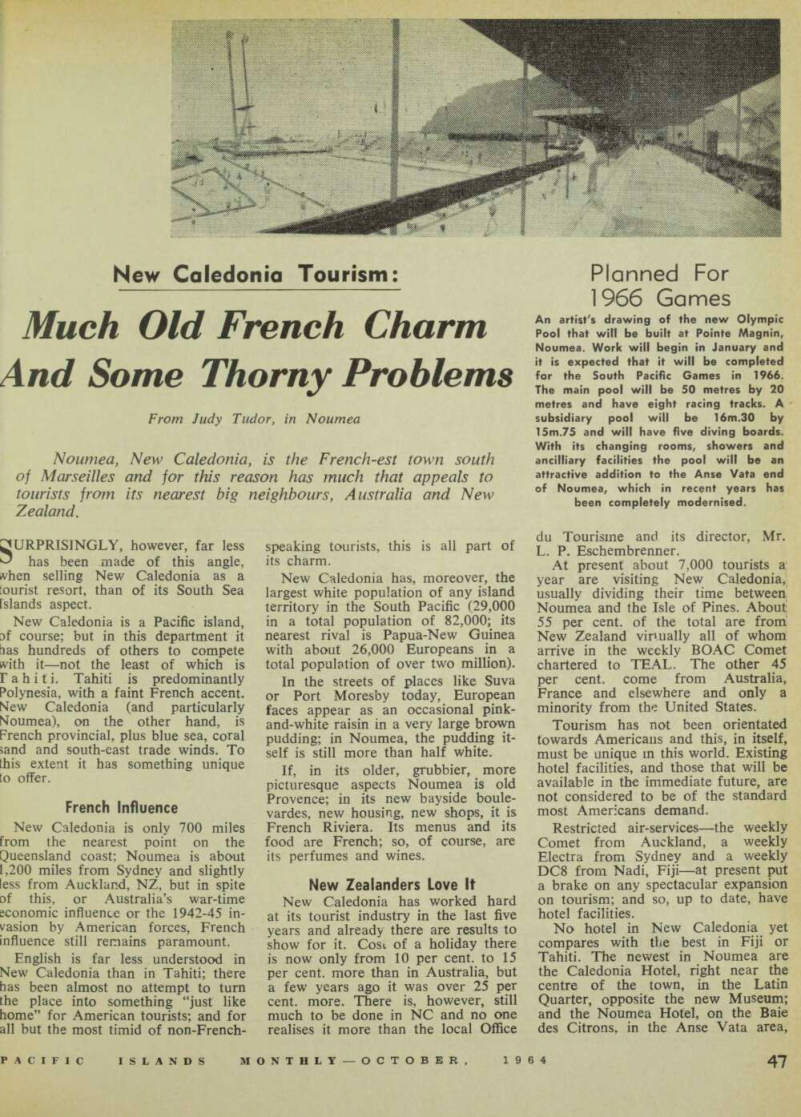
An artist's drawing of the new Olympic Pool that will be built at Pointe Magnin, Noumea. Work will begin in January and it is expected that it will be completed for the South Pacific Games in 1966.
The main pool will be 50 metres by 20 metres and have eight racing tracks. A
subsidiary pool will be 16m.30 by
15m.75 and will have five diving boards.
With its changing rooms, showers and ancillary facilities the pool will be an attractive addition to the Anse Vata end of Noumea, which in recent years has been completely modernised.
which has been operating about seven months.
The Noumea Hotel was the old Civil Club (which has now moved to new premises about 100 yards away).
Bedrooms have been added at one iide and on a top floor. Rooms have showers and toilets and telephones, and some have air conditioning. The hotel is just across the road from the beach.
In September, a 50-room extension to The Bungalows Hotel, at Anse Vata, had been started. When com pleted this hotel will then have a restaurant, night-club and a swim ming-pool—the first hotel pool in the territory. It is expected that the ex tensions will be complete by the end of 1965.
An even more ambitious project is the plan to build the Chateau Royal Hotel at Magnin Point, beyond Anse Vata. This is the only privately owned beach in Noumea and when the building, in French Colonial style, is complete, it should give New Caledonia its best hotel to date.
It, too, will have a swimming-pool.
An American consulting engineer and a French architect were in Noumea in September working on a preliminary layout. The interior of the hotel will be in the hands of M.
Royer, the French interior decorator responsible for the decor of the passenger liner France.
This 50-room hotel is being built by the owner of Alouette Restaurant in Sydney in association with Ameri can and French interests.
Only Two Waiters Trained staff for New Caledonian hotels and restaurants is a big problem for the tourist industry. As in France itself, dining-out is the number one entertainment and there are innumerable small restaurants to cater for this. Their food is usually very good but the service is poor.
For a nation that has elevated the profession of waiter to a very high pinnacle, it’s remarkable that in the whole of Noumea there are only two trained waiters. For the rest, the so called waiting is done by untrained girls of various races who are here today and gone tomorrow. Even when they are on the job, many of them are so inept they drive tourists to exasperation and local Frenchmen right up the wall.
Currently the Tourist Office is con sidering taking a page from New Zealand’s book and encouraging Aus tralian girls to take working holidays in New Caledonia. New Zealand hotels are almost entirely staffed by Australians who spend a year or two in the Dominion, moving on from
tourist hotel to tourist hotel. At home they are secretaries, nurses or school teachers, but they take to their holi day jobs with intelligence and charm.
Their efforts have saved NZ tourism from oblivion and it is sug gested that they may do the same for New Caledonia, which would be par ticularly attractive to girls who want to improve their French.
Japanese, who have been freed from some of their currency restric tions, are taking an interest in New Caledonia and it has been rumoured that Japanese interests want to build a hotel. It is believed that there is a potential 2,000 tourists a year for New Caledonia from this quarter, but
this has set the authorities wondering what would be Australasian tourists’ reactions to this minor Japanese flood.
New Caledonian facilities at pre sent couldn’t cope with 2,000 more of any sort of tourist but when current building programmes are com pleted and air services are stepped up, no doubt a large number of Jap anese can be absorbed.
Although there may be prejudice still remaining against Japan in the South Seas, it’s obvious that all terri tories are going to see more Japanese tourists in the future and the sooner everyone gets used to the idea the better.