Spectacle
pp. 43-47 · Read in the full issue
Without
Parallel
From R. W. Robson, in Goroka The Goroka, New Guinea
iighlands, Show of August
>9-30 will remain memorable or three reasons: ft TT provided a spectacle of native A dancing, singing and mock ighting without parallel in the world —and it may never be seen again, jecause of the rapid “Europeanisa ion” of this region. • The Goroka community, within ;even months, converted 27 acres of vaste land, just outside the town, into i vast park and showground, com prising 84 buildings, a permanent grandstand and pavilion, a show ring, lawns and gardens, two permanent lakes, 22 long-houses for the accom modation of some 20,000 native visitors —and ran the whole organisa tion efficiently and profitably. • The evidence it gave of a vibrant spirit of drive and confidence in the future, and of friendly relations and genuine co-operation between the European planters and the half-,million New Guineans of the Highlands.
The visitors arrived in thousands.
The roads brought in at least 60,000 natives, some in motor-vehicles, most of them walking, and all singing or yodelling.
Scores of planes came in over the ring of mountains, loaded with Euro peans from all over the world, and with food and supplies for the gather ing multitude.
At one time, there were 33 planes parked on the airstrip, and a noble band of DCA men were dispatching them at the rate of one a minute.. A dust-cloud hung over the airport for three days.
The hotel was jam-packed. Every private house had guests. Grass-filled palliasses were available in hundreds, for folk who were happy to bed down in schools and halls.
Rugs were at a premium—Goroka is close to the Equator, but at 5,000 ft it is not the “tiopics”. Planes flew in thousands of loaves of bread, hundreds of dozens of liquors, hard and soft. Lorries came from the sur rounding valleys, with tons of native foods.
Thirty teen-age girls, for example, arrived from Laurieton School, in Melbourne, in a chartered plane, and picnicked adventurously in the Farmers and Settlers’ Hall, (Their de parture on the last day, loaded with curios, was a sight to behold—the air hostesses pretested strongly as their sensitive bottoms were punctured with bundles of long spears, from which the Melbournites refused to be separated.) The New Guineans came in tribal parties, dressed in the old styles, from a score of valleys within hundreds of miles. They sang strange songs, paused frequently to practise their dances, and ignored the native town
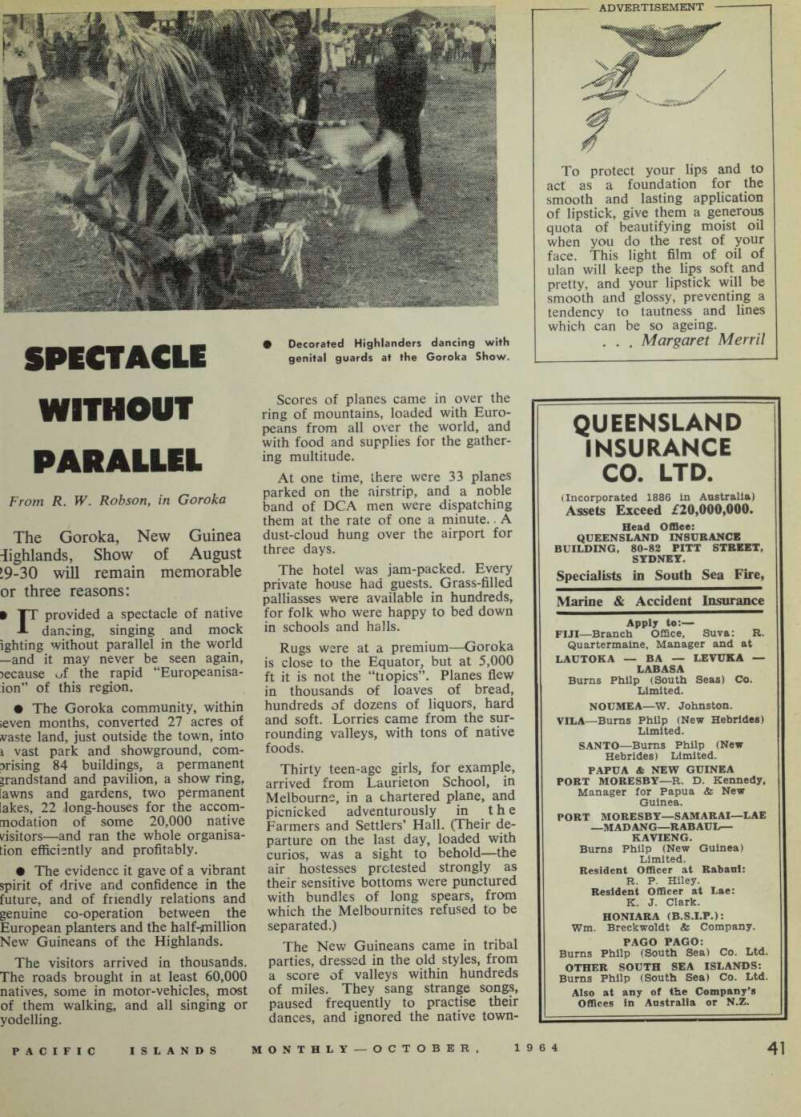
Decorated Highlanders dancing with genital guards at the Goroka Show.
folk—who were mostly in shorts and shirts, and who were as much in trigued by the visitors’ antics as were :he newly-arrived whites.
This rare gathering of the clans had its funny moments.
One was the arrival of a large party of Kukukukus, who had narched for many days from Men —the first time the notorious lighting mountaineers (often called pygmies) had responded to the official invitation to come to the show.
At first glimpse of the fierce little bowmen the spectators, whether decorated Chimbus or unarmed Gorokans, incontinently bolted. All dirough Highlands history, the Kuku kukus have been everyone’s ruthless ;nemy.
Uniformed police met them as they ipproached Goroka and gently took :harge of their spears and arrows; and for the whole of their stay, wherever they went, police and patrol afficers hovered around, keeping an sye on them and soothing the other tribes, who perceptibly shrank when ever they saw the savage-looking mountaineers.
Fibre Sporran
They could be recognised away of! —they had an enormous fibre sporran in front; their flanks were bare except for a spray of green leaves, while their faces were painted ferociously.
The native parties, as they arrived, were guided to a huge encampment of about 20 long-houses, alongside the showground, where they relaxed and cooked and seemed well content, hundreds to each long-house.
But the grass houses were tinder dry, cooking-fires were lit inside, and the inevitable happened. Flames shot high above showground rooftops, everyone started running and shout ing, There was no wind, and police and firemen came into action swiftly —but within minutes four long-houses were a smoking ruin.
It was sheer luck that the usual cool morning breeze was not blow ing.
The showground began to fill from daylight on Saturday.
Everyone paid. Some visitors were shocked to learn that all the New Guinean dancers—and there must have been at least 15,000 of them— had to pay 2/- each admission, each day, although they really made the show. ‘They don’t do this at Mt. Hagen (the show alternates between Goroka and Hagen)—the dancers went in free,” said one critic.
“Hagen did it all with Government funds—we are doing this as a com munity,” his Goroka friend replied.
There were no complaints from the New Guineans—although theirs was a spirit of genuine co-operation to make the show a success.
Proceedings built up to a climax in mid-afternoon of Sunday.
There were then at least 15,000 tribesmen in the ring, grouped in separate parties similar in dress and decoration, the parties in moving circles, proceeding in opposite directions—a mass of variegated colours, moving slowly under bright sunshine, Not one team was silent, and each team went on its own. The noise, ranging from screams, through syncopated howls to whistles and grunts, was indescribable. Each team danced —if a shuffling forward movement, from one foot to the other, could be called dancing.
Every now and then, a team would put on some specialised pantomime of its own—fights, feasts, hunts, devil chasing. There was nothing soft or sentimental about all this—it was the grim, purposeful, merciless life of the hard jungle, There were few women among them. Here and there, a couple of skinny females marched in front of the teams, howling something; but mostly it was the savage male on parade, decorated with paint, or feathers, or skins, or garlands, or weapons, or a combination of all.
Generally, beauty was not aimed at.
This Highlands man, in his primitive state, made himself as ugly as his art permitted—and some of the end re suits were horrible, Some teams had rolled themselves
in grey river mud, and encased their heads in clay masks. Some cancelled out the horror of their faces by colourful decorations mounted above their heads.
I do not suppose its like could be found anywhere else in the world— this great mass of moving men and colour, attended by a hellish clamour and notable for its evidence of vitality and strength, and its complete lack of humour. Some of the performers seemed playful, but their expression belied it.
Humourless?
That, in fact, was an outstanding feature of this great spectacle.
Wherever and whenever one sees NG Highlanders, their demeanour is dignified, withdrawn, solemn—they rarely smile, and I never have heard one laugh outright.
These thousands of dancers were enjoying themselves, but they gave no indication either of happiness or choler. They would stop, stand patiently and courteously for the swarming photographers, and move on again, without expression.
Yet they did not take life too seri ously.
As everyone knows, sections of the adult males of these people wear genital coverings—gourds, or shells, or wooden contraptions which they tie in front of them with string, in grotesque fashion.
One gang of ten young men wandered about the showground, with monstrous guards sticking out in front of them. Every now and then, they would stop and perform a blithesome dance, while two of them—apparently scouts, and each armed with an especially ferocious penis guard— would dart purposely at an onlooker —invariably a native.
The chosen one, of course, would run off shrieking, whereupon the scout would change direction, and scare another member of the crowded audi ence.
The audience laughed very much; but the performers’ faces were com pletely dead-pan.
Incongruities
Incongruities abounded. One man, fearfully decorated with thigh-bones and dead bats, inhaled smoke from a king sized filter cigarette, as he shuffled in the dance. Another had a square-faced gin bottle tucked under his woven snood.
Out in the moving mass of dancers sun-burned photographers, perched on little stands, worked away with their modern cameras, the boredom of their faces equalled only by the dead-pan
expressions of the dancing natives packed around them.
At one period, two contests proceeded side by side. In one place, young white equestriennes engaged in competitions, their good looks equalled only by the grace and beauty of their light horses and ponies, for which these Highlands are notable. , , Right alongside, painted and decorated New Guineans engaged m archery practice.
Another thing about these masses of New Guineans intrigued me—their orderly behaviour. There was no impropriety whatever. No fights, no drunkenness.
The show was a model of efficient management and good order, and a credit to the Goroka community,
Among the many who did a yeoman job was Mr. Max Orken, Native Lands Commissioner, who for two days sat a t the microphone, on top of the grandstand a tireless link (in English and Pidgin) between the show management and the army of officials m charge of sections, The following are the office-bearers of the Eastern Highlands Agricultural Society, who worked together as a t * to make the Goroka Show of i 964 a magnificent success: President, Ken James; Vice presidents, O. J. Matheson, N. B.
Latimer; Councillors, K. Bennett, R ev . K. Kenyon, I. Brazenor, P. W.
Reilly, I. F. G. Downs, A. J. Robin son; Secretary, S. Fox; Assistant Sec., Mrs. K. Bennett; Treasurer, E. Car penter; Assistant Treas., K. Lee.