Un Mission Leader
pp. 91-92 · Read in the full issue
The Month's New Reading
To New Guinea
Tells His Story
New Guinea Territorians who were shattered by the report of the UN Trusteeship Council’s Visiting Mission, led by Sir Hugh Foot, in 1962, will find some answers to previous mysteries in Sir Hugh’s own story, recently published. He has called it, with singular appropriateness, A Start in Freedom.
IT seemed to Territorians in 1962, that Sir Hugh was advocating independence for Papua-New Guinea from Australia immediately, and this revolutionary thinking (revolutionary, at least, at that time), was even more of a shock because Sir Hugh and his team had seemed such pleasant fellows.
To New Guinea in 1964, 1962 is ancient history. Although the reaction against the report was strong at the time, the Australian Government has gone a long way towards putting the recommendations it made into effect, and everyone concerned has adjusted accordingly.
Nonetheless, the name of Foot, in the Territory, still produces the dim echo of a bogey-man rattling its bones like some unfortunate skeleton in a cupboard.
Although Sir Hugh had been a distinguised Colonial Governor and UK representative at the United Nations, except as a name, he was unknown to Territorians.
As a former British Governor, it was expected that he would have sympathy for the status quo; there was no way of knowing that he was an advocate of the belief that political independence and rule by the majority are ends in themselves. Here lay the initial shock of 1962.
Remarkable Family
Foot comes from a remarkable Cornish family—remarkable in its own right and remarkable for a family of a Colonial Governor who reached such prominence.
At no point did the Foots impinge on the Establishment. Hugh had a strict Methodist and radical up bringing, went to a Quaker School before Cambridge and, with his four brothers and two sisters, was devoted to his parents and much influenced by them, even in his adult years.
In the British parliamentary elec tions of 1945, no less than four members of the family stood—Foot Snr., brothers John, Dingle and Michael—the latter perhaps better known as a leader writer on the Evening Standard than as a Labour MP.
Hugh Foot joined the Colonial
Service in 1929 and his first posting was in Palestine. For the first 15 years of his service—which covered the vital war years—his service con tinued to be amongst Arabs in Jordan, Jerusalem and North Africa.
He became devoted to the people, and in one passage in his book he describes how he and several Arab Legion officers, thrown together during the war in Amman, became Arab enthusiasts.
“We didn’t drink or smoke,” he records, “we carried a string of Arab beads which we would run through our fingers as we talked in the evening. I gave more and more time to my Arabic . . .”
But in spite of his devotion to all things Arab, the Colonial Office had its way and he was transferred to Nigeria as Colonial Secretary in 1944 and thus began his climb to the top.
He was there as a guest in 1960 when Nigeria became independent, but in 1951 he had become Governor of Jamaica and remained there as such until Jamaica’s independence in 1957.
UN Adviser From Jamaica, Foot went to Cyprus and remained Governor through the years of disorder and was there to conduct the obsequies at in dependence in late 1960.
As the international humourists were now to point out, there were few former British colonies left for Foot to liberate and the United Nations was a logical step for his particular talents.
In 1961, he became the principal
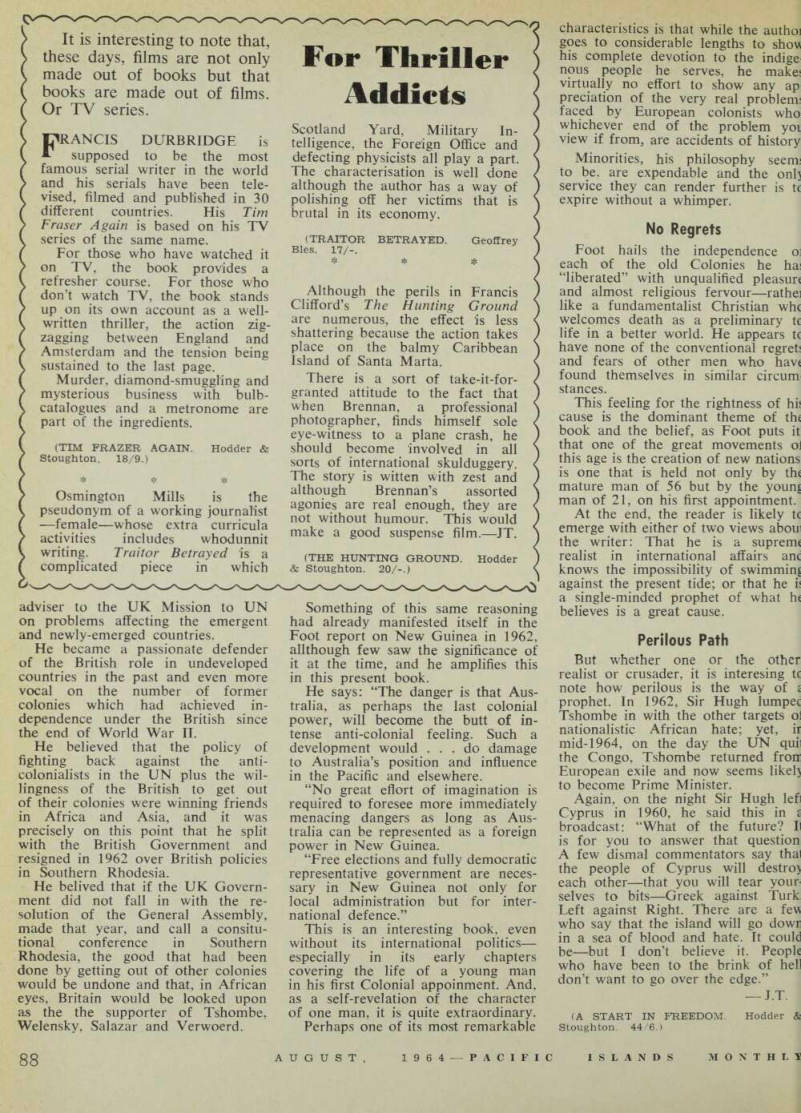
Sir Hugh Foot.
adviser to the UK Mission to UN on problems affecting the emergent and newly-emerged countries.
He became a passionate defender of the British role in undeveloped countries in the past and even more vocal on the number of former colonies which had achieved in dependence under the British since the end of World War 11.
He believed that the policy of fighting back against the anti colonialists in the UN plus the wil lingness of the British to get out of their colonies were winning friends in Africa and Asia, and it was precisely on this point that he split with the British Government and resigned in 1962 over British policies in Southern Rhodesia.
He belived that if the UK Govern ment did not fall in with the re solution of the General Assembly, made that year, and call a consitu tional conference in Southern Rhodesia, the good that had been done by getting out of other colonies would be undone and that, in African eyes, Britain would be looked upon as the the supporter of Tshombe, Welensky, Salazar and Verwoerd.
Something of this same reasoning had already manifested itself in the Foot report on New Guinea in 1962, allthough few saw the significance of it at the time, and he amplifies this in this present book.
He says: “The danger is that Aus tralia, as perhaps the last colonial power, will become the butt of in tense anti-colonial feeling. Such a development would ... do damage to Australia’s position and influence in the Pacific and elsewhere.
“No great effort of imagination is required to foresee more immediately menacing dangers as long as Aus tralia can be represented as a foreign power in New Guinea.
“Free elections and fully democratic representative government are neces sary in New Guinea not only for local administration but for inter national defence.”
This is an interesting book, even without its international politics— especially in its early chapters covering the life of a young man in his first Colonial appoinment. And, as a self-revelation of the character of one man, it is quite extraordinary.
Perhaps one of its most remarkable
characteristics is that while the authoi goes to considerable lengths to shov his complete devotion to the indige nous people he serves, he make; virtually no effort to show any ap predation of the very real problem: faced by European colonists who whichever end of the problem yoi view if from, are accidents of history Minorities, his philosophy seem: to be, are expendable and the onfi service they can render further is tc expire without a whimper.
No Regrets
Foot hails the independence o; each of the old Colonies he ha: “liberated” with unqualified pleasun and almost religious fervour—rathei like a fundamentalist Christian whc welcomes death as a preliminary tc life in a better world. He appears tc have none of the conventional regret: and fears of other men who have found themselves in similar circum stances.
This feeling for the rightness of hi: cause is the dominant theme of the book and the belief, as Foot puts it that one of the great movements o] this age is the creation of new nations is one that is held not only by the mature man of 56 but by the younj man of 21, on his first appointment.
At the end, the reader is likely tc emerge with either of two views abou 1 the writer: That he is a supreme realist in international affairs anc knows the impossibility of swimming against the present tide; or that he i: a single-minded prophet of what he believes is a great cause.
Perilous Path But whether one or the other realist or crusader, it is interesing tc note how perilous is the way of £ prophet. In 1962, Sir Hugh lumpec Tshombe in with the other targets oj nationalistic African hate; yet, ir mid-1964, on the day the UN qur the Congo, Tshombe returned froir European exile and now seems likely to become Prime Minister.
Again, on the night Sir Hugh lefi Cyprus in 1960, he said this in £ broadcast: “What of the future? I) is for you to answer that question A few dismal commentators say thal the people of Cyprus will destroy each other—that you will tear your selves to bits—Greek against Turk Left against Right. There are a few who say that the island will go dowr in a sea of blood and hate. It could be—but I don’t believe it. People who have been to the brink of hell don’t want to go over the edge.”
J.T.
Fa Start In Freedom. Hodder &
Stoughton. 44/6.)