yesterday
p. 89 · Read in the full issue
Things were going so badly for the Japanese in the Pacific War by mid-1944 that General To jo was removed as Chief of the Japanese General Staff on July 18. This was one of the main news items in the issue of PIM for August, 1944.
Other items were :
ON August 1, US forces landed unopposed in the Cape Sausapor area at the extreme western tip of Dutch New Guinea, thus cutting off the last Japanese forces in New Guinea from Japan. However there were still numerous Japanese forces in New Guinea at places such as Rabaul, Kavieng and Aitape, but they were being steadily mopped up. ♦ * * The most ambitious agricultural fair ever held in Papeete, Tahiti, was ruined by rain in July. A group of buildings in the old Tahitian style was erected on the racecourse, but prolonged rains turned the course into a “quaking morass”. * * % The retirement was announced in Suva of the Chief Justice of Fiji, Sir Owen Corrie. * * * An epizootic tick was playing havoc with cattle in New Cale donia—creating a serious situa tion, as the cattle industry, after mining, was New Caledonia’s largest. The territory had pre viously been free of the tick.
Experts attributed its presence to the waiving of quarantine restric tions during the dark days of the Pacific war. * * * After a Japanese garrison on one of the Nissan Islands (200 miles east of Rabaul) was wiped out, a New Zealand soldier dis covered three keys and a silver medal attached to an enemy wire less set. The medal, shaped like a Maltese cross, was inscribed, “Five Miles Ordinary Champion ship, C. R. Wilson, 1892. New Zealand Cycling Alliance”. In quiries revealed that the medal was owned by Mr. G. L. Wilson, of Nambour, Queensland, formerly manager of Asalingi Plantation, 35 miles from Rabaul. * * * In an outspoken article on New Guinea, PIM said: “The con tinuance of military government
in Papua, 18 months after the last Jap has been thrown out of the Territory, is one of the remarkable political developments in the Pacific War.
“The Australian Government, being little better than an uncoordinated gang of bumble-footed blunderers, allows bureaucracy to do what it likes with the Terrilories; and, as the Australian public is completely indifferent to what happens there, there is no check on anyone. So the Australian Army, through a branch called ANGAU (Australian and New Guinea Administrative Unit) is running the Territories in its own way, irrespective of cost, and without any regard for the interests of the thousands of civilians who were compulsorily removed from both Territories when the Japs invaded.” * * * The deaths were announced of a number of old Islands residents, They included: Captain Lloyd Pursehouse, a former New Guinea patrol officer, who was killed in action after the Australian 9th
Division landed in Lae; Mr. Emil Noller, a businessman in Papua from 1906 to his evacuation in 1942; Mrs. C. E. Hill, widow of a pioneer planter at Emae Island, New Hebrides; Mrs. Jane Beddoes, a well-known Fjii resident for more than 50 years; the Rev.
Frere T. Lane, of the New Guinea Anglican Mission, who died in Brisbane; and Mr. Arthur Jewell, a well-known Papua resident, who died in Sydney at the age of 65. * * * Damien Parer, of the irrepressible Parer family of New Guinea, was winning the admira d°n °f American troops for his daring in filming the fighting on Guam for Paramount News, Melbourne Herald war corres pondent, Denis Warner, said in a dispatch from Guam: “The Marines think of him as a sort of legendary figure the bullets cannot touch. Four of their own corps’ cameramen have been killed in the fighting here, but none took the same risks as Parer to get what he calls ‘the best action pictures I have taken this war.’ ”
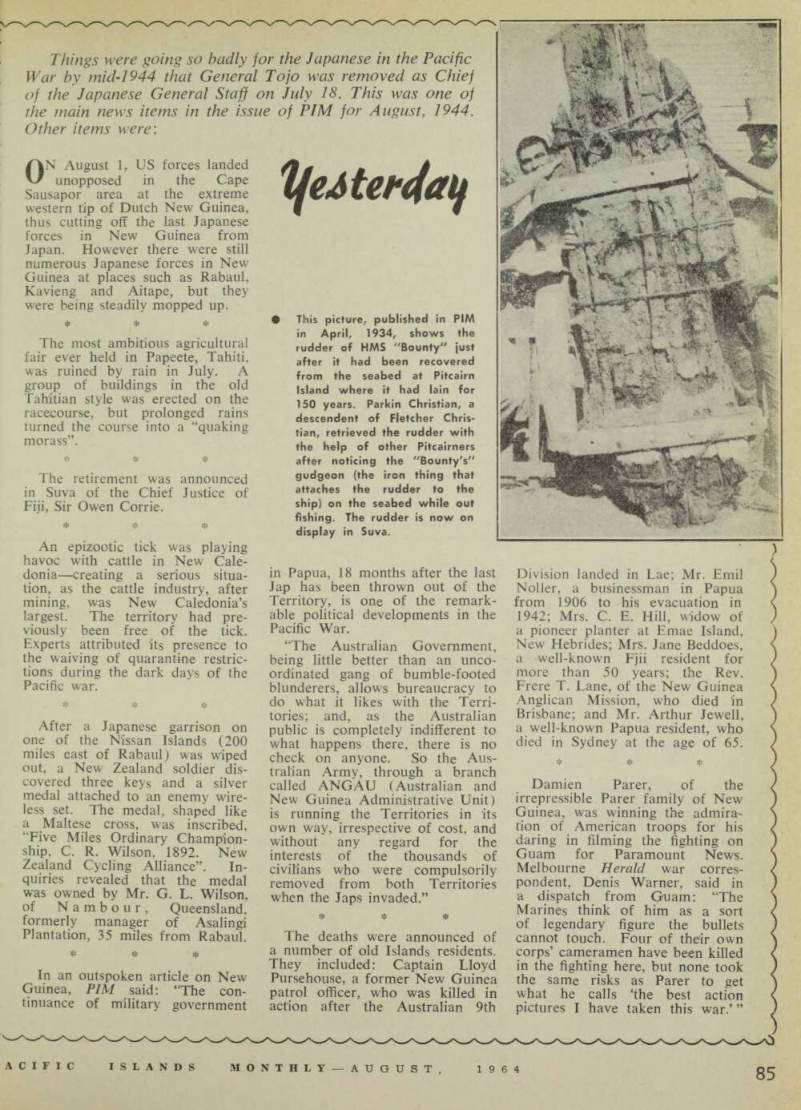
This picture, published in PIM in April, 1934, shows the rudder of HAAS "Bounty" just after it had been recovered from the seabed at Pitcairn Island where it had lain for 150 years. Parkin Christian, a descendent of Fletcher Chris tian, retrieved the rudder with the help of other Pitcairners after noticing the "Bounty's" gudgeon (the iron thing that attaches the rudder to the ship) on the seabed while out fishing. The rudder is now on display in Suva.