Quiet
pp. 65-68 · Read in the full issue


Revolution In South Pacific Churches
From Correspondents in Suva and Lae.
Side-by-side with the swift political changes throughout the South Seas in the last year or two has been a political revolution of a different kind-a revolution within the Pacific cnurcnes.
THE churches are drawing together.
They have already come so far along the road of unity that it is only a matter of time now before they will be able to speak and act with one voice through a South Seas division of the World Council of Churches.
Missionaries everywhere see the present developments as exciting, and agree that there never has been a time in South Seas history when the outlook in the churches looked brighter.
The first link in the chain of the recent developments was forged in Western Samoa in 1961 when re presentatives of Protestant churches got around the table to discuss first steps in church unity.
They decided that something in the nature of a South Pacific church :ouncil was needed if the churches were to pool their knowledge of local problems for the common good, and be able to exert pressures where they were needed.
College Being Established
All realised that influence was ex pecially needed in the South Seas, where the churches carried such a big -esponsibility in matters of education and health. Unlike the situation in more developed countries, most Pacific territories simply cannot run
their education systems without the churches and missions.
The Samoan meeting also agreed that the Pacific churches badly needed a central theological college, for only a central college supported by all could be strong and prosperous enough to provide advanced training for church leaders—churches which themselves were emerging to in dependence.
The meeting established committees to carry on the plans for both a council of South Seas churches and a central college, the college to be based in Suva.
Hands to the Wheel In the last three years there have been many hands to the wheel, and there has been no Pacific territory where work has not been going on towards reaching the twin objectives.
There have been many important meetings and visits between church leaders, and a number of vital con ferences to allow views to be ex changed.
The last important one was in Lae, New Guinea, in April, when the continuation committee, under the chairmanship of a Fijian, the Rev.
Setareki Tuilovoni, president of the Methodist Church in Fiji, laid the groundwork for what will be the first real assembly of the Pacific churches.
This will be in 1966.
Lae has been provisionally chosen as the site for it, although this won’t be decided firmly for several months yet.
Also at the Lae meeting, were Pastor Vavae Toma, secretary of the committee and Pacific secretary of the World Council of Churches; Mrs.
Fetaui Mata’afa, Western Samoa, wife of the Samoan Prime Minister, of the Congregational Church; the Rev. Graham Horwell, New Hebrides, Presbyterian Church; Pasteur M.
Pont, New Caledonia, French-speak ing churches; Mr. Stahl Mileng, New Guinea, Lutheran Church; Arch deacon H. V. C. Reynolds, represent ing the Melanesian Mission in the Solomons; Dr. Harry Haines, of the Department of Inter-Church Aid, World Council of Churches, Geneva; and the Rev. Paul Freyberg, New Guinea, Lutheran Missions.
It was hoped that the 1966 as sembly will represent 1,650,000 Christians who are members of 21 churches, from New Guinea in the west to Tahiti in the east, and from the American Trust Territories in the north to Tonga in the south. Also attending will be observers from Aus tralia, New Zealand, South-East Asia, Africa and the World Council of Churches.
The Lae meeting decided to invite some outstanding church leaders, in
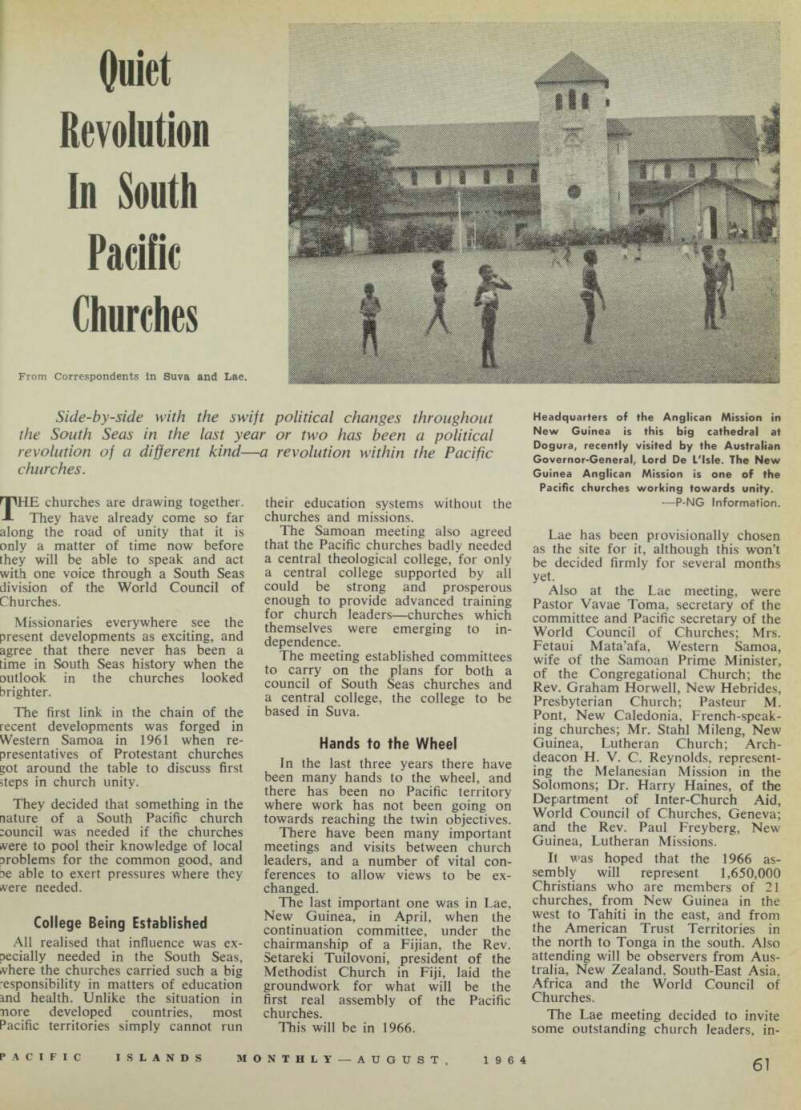
Headquarters of the Anglican Mission in New Guinea is this big cathedral at Dogura, recently visited by the Australian Governor-General, Lord De L'lsle. The New Guinea Anglican Mission is one of the Pacific churches working towards unity. —P-NG Information.
□ding Dr. Visser ’t Hooft, general cretary of the World Council of [lurches, Geneva; Bishop Lesslie ewbegin, assistant secretary of the brld Council of Churches and neral secretary of the Dept, of brld Mission and Evangelism; Dr. adeleine Barot, secretary of the apartment of Co-operation of Men d Women in the World Council Churches; and Dr. D. T. Niles, Methodist minister from Ceylon.
Exchange of Information The plan is for all the churches to change as much information as ssible before 1966 so that the as nbly will meet fully equipped to ►cuss the problems ahead and the -operation needed. Already there s begun an intensive exchange of iresentatives between churches in areas.
Talks so far have indicated that ; churches will find common ground lecially in helping to solve the of youth, the family, image, education, native customs, Danisation, and evangelistic work, lich is still needed in many areas, rticularly in New Guinea.
Conferences from time to time tween now and 1966 will help rminate ideas for the assembly. In igust, for instance, there is a big ;eting in Western Samoa on youth dership training, with young men ending from a large number of cific territories.
Catholics, Too
Die first big Assembly in 1966 y not be an all-Protestant meeting, the churches are hopeful that the man Catholic Church will take t. ‘lt would be a very good thing if y came along,” said the Bishop of w Guinea, Bishop Hand, recently.
Meanwhile other hard work has ;n going on towards establishing central theological college in /a, and it looks very much as if it 1 be opened in January, 1966.
Organising secretary of this side of work has been the Rev. L. D. llerton, until recently chairman of Fiji-Indian District of the ;thodist Church in Fiji, n June, Mr. Fullerton handed over duties to a Methodist colleague, Rev. C. H. Germon, and he is v in the United States on a scholar p which will keep him away for ne time. [Tie college has an executive corn tee, comprising the Bishop in lynesia, the Rt. Rev. J. C. Vockler [airman), and the Revs. S. A. ilovoni and Germon, with the ver to co-opt. fhe Pacific churches, which have
been kept informed of progress, have approved a budget of £F65,000 for building the college. £40,000 of this came from a grant of the World Council of Churches, and £25,000 from Pacific churches.
The churches will find the money to operate the college, and it is hoped that support will come from churches outside the Pacific.
A college council will probably hold its first meeting in September, and will arrange construction of the college, appoinment of the staff and matters concerning the curriculum.
A principal and bursar will probably be appointed early in 1965.
The council will comprise two representatives each from Congrega tional, Presbyterian, Methodist and Anglican communions, plus a re presentative of the World Council of Churches and the student body. It y vill have a lar 8 e measure of academic independence,
Representation
. churches represented so far in “c co ’’ e B e are: Congregational: Western and American Samoa, Gilbert and Ellice Islands, Cook Islands, Niue.
Presbyterian Reformed; New Hebrides, New Caledonia and Tahiti
(in the latter two places the Fiend speaking Reformed Church).
Methodist: Fiji, Tonga, Wester and American Samoa.
Anglican: Diocese of New Guine; Mr. Fullerton said before h departure for the US that it wj anticipated that other Pacific church* would participate. The organise] hoped that the Anglican Dioceses c Melanesia and Polynesia would mali formal decisions about this at the next Synods.
As a college site, the organisir committee has applied to the Fi Government for 15 acres of land ; Veiuto, right on the point of Su\ Peninsula. Already this area is small centre of education, for it opposite the Suva Grammar Scho< which, in turn, adjoins the Cathol Corpus Christi Teachers’ Trainir College, and several other Cathol; schools.
The site is also close to th RNZAF base camp at Laucala Ba; and it has been suggested that th camp, when the RNZAF final] leaves, may become a site for unive; sity development.
Many Courses
Mr. Fullerton said that once th foundation of sound theologia training had been laid for the colleg it was planned to offer help to th Pacific churches through associate courses such as the training of mil sionaries, an institute of Christia education, a lay training centre, an courses in the French language, etc.
The purpose of the college was t take a small body of select student who already had had theologicj training.
“There will be a high ratio of sta; to students—four full-time teachin staff and a bursar,” he said.
“This follows the pattern c development of similar central ir stitutions in Asia and Africa. Ulti mately the facilities might be ir creased to provide training for th special abilities of 50 students. Thes students, it is hoped, will eventual! replace men from overseas, who give leadership to the churches.
“We want the college to give th churches well trained leaders fron among the indigenous peoples. The; will be men who have receive* training for a period of rapid socia change.”
The college will enrol students a two levels: A specialised course lead ing to the the BD degree; and : course designed for pastors, for whicl the entry standard would be passe in a minimum of three units of th* L. Th. (Licentiate of Theology) or ai equivalent standard.