Aroi, Mbe-Teacher,
p. 63 · Read in the full issue
Missionary And
Hon. Dentist
From a Nauru Correspondent The population of Nauru, phosphate utpost in the Central Pacific, had a 'arm feeling of satisfaction in June ; hen they learned that 75-year-old acob Aroi had become the first lauruan to be honoured by the î 1 ROI was made a Member of the Order of the British Empire in le Birthday Honour’s list.
For 53 years Aroi has been in the ;rvice of education on the island, nd he is one of Nauru’s most rominent and interesting person lities. He is only now on leave prior ) his retirement from the Nauru üblic Service, and despite his age 2 is still an active and familiar gure as he moves about Nauru on is auto-cycle.
Born in October, 1888, soon after ic German occupation of Nauru, roi has witnessed much of its in resting history.
At the time of the German occu ation the islanders were fighting nong themselves with guns and nmunition bought from the traders.
Their weapons were confiscated by e Germans, and in 1899 the first uropean missionary to arrive started school. Aroi attended the school
along with other Nauruans of all ages.
In 1911 he started to teach and when the Australian Administration took over the schools in 1923 he was made Head Teacher of the three schools, each of them having one student teacher.
As the years went by so the num ber of teachers increased, but then came World War 11.
Japanese Occupation
The Japanese occupied Nauru and took over the schools, installing their own Japanese teachers. The Japanese language was taught instead of English.
He was on Nauru for a year under the Japanese occupation and then was taken with several hundred other Nauruans to Truk Island, in the Carolines. A few months after they arrived there, a school was started but it didn’t last very long. It was bombed by the Allies.
Aroi became Superintendent of Nauruan schools after the war. The number of European and Nauruan teachers increased along with the children.
Aroi’s knowledee of Nauruan customs and language and long ex perience in the schools has been of
invaluable assistance to the Adminis tration. In recent years he has been regarded as a special adviser to the Director of Education.
In addition, he became Honorary Magistrate in the District Court in 1957 and of the Central Court in 1961. He remarked recently that he found that the cases which were brought before the Court were not very serious—no murders, nothing of that kind—as the Nauruans are a veiy peaceful people.
He is still honorary pastor of the LMS, a position which followed active mission work on Nauru after World War I.
He recalls that during the German time, because the people could not speak a word of German, he acted as interpreter for many years between patients and doctors. At that time he became a sort of honorary dentist.
“Sometimes people would come to me and say, ‘I want my teeth ex tracted’, but when I got my forceps out they would then say, ‘I am quite well now, there is no more pain’,” explained Aroi. “The next time they came I assured them I would be quick and there would be no pain.
I used no anaesthetic.
“As soon as I got hold of a tooth the forceps never let go. The doctor told me to look after them, as they were a better pair than his.”
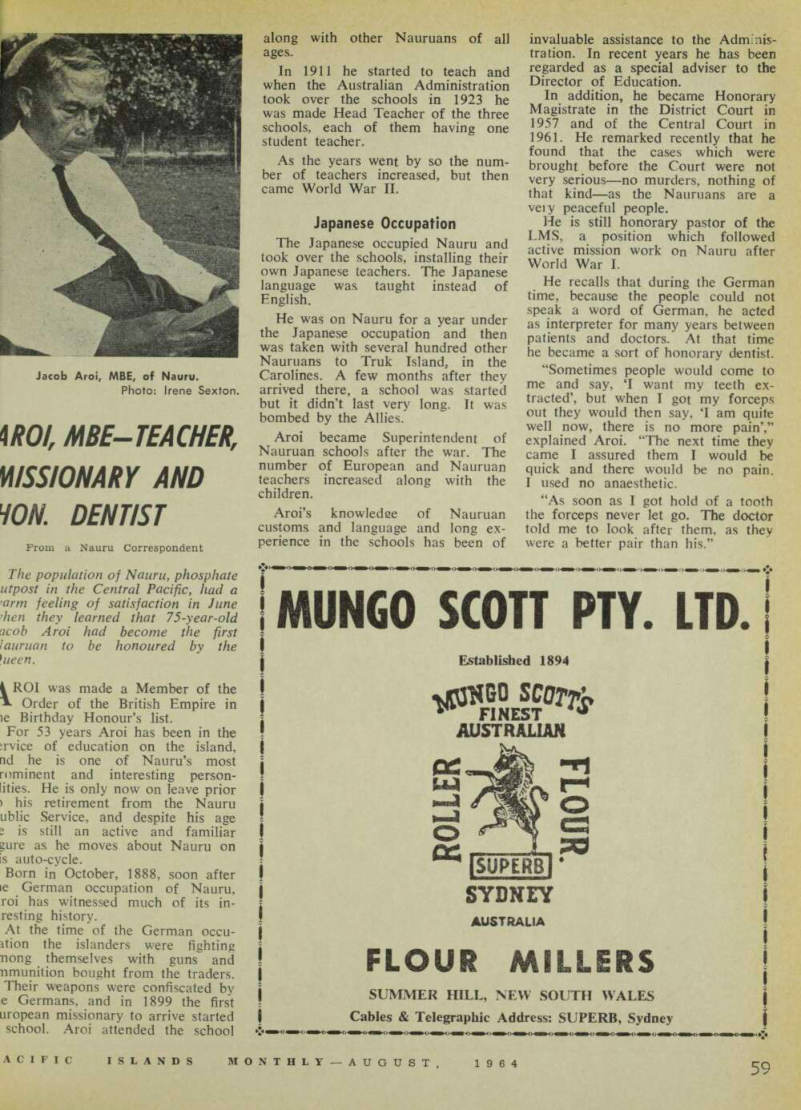
Jacob Aroi, MBE, of Nauru.
Photo: Irene Sexton.