A Controversial
pp. 57-61 · Read in the full issue
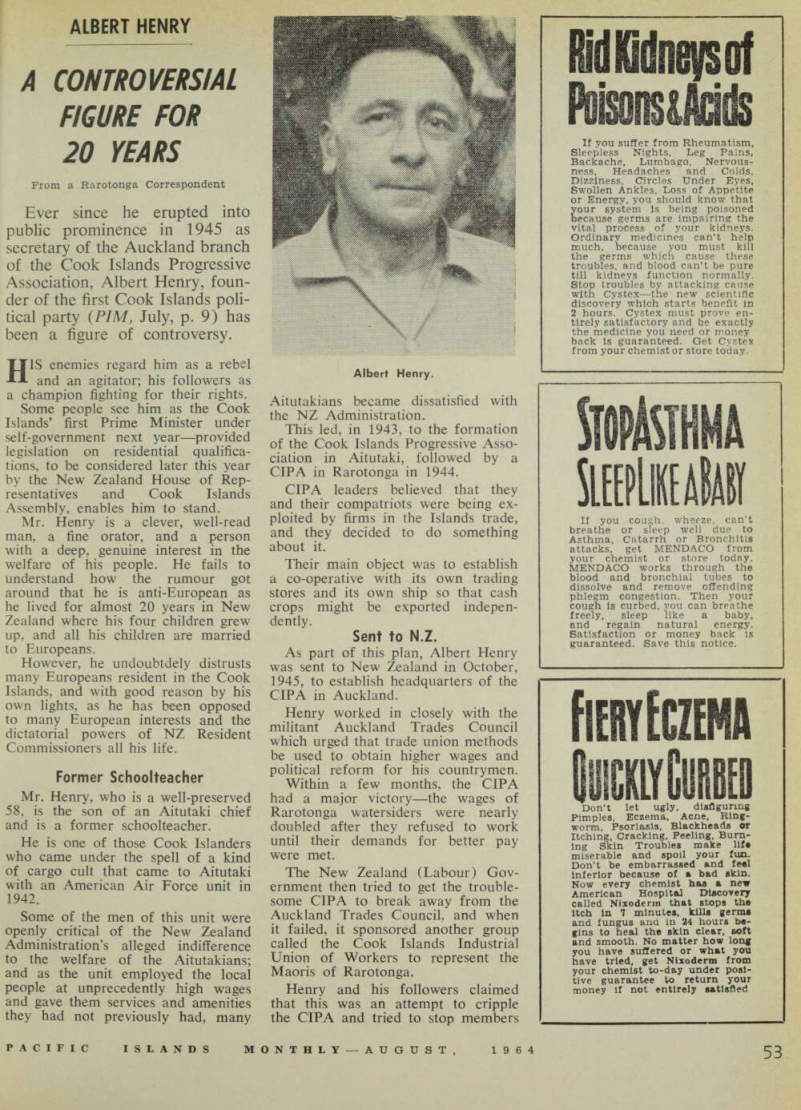
Albert Henry
Figure
20 Years
From a Rarotonga Correspondent Ever since he erupted into public prominence in 1945 as secretary of the Auckland branch of the Cook Islands Progressive
Association, Albert Henry, foun
der of the first Cook Islands poli tical party ( PIM, July, p. 9) has been a figure of controversy.
HIS enemies regard him as a rebel and an agitator; his followers as a champion fighting for their rights.
Some people see him as the Cook Islands’ first Prime Minister under self-government next year—provided legislation on residential qualifica tions, to be considered later this year by the New Zealand House of Rep resentatives and Cook Islands Assembly, enables him to stand.
Mr. Henry is a clever, well-read man, a fine orator, and a person with a deep, genuine interest in the welfare of his people. He fails to understand how the rumour got around that he is anti-European as he lived for almost 20 years in New Zealand where his four children grew up, and all his children are married to Europeans.
However, he undoubtdely distrusts many Europeans resident in the Cook Islands, and with good reason by his own lights, as he has been opposed to many European interests and the dictatorial powers of NZ Resident Commissioners all his life.
Former Schoolteacher Mr. Henry, who is a well-preserved 58, is the son of an Aitutaki chief and is a former schoolteacher.
He is one of those Cook Islanders who came under the spell of a kind of cargo cult that came to Aitutaki with an American Air Force unit in 1942.
Some of the men of this unit were openly critical of the New Zealand Administration’s alleged indifference to the welfare of the Aitutakians; and as the unit employed the local people at unprecedently high wages and gave them services and amenities they had not previously had, many
Aitutakians became dissatisfied with the NZ Administration.
This led, in 1943, to the formation of the Cook Islands Progressive Asso ciation in Aitutaki, followed by a CIPA in Rarotonga in 1944.
CIPA leaders believed that they and their compatriots were being ex ploited by firms in the Islands trade, and they decided to do something about it.
Their main object was to establish a co-operative with its own trading stores and its own ship so that cash crops might be exported indepen dently.
Sent to N.Z.
As part of this plan, Albert Henry was sent to New Zealand in October, 1945, to establish headquarters of the CIPA in Auckland.
Henry worked in closely with the militant Auckland Trades Council which urged that trade union methods be used to obtain higher wages and political reform for his countrymen.
Within a few months, the CIPA had a major victory—the wages of Rarotonga watersiders were nearly doubled after they refused to work until their demands for better pay were met.
The New Zealand (Labour) Gov ernment then tried to get the trouble some CIPA to break away from the Auckland Trades Council, and when it failed, it sponsored another group called the Cook Islands Industrial Union of Workers to represent the Maoris of Rarotonga.
Henry and his followers claimed that this was an attempt to cripple the CIPA and tried to stop members
Albert Henry.
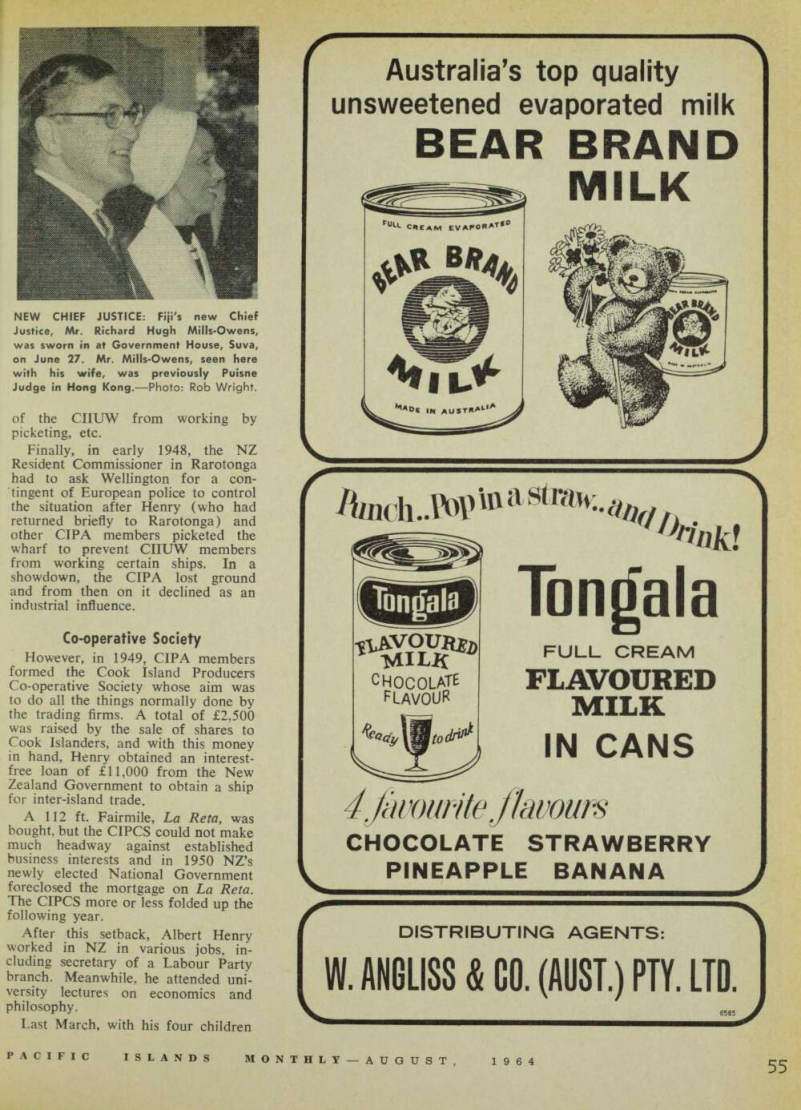
NEW CHIEF JUSTICE: Fiji's new Chief Justice, A Ar. Richard Hugh Mills-Owens, was sworn in at Government House, Suva, on June 27. Mr. Mills-Owens, seen here with his wife, was previously Puisne Judge in Hong Kong.— Photo: Rob Wright. of the CIIUW from working by picketing, etc.
Finally, in early 1948, the NZ Resident Commissioner in Rarotonga had to ask Wellington for a con tingent of European police to control the situation after Henry (who had returned briefly to Rarotonga) and other CIPA members picketed the wharf to prevent CIIUW members from working certain ships. In a showdown, the CIPA lost ground and from then on it declined as an industrial influence.
Co-operative Society
However, in 1949, CIPA members formed the Cook Island Producers Co-operative Society whose aim was to do all the things normally done by the trading firms. A total of £2,500 was raised by the sale of shares to Cook Islanders, and with this money in hand, Henry obtained an interest free loan of £ll,OOO from the New Zealand Government to obtain a ship for inter-island trade.
A 112 ft. Fairmile, La Reta, was bought, but the CIPCS could not make much headway against established business interests and in 1950 NZ’s newly elected National Government foreclosed the mortgage on La Reta.
The CIPCS more or less folded up the following year.
After this setback, Albert Henry worked in NZ in various jobs, in cluding secretary of a Labour Party branch. Meanwhile, he attended uni versity lectures on economics and philosophy.
Last March, with his four children
larried and with families of their wn, Henry went back to the Cooks, r hich are due for self-government ext year.
Within 24 hours of his homecom ig ( PIM, May, p. 18), representa ves of the CIPA, CIIUW and IPCS agreed to merge into a new ssociation.
I
Polynesian Agencies
Another organisation that Mr. [enry has established is a wholesale rganisation registered in Auckland, nown as Polynesian Agencies (Cook ;lands) Limited.
This organisation has acquired usiness premises in Tutakimoa, a istrict of Rarotonga occupied mainly y landless Outer Islanders on very )w incomes. These islanders have sen invited to join the organisation y buying shares worth 4/- each, to maximum of £2O worth.
The shares permit the shareholders ) buy basic foodstuffs imported by le company, such as rice, sugar and orn beef, at landed cost plus 5 per mt.
Quite often several shareholders ub together to buy a sack of sugar r a case of meat.
At the last count, there were 458 lareholders and Mr. Henry proposed ) limit the number to 500.
His supporters say he is also lively engaged in finding New ealand markets for Cook Islands reduce, such as taro, native chest uts and tomatoes, and indications re that there is a ready market mong the 3,000 Cook Islanders,
Tongans and Niueans living in the Auckland area.
Mr. Henry says his original inten tion was to see his company success fully launched, hand over control to a board of directors to be elected by the shareholders, and return to New Zealand.
Insight Into Maori Mind But he has become increasingly in terested in local politics and now in tends to settle in Rarotonga and stand for election to the Cook Islands par liament as soon as he can.
He has given several talks (in Maori and English) at public meet
ings in Rarotonga since his return, in which he has outlined the economic history of the Cooks, pointed out what he says are the blunders of the past, and tried to show how such mistakes can be avoided in future.
He does not pretend to know the answers to every Cook Islands problem. But he has insight into the Maori mind, a natural gift for oratory and a bright desire to help the underdog. He also has a reputa tion as a rebel. These facts, plus his personal history of struggle, have given him local mana second to no ne.