Much Ado About UN Expert's
pp. 49-55 · Read in the full issue



The Month In Western Samoa
Much Ado About UN Expert's Bombshell On Education
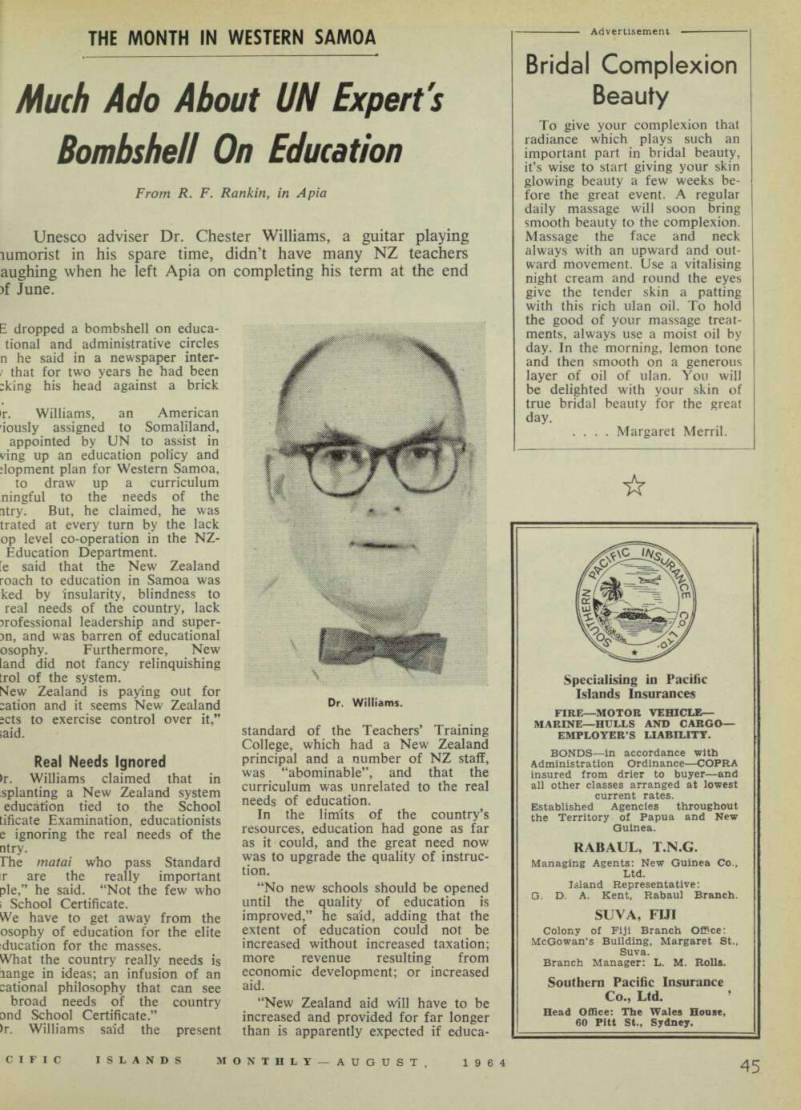
From R. F. Rankin, in Apia Unesco adviser Dr. Chester Williams, a guitar playing lumorist in his spare time, didn’t have many NZ teachers aughing when he left Apia on completing his term at the end >f June.
E dropped a bombshell on educa tional and administrative circles n he said in a newspaper inter f that for two years he had been :king his head against a brick ir. Williams, an American iously assigned to Somaliland, appointed by UN to assist in ving up an education policy and dopment plan for Western Samoa, to draw up a curriculum ningful to the needs of the itry. But, he claimed, he was trated at every turn by the lack op level co-operation in the NZ- Education Department. [e said that the New Zealand roach to education in Samoa was ked by insularity, blindness to real needs of the country, lack ?rofessional leadership and super m, and was barren of educational osophy. Furthermore, New land did not fancy relinquishing trol of the system.
Mew Zealand is paying out for nation and it seems New Zealand ;cts to exercise control over it,” ;aid.
Real Needs ignored >r. Williams claimed that in splanting a New Zealand system education tied to the School tificate Examination, educationists e ignoring the real needs of the ntry.
The matai who pass Standard ir are the really important pie,” he said. “Not the few who ; School Certificate.
We have to get away from the osophy of education for the elite :ducation for the masses.
What the country really needs is lange in ideas; an infusion of an cational philosophy that can see broad needs of the country and School Certificate.” )r. Williams said the present
standard of the Teachers’ Training College, which had a New Zealand principal and a number of NZ staff, was “abominable”, and that the curriculum was unrelated to the real needs of education.
In the limits of the country’s resources, education had gone as far as it could, and the great need now was to upgrade the quality of instruc tion.
“No new schools should be opened until the quality of education is improved,” he said, adding that the extent of education could not be increased without increased taxation; more revenue resulting from economic development; or increased aid.
“New Zealand aid will have to be increased and provided for far longer than is apparently expected if educa-
Dr. Williams.
,n is to be substantially improved,” said. , “This place is both a paradise and hell. The people have more leisure an almost any place in the world, it what do they do with it?
“They are often mere vegetables.
“Until this enormous waste of iman potential is utilised—until the eative ability of the people is pression, education is sterile.
In Apia, reaction was immediate, lucation and administrative officials jre shocked, and local UN head, arry Spence, bent over backwards dissociate himself and his office am Dr. Williams’ statement.
Prime Minister Mataafa repudiated r. Williams’ criticism in a radio eech.
Others criticised Dr. Williams in e Press for being unconstructive, r not making his comments until was about to leave Samoa, and forth.
But amid the cries of outraged nocence, there were many who pported Dr. Williams.
“When you think about it, he is ad right,” said one New Zealand acher with long service in Samoa. kN July 1, Coca-Cola produced by " the American Samoan-owned Dttling Corporation of Samoa came i sale in Apia for the first time the Vaisigano store of American imoan businessman Pila Patu. The ink is produced at Tafuna under anaging director Dick Carpenter.
With free “cokes”, sun visors, mcils and rulers, Apia children wish at new drinks were introduced rery day.
WHAT with Dr. Williams blasting the education system and Public Service Commissioner Vaiao Ala’ilima shooting down the Elvins Report ( PIM, March, p. 49), the air was hot with charge and counter charge in Apia during the last week of June.
The main faults in the Elvins Re port according to the PSC and many local public servants, who were on the same side for a change, were that it gave insufficient emphasis to the Samoanisation of the public service.
“I appreciate many of the technical
suggestions made by Mr. Elvins as to departmental organisation,” said Public Service Commissioner Alailima, “but I doubt whether he was sufficiently acquainted with Samoans and their struggle for independence to suggest radical changes in conflict with the Con stitution, and the policy to Samoanise the public service as soon as possible.”
He said the Public Service Com mission did not agree with Mr. Elvins on a number of points: • The Commission did not share Mr. Elvins’ view that it would be impracticable to train Samoans for
Prime Minister Mataata.
xecutive positions until students who lad completed full secondary educa ion were available.
He said: “The Prime Minister and ight Cabinet Ministers are perform ig important executive duties though nly one or two have had a scondary education. If they were isqualified because of lack of formal ducation we would not today have n independent country”. • The Commission strongly dis pproved of Mr. Bivins’ proposal to lace the Public Service Commission nder the Secretary to the Govern lent (an overseas officer) on the round that it violated the Con itution and made the professional ork of the Commission even more isceptible to political influence. • The Commission believed Mr.
Ivins’ salary scales would consider bly increase the disparity between le salaries of local and overseas fficers and it doubted whether this ould encourage harmony, con dence, efficiency or economy in the Liblic service. • The Commission did not believe )und recommendations could be rawn up based on personal inter ews with a few selected individuals > conducted by Mr. Elvins and ;commended calling in a recognised lanagement consultant firm to do the ib. i LTHOUGH Samoa seems deter * termined to hold staunchly to its idependence and not join the Com lonwealth, Samoan politicians have pparently decided that the annual *ee trip for one of their number to le Commonwealth Parliamentary Conference is too good a chance to irn down.
In mid-June, Tuaopepe Tame was hosen to represent Samoa at this ear’s conference to be held at Kingston, Jamaica, in November. He dged out Lesa Anisi in a final ballot y 23 votes to 21. Other members ominated and eliminated by ballot 'ere Tuala Paulo, Toleafoa Talitimu, lalotutoatasi K., and Polataivao osi.
Representatives of previous years iclude G. F. D. Betham, Amoa 'ausilia, P. Plowman and Magale ite. Samoa’s parliamentary set-up nd procedure is modelled closely on British lines. jl/HAT with a recently formed and ' * flourishing film society; a well jpported if irregular public lecture rogramme; the Church College of Western Samoa’s annual operetta; le highly successful presentation in ipia by Pago students of the King nd I; a talent-filled repertory Dciety; and painting displays in the
Library, the arts and cultures in Apia seem in no danger of being neglected.
The high standard of local talent was once more illustrated by players of the Apia Repertory Society in their production of the two-act play, The Reluctant Debutante at the end of June.
The cast of Rosaleen Smyth, Meredyth Tunick, Michael Watt, Peter Creevey, Jennifer Neal, Louise Thieme, Laurie Harding, and Liselotte Thieme gave a remarkably good per formance under the direction of Max Stevenson, The Samoa College auditorium was packed for both nights of the per formance and audience response was very enthusiastic.
THE face of Apia is starting to change so rapidly and there are so many strangers in town that old residents may soon be wondering just where they are!
The £70,000 Ellicot cutter suction dredge with its 16 in. discharge had its first trial run at the end of June.
Within a day a small island appeared in the Bay built from sand, mud and coral dredged from the jetty basin.
This was some indication of the speed with which the eight acres be hind the new wharf site at Matautu, and the 30 acres in front of the town between Beach Road and the harbour reef will be reclaimed.
Work on the wharf site started
arly in July and was expected to be ampleted within 45 days.
As the dredge was having its trials, :abinet approved in principle a public orks town planning scheme incor orating the new land.
The scheme provides for a con oiled tidal canal sweeping right irough the back of Apia, a swim ling pool and sports area on the re laimed town front, and of all things, new airport only about two miles om the centre of town.
Using the dredge, a dream from rerman times will be fulfilled. The vamp and wide, shallow Vaiusu Bay ist to the west of Apia are to be to make an ideal airport nd probably a large central sports rea on which the South Pacific rames will one day be held.
With harbour dredging expected to e completed within 18 months, it is lanned to start reclaiming the Vaiusu ay area in 1966.
If the growing friction between re Lands and Survey Office and the üblic Works Department over who responsible for town planning can e settled soon, Apia promises to be re garden city of the Pacific within nother four or five years.
PICNICKERS and sportsmen had every right to complain about re weather in Apia in June. The iinfall for the month has been ex uded only three times in the last 0 years.
Meteorologist Vern Andrew re orted that rainfall for June this year )talled 10.26 inches, almost double le average of 5.21 inches.
Higher figures were recorded in 950 with 11.37 inches; 1947 with 1.88 and 1945 with the all-time high f 13.44 inches.
Rainfall for the first six months of the year totalled 70.12 inches, not much above the average for the period, which is 65.06 inches.
FOLLOWING an investigation into Western Samoa’s banana in dustry, which, according to new Minister of Agriculture Laufili Time is in a “serious condition”, the local Department of Agriculture has announced a number of staffing changes. Emphasis has been laid on increased extension work and a banana research programme.
A new position of Agricultural Officer—Research has been filled by former scholarship and Lincoln College student Tavita Leupolu. He will be in overall charge of depart mental research and Nafanua Station and will immediately implement a comprehensive banana research pro gramme.
Seventeen extension officers have been posted to districts to explain to growers the new policy aimed at increased production and to survey plantations to arrive at the fixed quota system soon to be introduced.
Laufili Time, Minister of Agriculture.