Puzzles
p. 114 · Read in the full issue
Coin From Wreck Puzzles Numismatists
By Robert Langdon
A gold coin, which Vila skin diver Reece Discombe recovered at Vanikoro in December, 1962, from the wreck of La Rerouse's
ship “Boussole”, has mystified
numismatists in Sydney and London. The “Boussole” and La Perouse's other ship “Astrolabe" were wrecked at Vanikoro after
leaving Botany Bay, NSW, in
March, 1788.
WHEN recovered from the seabed, the coin was embedded in coral and only a fraction of it—about the size of a fingernail paring—was visible. It is not in good condition.
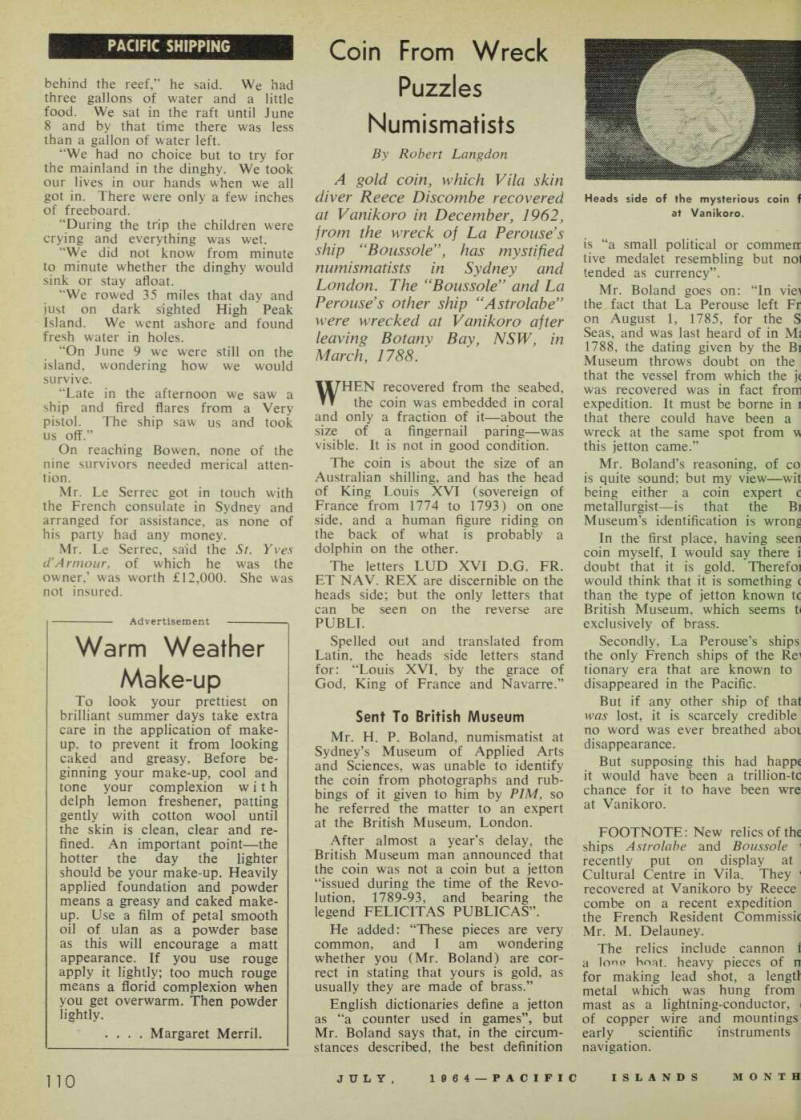
The coin is about the size of an Australian shilling, and has the head of King Louis XVI (sovereign of France from 1774 to 1793) on one side, and a human figure riding on the back of what is probably a dolphin on the other.
The letters LUD XVI D.G. FR.
ET NAV. REX are discernible on the heads side; but the only letters that can be seen on the reverse are
Publi.
Spelled out and translated from Latin, the heads side letters stand for: “Louis XVI, by the grace of God, King of France and Navarre.”
Sent To British Museum Mr. H. P. Boland, numismatist at Sydney’s Museum of Applied Arts and Sciences, was unable to identify the coin from photographs and rub bings of it given to him by PIM, so he referred the matter to an expert at the British Museum, London.
After almost a year’s delay, the British Museum man announced that the coin was not a coin but a jetton “issued during the time of the Revo lution, 1789-93, and bearing the
Legend Felicitas Publicas”.
He added: “These pieces are very common, and I am wondering whether you (Mr. Boland) are cor rect in stating that yours is gold, as usually they are made of brass.”
English dictionaries define a jetton as “a counter used in games”, but Mr. Boland says that, in the circum stances described, the best definition
is “a small political or commeir tive medalet resembling but nol tended as currency”.
Mr. Boland goes on: “In vie) the fact that La Perouse left Fr on August 1, 1785, for the S Seas, and was last heard of in M; 1788, the dating given by the Bi Museum throws doubt on the that the vessel from which the j( was recovered was in fact from expedition. It must be borne in i that there could have been a wreck at the same spot from w this jetton came.”
Mr. Boland’s reasoning, of co is quite sound; but my view—wit being either a coin expert c metallurgist—is that the Bi Museum’s identification is wrong In the first place, having seen coin myself, I would say there i doubt that it is gold. Thereto] would think that it is something c than the type of jetton known tc British Museum, which seems t< exclusively of brass.
Secondly, La Perouse’s ships the only French ships of the tionary era that are known to disappeared in the Pacific.
But if any other ship of that was lost, it is scarcely credible no word was ever breathed aboi disappearance.
But supposing this had happe it would have been a trillion-tc chance for it to have been wre at Vanikoro.
FOOTNOTE: New relics of the ships Astrolabe and Boussole 1 recently put on display at Cultural Centre in Vila. They 1 recovered at Vanikoro by Reece combe on a recent expedition the French Resident Commissic Mr. M. Delauney.
The relics include cannon i a lons boat. heavy pieces of n for making lead shot, a lengtl metal which was hung from mast as a lightning-conductor, i of copper wire and mountings early scientific instruments navigation.
Heads side of the mysterious coin f at Vanikoro.