Cruising Yachts
pp. 109-114 · Read in the full issue

• Flying Cloud, 65 Ft
American staysail schooner, which we last mentioned in these pages after she arrived in Sydney in April, 1963, is now on her way to Portuguese Timor and Indonesia.
Flying Cloud is owned and skippered by Charles Daniels, who has sent us news of his latest wanderings in a note from Thursday Island.
Says Mr. Charles; “From Sydney we went to Brisbane, called into Mackay, then cruised the Barrier Reef where we bumped into Vic.
Meyer and Solo. Then we went on to Townsville, Cairns, Cooktown, Portland Roads and Thursday Island.
“From Brisbane to Cairns the crew was: Mary Pietsch, of Portland, Oregon; Trevor Griffith and Rose mary Ransom, of Auckland; Helen Walters, of Sydney; and Keith Marshall, of Surfers Paradise, who left in Townsville.
“In Cairns, we lost Rosemary and gained another male crew member,
Holmes, of Sydney, who owns Cimba. At Thursday Island, we Bill and took on Chris and Gary -bes.”
The frip so far has been fai* ither, good sailing and no trouble, hope it will continued.”
I SARABANDE, 45 ft converted ster boat, skippered by Charles Trill, was found by HMNZS yalist and towed into Whangarei, , on June 9 after drifting for six s miles off the coast without fuel I with her radio out of action. abande, en route from England, i in Tahiti, Bora Bora and Raro ga in May. > NEOPHYTE, 45 ft ketch led and skippered by Lee Quinn, ed from Nukualofa, Tonga, at the of May for New Zealand, nn, who is noted for his partiality all-girl crews, was disappointed : the New Zealand Government ild not allow him to take three igan girls to New Zealand as v. )n leaving Tonga, the only other nber of his crew was Miss bara Stodt, 27, an advertising ywriter for the Chicago Tribune. ee other women crew members, ) sailed with Quinn from Hono i, signed off in Moorea some time ’he three Tongan girls whom nn wished to take to New Zealand Fane Lavulo, 21, Mau Mou, 23, li Maumu also 23. All the girls reported to have obtained their snts’ permission for the voyage, des that of Tonga’s Premier, ice Tungi. But the New Zealand
Government refused Quinn per mission to bring them to New Zealand even though he offered to put up a bond for each girl and guaranteed that they would be out of New Zealand within two months.
According to the New Zealand Herald, Quinn hoped to reach New Zealand between June 6 and June 10 to meet his wife who was flying from California with her three children. ( Late News: The ketch reached Auckland on June 14.) Quinn’s wife, formerly Mrs.
Bernice Berkson, was a member of his crew when Neophyte left San Francisco for Honolulu in December, 1962. The pair were married in
Honolulu last March after Quinn’s first wife, Mary, divorced him in San Jose, California, in February.
Soon after the ceremony, Quinn sailed for Tahiti via Johnson Island, the Marquesas and Tuamotus. He went on to Rarotonga and Nukualofa after touching at Bora Bora.
According to another NZ Press report, Quinn was “ordered to leave” the Cook Islands for attempting to sign on female replacements in Raro tonga for the three girls who left Neophyte in Moorea.
Quinn is reported to have said that a man went aboard Neophyte to conduct a “safety survey” of the
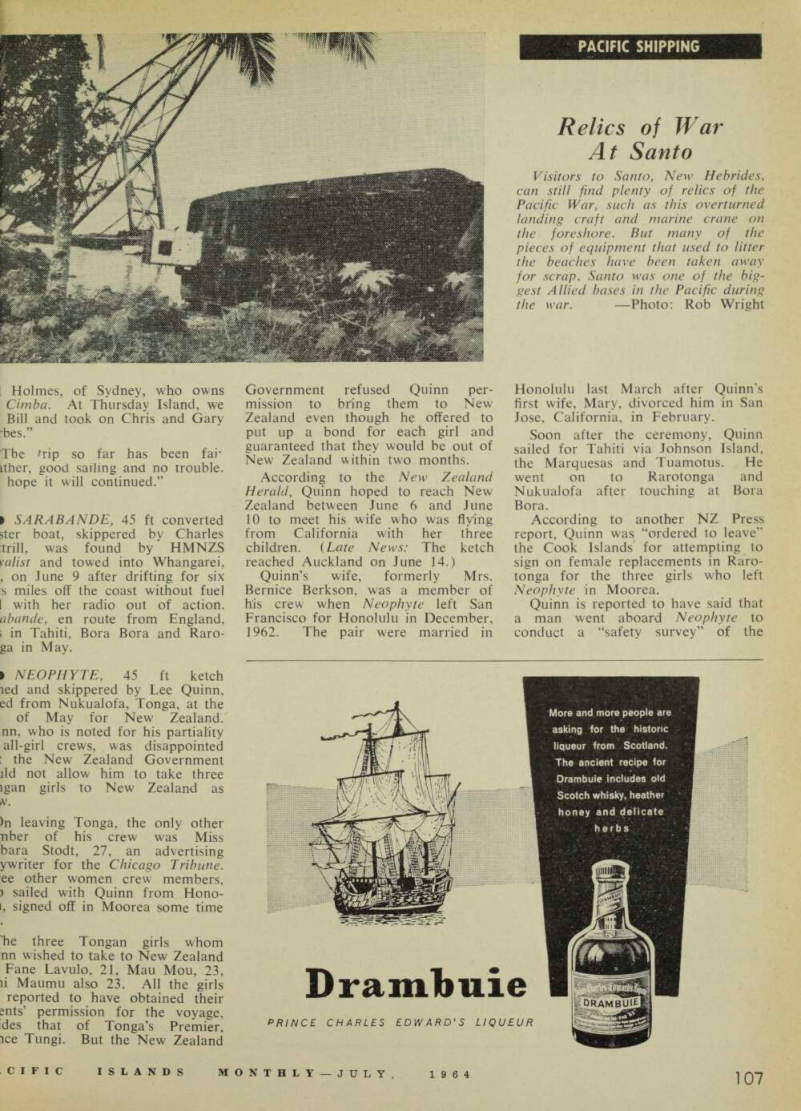
Relics of War
At Santo
Visitors to Santo, New Hebrides, can still find plenty of relics of the Pacific War, such as this overturned landing craft and marine crane on the foreshore. But many of the pieces of equipment that used to litter the beaches have been taken away for scrap. Santo was one of the big gest Allied bases in the Pacific during the war. —Photo: Rob Wright
ssel, but seemed mainly interested [ where the girls were to sleep relation to himself.
Quinn added that he intended to ke on the whole Cook Islands rritorial Government” over the itter. • SAINT BRIAC, 39 ft. ketch, led from Tahiti for New Caledonia June 4 after spending a year and days in Tahitian waters. En route New Caledonia, the ketch intended call at Raiatea, Tahaa, Borabora, i, Samoa and the New Hebrides.
Saint Briac, which is registered in nnes, left France in January, 1960, a voyage round the world which expected to take nine years. Be e reaching Tahiti, the ketch spent r ear in the Antilles.
Hie ketch’s crew of four includes ■nadette and Tidier Depret, and tin Courteville, a journalist and itographer who arrived in Tahiti eral months ago in the yacht rope.
I CYTHERA, the 50 ft steel led Sydney yacht, which was very ch in the news last year after ig stolen at Lord Howe Island the beginning of a round-the- Id cruise, will probably he head into the Pacific again before long. ! yacht belongs to Mr. Peter iton and his wife Pat.
Irs. Fenton told us in a recent s that a court case which is ding over last year’s episode has n set down for the end of this r, he added: “We just hope that we soon sail away once more, back he islands, and see just what we nded to see the first time”.
\ St. Yves D’Armour, 70
Tench yacht, was wrecked on the at Barrier Reef near Pine Island the night of June 4. (Pine nd is about 40 miles off the ensland coast between Rock ipton and Mackay). he nine people on board, includ three young childen, were rescued days later after they had spent e and a half days on a raft, a in a dinghy, and a day on a en, uninhabited island, he nine people are Robert Le ec, 36; his wife, Raymonde, 34; r children, Annaich, 7, Gwenole, nd Yves, 2; Robert Gordon, 42, his wife, Joan; Sydney Forrester; Hank de Jong, 21. [r. and Mrs. Gordon, Mr. For :r and Mr. de Jong are all from ley. They were planning to leave yacht at North Australian ports.
The Le Serrec family was on a cruise around the world which began at Etel, Brittany, in 1960. The two youngest children were born during the voyage—Gwenole at Casablanca, and Yves at Nassau. Both were taken to sea only a few weeks after their birth.
The St. Yves d’Armour visited Suva last November, and arrived in Sydney in January after calling at New Caledonia. She was wrecked while heading for the northern tip
0 f Australia en route to Indonesia, South Africa, the Azores and home, The nine people from the yacht were brought to Bowen in the coastal trading vessel Mittagong.
Mr. Le Serrec told the Press that the yacht began to break up in heavy weather soon after hitting the reef.
“We all got down on to a life raft and took shelter in a lagoon
behind the reef,” he said. We had three gallons of water and a little food. We sat in the raft until June 8 and by that time there was less than a gallon of water left.
“We had no choice but to try for the mainland in the dinghy. We took our lives in our hands when we all got in. There were only a few inches of freeboard.
“During the trip the children were crying and everything was wet, “We did not know from minute to minute whether the dinghy would sink or stay afloat.
“We rowed 35 miles that day and just on dark sighted High Peak Island. We went ashore and found fresh water in holes.
“On June 9 we were still on the island, wondering how we would survive.
“Late in the afternoon we saw a ship and fired flares from a Very pistol. The ship saw us and took us off.”
On reaching Bowen, none of the nine survivors needed merical atten tion.
Mr. Le Serrec got in touch with the French consulate in Sydney and arranged for assistance, as none of his party had any money.
Mr. Le Serrec, said the St. Yves d’Armour, of which he was the owner,’ was worth £12,000. She was not insured.