Crocodile Poaching In Wild, Wi
pp. 94-95 · Read in the full issue
West New Guinea
Anyone with regrets for the good old Islands days she lament no more. They still live—at least in Gunther Behnemai New Guinea Crocodile Poacher, which reads like fiction tho Gunther says it’s fact.
THE last time we met Gunther was in 7 Deserted Rommel, in which he described how, after serving with the German Army in Poland and Norway, he became a dispatch rider attached to the Afrika Korps. Some time in 1941, he deserted, was picked up by the British and sent as a POW to Australia. At some later stage he became a legitimate New Australian.
For some reason best known to himself, when Gunther decided to shoot crocodiles, sometime in the 1950’5, he went to the Digoel River of West New Guinea, and for the purpose of his book it is just as well that he did. If he had followed the more orthodox course and gone to the Fly River of Papua very few of the exciting adventures he writes about could have happened—the New Guinea administration would have seen to that.
He didn’t feel that he would get permission from the Dutch to go into the vast swamps that extend for miles behind the mouth of the Digoel and provide a home for thousands of crocodiles, but he decided to go
anyway and that is where Poa fits in to the title.
Although we are all for a hi red-blooded adventure ourselv especially in a book— we must that, judging from Gunther’s sequent actions when he got into swamp, the Dutch knew would tainly have been right in refu entry. We’ve been under the imj sion for years that the punitive pedition went out about the s time as hansom-cabs.
Gunther began his adventures sneaking into the estuary of the River without the formality of g< through the adjacent port of er Daru. The reason for this is not exa clear except that it provides at sphere, but the purpose of the
POPULAR: Two New Gu books, published just before Ch mas, recently went into second pi ings. They are New Guinea: The j Unknown, by Gavin Souter (Ai and Robertson Ltd., Sydney); Patrol into Yesterday, by Keith Carthy (Cheshire, Melbourne).
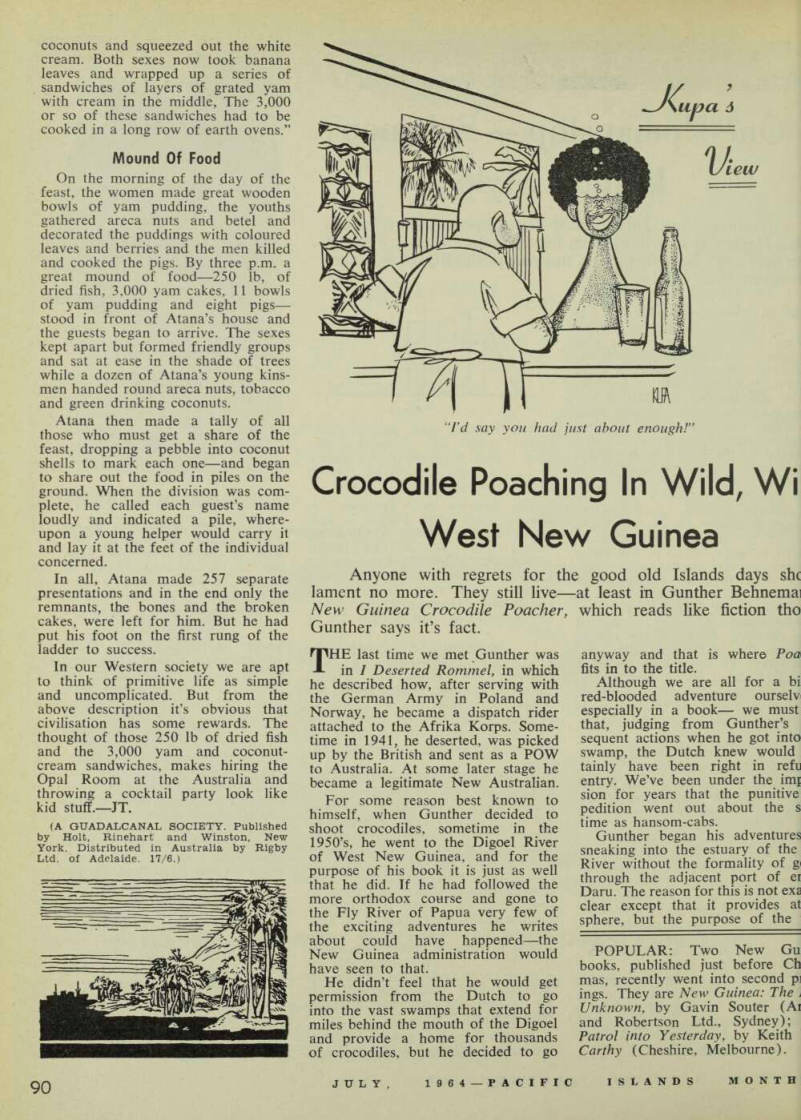
“I’d say you had just about enough!”
I to call upon a friend called Tom ensen who had a coconut plantation long the shores of the estuary.
Because the coconut plantations on le Fly estuary can be counted on bout half a hand, we can guess that bm is either a figment of the Titer’s lively imagination or not est pleased by this appearance in rint.
Among the decorative pieces in bm’s household was a native girl, are from the waist up, whose breasts seemed to lift with invita on.”
“Phew,” said Gunther, “how in ;11 can you stand up to that, Tom?”
“Doesn’t bother me,” said Tom, [ don’t stand up to it. I take it lying awn. We’re in the tropics, after all. o cinema, no pub, no dances and, )ove all, no white women, just icsquitoes and coconuts . . .”
Pitched Battle In the finale of Gunther’s story he id his crocodile-hunters have a tched battle with hundreds of reaming headhunters from the igoel swamps in which the crocodile inters use automatic weapons, shot ins, .303’s and a home-made izooka that fires dynamite bombs flatten the savages and fire their aus Tambaran.
Having dealt out death and struction all round, the party then tricates itself only to run foul of a atch patrol vessel anchored in the outh of the river.
This presents little trouble, however, le of Gunther’s divers goes over >ard and ties up the Dutch ship’s opellers with a wire rope and Jnther shoots out its searchlight th a well-directed burst from a annlicher gun which he had had the rsight to install somewhere on his m vessel.
After all, as Gunther put it, “the ject of our visit had simply been mmercial. If the Dutch Government >uld not, or could not, protect or en allow expeditions such as ours o those swamps, we felt we had protect outselves, and we had done ’5 With wild men like Gunther hnemann about no wonder the itch were glad to give West New linea to the Indonesians in 1962.
IT.
Ew Guinea Crocodile Poacher,
blished by Jarrolds. 26/-.)