One-Upmanship Solomon
pp. 93-94 · Read in the full issue
The Month S New Reading
One-Upmanship Solomon Islands Style
Although just published, A Guadalcanal Society by Dr. lan Hogbin, is something of an historical document as it relates to field work he undertook in this part of the British Solomons between 1927 and 1945.
BEFORE the war, Guadalcanal was f of little importance to anyone isides the 15,000 Melanesians who red there and Lever’s Pacific Planta >ns Pty Ltd. which worked large eas of coconuts.
The war changed all this. It im ortalised the name Guadalcanal, pecially with Americans; it pro iced Honiara, which previously did ►t exist, as the capital of the BSIP; id it brought a great many of its ople into head-on contact with the ith century. >r. Hogbin worked mainly amongst language group on the north-east ast of the island, about 50 miles st of Honiara, which is still fairly dated as the coastal road stops ort about 30 miles west of there, oreover, there are many places in iiadalcanal, in spite of its plunge :o the modern world, where customs ve changed as little in the last 30 ars as they did in the 300 years fore that. To this extent, his small ok is undated and it provides, as ill, an excellent background from lich present white Honiarians might 5W the current indigenous popula- Well Known Dr. Hogbin, while not yet exactly the sere and yellow, is well known a couple of generations of an •opology students at Sydney Univer y; he has done a great deal of itinguished field work in the Solo ms and in New Guinea; has itten a number of books and in merable papers; and, in the last years, has had practically every thropological honour heaped upon n. At present he is developing a w side-line. He’s one of the lec •ers in the ABC’s television series, liversity of the Air.
Dr. Hogbin is an incisive speaker d he writes with the same economy words. The present book is signed for students and others with interest in but no technical know- Ige of sociology.
It is therefore quite painless to tb 2 general reader and, although it con cerns a small Solomon Islands society, serves as basic instruction in the Melanesian background.
This becomes more interesting to readers today when people in such places as Papua-New Guinea are being pushed further and further away from their old ways into a 1964 type of Western democracy with common rolls, adult franchise, self government - too-soon-rather-than-too late and all the political frills that go with it.
It is interesting to compare the procedure necessary for a New Guinean to become an elected member of the P-NG House of Assembly with Hogbin’s description of how Atana, in a small village on the Guadalcanal coast, set about the first steps to becoming a village head man.
As the author explains, to become a headman in a Melanesian village society depends on esteem only and not on hereditary right. Ambition to become such a leader usually manifests itself in a man’s thirties, and pro bably takes another 10 years to accomplish. First, he must possess certain basic attributes—he must be industrious, a good organiser, a positive character, tactful and a good speaker. From there on, up to the top, it is a matter of one-upmanship, the ability to provide hospitality on a more lavish scale than anyone else with the only wealth recognised in the village society—vegetable sup plies and pigs.
Atana’s opening gambit was to announce that he would build a
house larger and finer than was customary for which it was necessary to enlist the aid of many others.
When the house was built, prepara tions for the feast to celebrate it were begun.
For 10 mornings Atana and his kinsmen went out fishing and each day on their return they smoked the catch over a pit until they had 250 lb of dried fish. Meanwhile, Atana’s wife had organised the women of the group and between them they gathered five tons of yams.
Dr. Hogbin goes on: “Atana now announced that the feast would take place in four days’ time. He and his wife’s working parties spent the first day collecting firewood and coconuts.
The men brought in logs, the women bundles of sticks, the youths strings of ripe coconuts . . . Next morning all worked together chopping the logs and piling the pieces into tidy stacks alongside the ovens.
“Finally, on the third day, they occupied themselves making yam cakes. The women peeled the tubers and grated the raw flesh while the men grated the meat of some of the
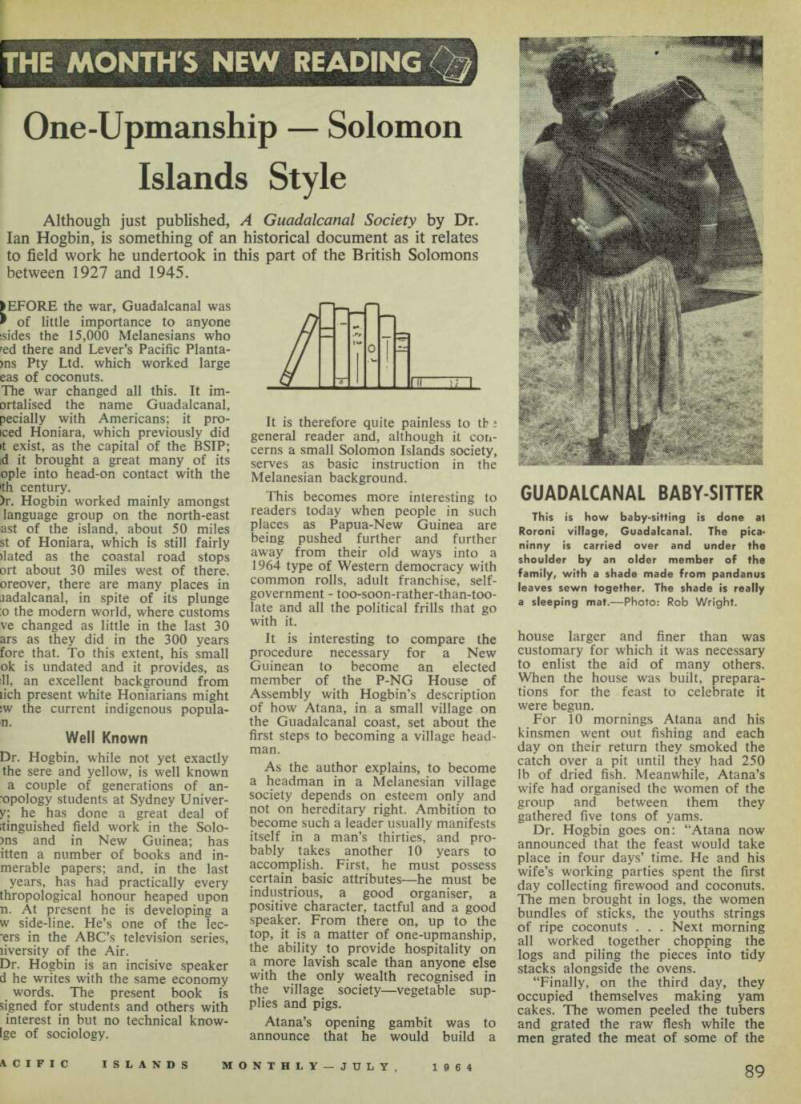
Guadalcanal Baby-Sitter
This is how baby-sitting is done at Roroni village, Guadalcanal. The pica ninny is carried over and under the shoulder by an older member of the family, with a shade made from pandanus leaves sewn together. The shade is really a sleeping mat.—Photo: Rob Wright.
coconuts and squeezed out the white cream. Both sexes now took banana leaves and wrapped up a series of sandwiches of layers of grated yam with cream in the middle, The 3,000 or so of these sandwiches had to be cooked in a long row of earth ovens.”
Mound Of Food On the morning of the day of the feast, the women made great wooden bowls of yam pudding, the youths gathered areca nuts and betel and decorated the puddings with coloured leaves and berries and the men killed and cooked the pigs. By three p.m. a great mound of food—2so lb, of dried fish, 3,000 yam cakes, 11 bowls of yam pudding and eight pigs— stood in front of Atana’s house and the guests began to arrive. The sexes kept apart but formed friendly groups and sat at ease in the shade of trees while a dozen of Atana’s young kins men handed round areca nuts, tobacco and green drinking coconuts.
Atana then made a tally of all those who must get a share of the feast, dropping a pebble into coconut shells to mark each one—and began to share out the food in piles on the ground. When the division was com plete, he called each guest’s name loudly and indicated a pile, where upon a young helper would carry it and lay it at the feet of the individual concerned.
In all, Atana made 257 separate presentations and in the end only the remnants, the bones and the broken cakes, were left for him. But he had put his foot on the first rung of the ladder to success.
In our Western society we are apt to think of primitive life as simple and uncomplicated. But from the above description it’s obvious that civilisation has some rewards. The thought of those 250 lb of dried fish and the 3,000 yam and coconut cream sandwiches, makes hiring the Opal Room at the Australia and throwing a cocktail party look like kid stuff.—JT.
(A Guadalcanal Society. Published
by Holt, Rinehart and Winston, New York. Distributed in Australia by Rigby Ltd. of Adelaide. 17/6.)