Best Of The Bunch
pp. 51-52 · Read in the full issue
First Undersecretaries Are
It is unlikely that Papua-New Guinea could have done any better in selecting its first 10 native Parliamentary Under secretaries. All are intelligent men , most are personalities and none can definitely be said to be a “Government man”.
HHE fact that all speak some Eng- L lish and most speak excellent nglish might or might not have fluenced their choice, but it will irtainly help them in their new jobs -which are worth £1,300 a year to em plus £350 living allowance.
For that they will be expected to end about three-quarters of the year Administration headquarters in )rt Moresby, or travelling on Ad inistration business.
They will go home about once a onth —according to the Adminis ition. But, in fact, the Under cretaries probably have minds of eir own and just how long they 11 spend in Port Moresby will be teresting to see. A number are nscious that they have to keep their jetors “on side”.
At this stage, the Under-Secretaries y they don’t exactly know what they II be required to do, and the truth that the Administration doesn’t actly know either—although it has better idea than they have of what wants them to do.
May Read Files It wants them to understudy de rtmental heads, to see how they idle their departments and to sit on policy decisions. They may read : files, but they have taken an oath t to use any official information a way damaging to the Govern nt. If they want to vote against Government, they have to give tice.
Dne of their main tasks will be to as a connecting link between Gov ment policy and the electors. They 1 be expected to explain to the ks back home just why the Gov ment is doing what it is doing.
Fhe Administration has authority appoint up to 15 Under-Secretaries, it doesn’t plan to announce any ther names this year. It will see t how this experiment works out. all goes well, it plans to let them wer questions in the House next ir. s robably progress of the 10 will
depend greatly on the relationship they have with their departmental heads. Not all the heads are exactly enthusiastic about their new under studies, and there will no doubt be as much education required on the Euro pean side as on the side of the learners. But given even half a chance, the system should work as successfully in New Guinea as it has in Western Samoa and is currently working in the Cook Islands.
Of the 10, only three can be said to be reasonably well known to Terri torians—John Guise, Simogun Pita and Nicholas Brokam. All have served in previous Legislative Councils. who will assist the Assist ant Administrator for Economic Affairs, was elected in 1961 but had little to say during the life of that council. He represents New Ireland.
He’s about 30, has two children, is a former mission school teacher and co-operative storeman, but is cur rently a farmer. He has visited Aus tralia.
John Guise is probably the best known of any. .He was born in 1914, represents Milne Bay, which he won on the primary count, and has several times been overseas. He attended the Queen’s Coronation in 1953 with part of the contingent of the Papua-New Guinea Constabulary, with whom he was a sergeant-major..
He was in Pago in 1962 for the South Pacific Conference and in the
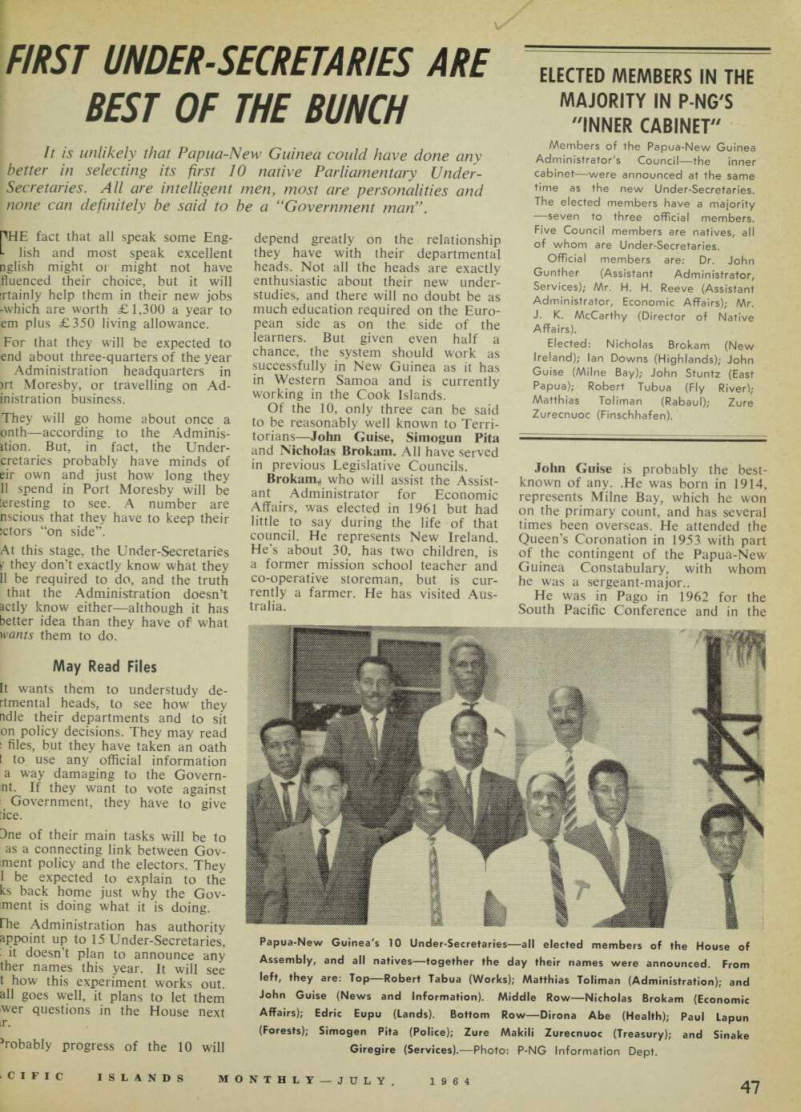
Papua-New Guinea's 10 Under-Secretaries—all elected members of the House of Assembly, and ail natives—together the day their names were announced. From left, they are: Top—Robert Tabua (Works); Matthias Toliman (Administration); and John Guise (News and Information). Middle Row—Nicholas Brokam (Economic Affairs); Edric Eupu (Lands). Bottom Row—Dirona Abe (Health); Paul Lapun (Forests); Simogen Pita (Police); Zure Makili Zurecnuoc (Treasury); and Sinake Giregire (Services). —Photo: P-NG Information Dept.
same year was in New York for the UN meeting. He was a signals corporal with ANGAU during the war.
John Guise is a prominent layman of the Anglican Church and has several times represented the Church in overseas visits. He has eight chil dren.
He will be Under-Secretary for In formation and Extension Services—a job he should well be able to do. He is an excellent English speaker (he speaks six languages) and is a fervent nationalist. He is part-European.
Simogen Pita, of Wewak Aitape, who was born about 1900, is another former police sergeant. He is Under secretary for Police. Simogen has had no formal education and still pre fers to speak Pidgin although he can understand English and in fact speaks it not badly when encouraged.
He won fame and a BEM with the Coastwatchers in New Guinea during the war, and until 1961, when he failed to win election, he was an appointed member of Legco. He could always be counted on to say some thing with humour and common
sense. He has several times visited Australia. He has eight children.
Dirona Abe, from Rigo-Abau elec torate, is Under-Secretary for Health.
About 37, he was educated at LMS schools and taught at Kwato Mission for some time. He spent two years at the Sydney Teachers’ College. He has a block of land under the Land Settlement Scheme and is a member of the Central District Advisory Council. He has six children. Those who know him well say he is an ex cellent, sound man.
Matthias Toliman, representing Rabaul, is the new Under-Secretary for the Administrator’s Department.
Aged about 38, and an excellent speaker of English, he comes from a family of school teachers and was a teacher himself until becoming In spector for Catholic Schools in his area. His four brothers are school teachers and so is his wife.
Toliman was elected despite a policy speech in which he attacked Tolais for being jealous of Chinese and European homes and cars. He said that Tolais ought to honour land contracts, even if the land had orig inally changed hands for a few toma hawks, “as that was a fair price at the time”.
Those who felt that Europe ought to be thrown off their 1j merely wanted something for nothi Toliman is deservedly proud of family background. He has ne previously been out of Rabaul ! hopes his new job will give hin chance to travel. He has four c dren.
Robert Tabua, Fly River, is anot member of a well-known nai family. About 44, and with se children, he was LMS-educated, a before the war, was an Adminis tion clerk. He served with the A tralians in the war as wire operator and after the war 1 appointed Postmaster at Dam. has been a member of the West District Advisory Council since IS He has some Fijian ancestry. Tal is Under-Secretary for Works.
Edric Eupu, Under-Secretary Lands, is from Popondetta, where is a soldier settler with a well veloped cocoa plantation at Sangi He is president of the Popond Ex-servicemen’s Association and member of the Northern District > visory Council. Born in 1922, he mission-educated, was with Papuan Infantry Battalion during war, and an Administration cl afterwards. He has a reputation having a mind of his own. He visited Australia.
Zure Makili Zurecnuoc, of Fins hafen, a store-owner and sch( teacher for a long time, is about He is Under-Secretary for Treasury. He comes from a w known local family—his father be first ordained pastor in the Luthe Mission in Morobe.
He is probably the most eloqu of the native members of the Hoi and by all accounts should turn to be one of the most able. He visited Australia and was at the P; conference in 1962. He has th children.
Sinake Giregire, of Goroka, Under-Secretary for the Assists Administrator (Services). About he has a big coffee plantation s market garden, a carrier business s trade store. He is director of Highlands Commodity Exchange i president of the Asaro Native Lc Government Council. He has < child.
Paul Lapuu, of Bougainville, about 40 and lives in Buin. He, t is a former Catholic schoolteac with long experience. He is now fai ing. He was once a seminarian the Roman Catholic Church. He visited Australia. Lapun is promin in his area and a sound man. He four children. He is Under-Secret for Forests,