New P-Ng Assembly Won't
pp. 46-49 · Read in the full issue
Be A Tame-Cat Affair
From Stuart Inder, in Port Moresby Those of us who felt that Papua-New Guinea’s brand-new 64-member House of Assembly would most likely be tame-cat or European-dominated for the first 12 months are going to have to eat our words.
AT the end of the inaugural session on June 16 it looked like being neither. The Hon. Members—the majority of them natives of the place —have treated fascinated and sur prised Territorians to such bursts of oratory mixed with sound common sense that even hardened sceptics have been asking themselves whether.
perhaps, they haven’t been under estimating a lot of people.
It’s certainly no parliament yet.
But one thing seems clear: With only a few exceptions the Territory’s one million electors knew who they were electing. As a starter for what is to follow in the next four years in the life of this House, who could ask for more?
The new House, with its 10 Gov ernment members and 54 elected members (38 of them natives) was opened by the Governor-General, Lord De LTsle, on June 8. The open ing ceremony, and the pomp and circumstance which followed into the next day, are best forgotten.
Opening Ceremony Mess-Up
The thing was a messy mish-mash, a trial to all those who had to take part, and a disappointment to the thousands who missed it because of a muck-up over holidays.
The Hon. Members, confused or resentful at being shepherded like puppy dogs to this place or that to act as a convenient backdrop to the occasion, were obviously relieved when the visitors roared off back to Australia and let them get on with the business they had been waiting for.
The House of Assembly met with the shadow of Sogeri hanging over it.
Sogeri, in the ranges above Port Moresby, had been the scene of a seminar arranged only a few weeks before to give the new members some training in the mysteries of parlia mentary procedure.
It had been a success, especially in the eyes of many European mem bers who came away with the im pression that there was good native material which could be worked into useful, active groups in the House.
Among a number of things cided at the seminar was that fort District Commissioner “Horrie” N would be chosen for the import new post of Speaker on the nomi tion of Simogen Pita, seconded John Guise.
This, it was felt, would show world that the native people (pi European John Guise regards himi as one) wanted a European in chair.
Unfortunately, when the time ca for nominations, planter Don Barr an old-hand at the Legislative Co cil until his defeat some years a got to his feet and did the hono for Mr. Niall, leaving John Guise do the seconding and Simogen to
perplexed.
The result was the same, of coui and Mr. Niall thus ends a dis guished career with the Adminis! tion by taking unopposed, the higl post in the Territory’s first legi; ture with an elected majority.
But lots of members were furi with Mr. Barrett and accused 1 of limelighting for the benefit of newsreel and Press cameras t jammed the House for the occasi Mr. Barrett was indignant in turn and retorted that he hat been at the Sogeri seminar and t nobody had bothered to tell / about the arrangements.
Within a day or two it beca apparent that Mr. Barrett wai necessarily going to be a party to
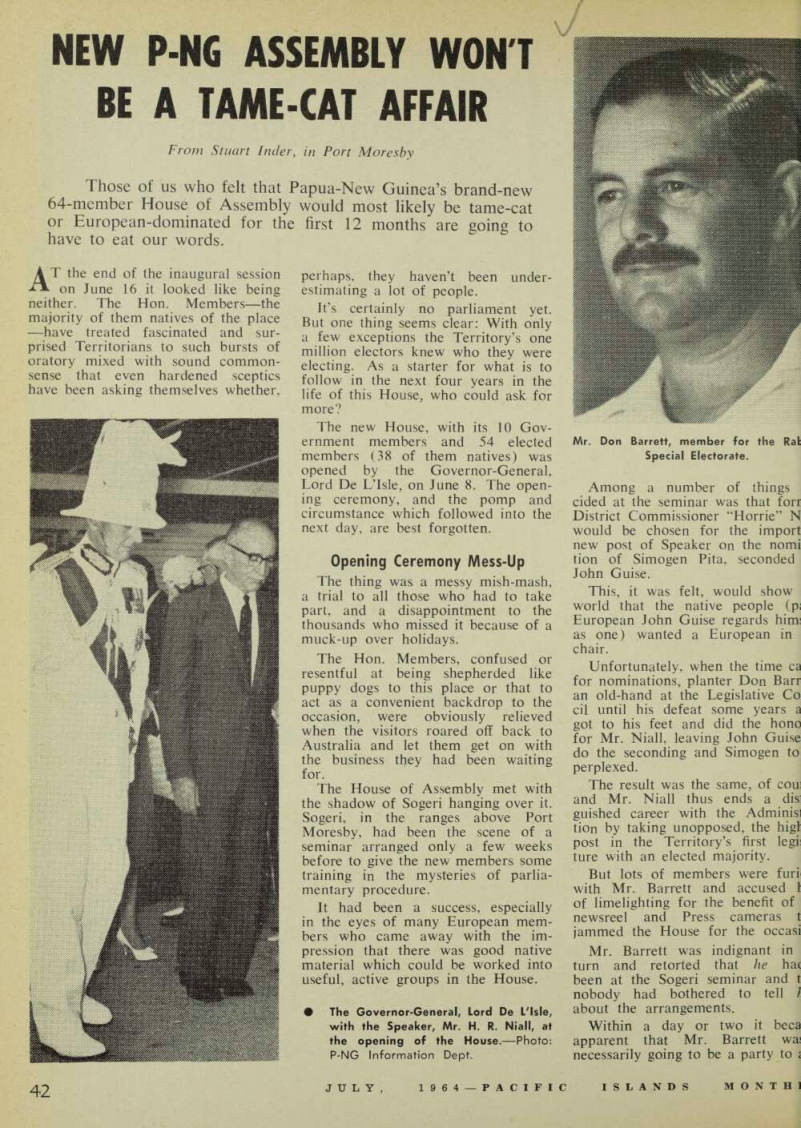
The Governor-General, Lord De L'lsle, with the Speaker, Mr. H. R. Niall, at the opening of the House. — Photo: P-NG Information Dept.
Mr. Don Barrett, member for the Rat Special Electorate.
jecial arrangements with anybody, md he wasn’t the only one.
The sense of togetherness which )me people felt had begun to de slop in Sogeri was dissipated now by le physical impossibility of getting )gether for private talks 54 elected lembers spread in accommodation ght around the town.
Messrs. lan Downs and John tuntz, both old Legco hands and oted The-Most-Likely-to-Succeed at siting some battle order into the nwieldy unofficial forces, did their sst but found it an unequal task.
They ended by ferreting out a umber of apparently kindred spirits and a number of others who looked ke being out of sympathy), but nee there were lost souls in other arts of the House making exactly le same discoveries in their own ailiwicks, it was a fragmented aciety at the end of the session.
Generally speaking, men with the ime geographic interest seemed to link they might have common cause, ad after the first one or two formal ays this was even reflected in the :ating arrangements.
Many Europeans appeared to be tting within striking distance of ien elected from nearby areas. This, )me said, was so they could help lem if they needed it.
Motives Suspect
But motives of some of them were aspect to a number of the native lembers, who had no intention of ;ceiving European patronage. There as no anti-European feeling in this; )me of those I spoke to made it iear with directness and shrewdness lat they intended to select in their wn good time their own running lates, white, brown or brindle.
If there was any semblance of or anisation anywhere in the House, ien it was on the Government enches. Government Leader Dr. ahn Gunther, a shrewd tactician 'ho is impressive in his efficiency, uickly concentrated on culling out ae likely Government supporters,
and by the end of the session he seemed to have what one elected member admitted might be the rudi ments of a “Government Party”.
Ready-made Opposition
At this stage it had occurred to one or two of the more astute tacticians on the opposite side of the House that if Dr. Gunther continued to enlist Government supporters then what was left would obviously be a ready-made Opposition.
The keystone of Dr. Gunther’s “party” is his panel of Under secretaries—whose names were an nounced on the first day of the sitting.
Under the Ordinance the Govern ment may appoint 15 of them (of any race), but it chose to select 10 and it is most unlikely that any more names will be added until there is a better clue as to how the experiment will work out. All are native. (See p. 47.) There were some minor murmur ings that the Europeans had a share in Government too, and that at least one European should have been selected. But this is a pointless sug gestion as the system is obviously de signed as a training ground for an emerging Government.
Unlike the recently announced Fiji system of “membership”, the New Guinea Under-Secretaries do not have to abide by “Cabinet” decisions or else get out.
They will be allowed to put up an opposition view in the House so long as they first give notice to the Ad ministration.
That’s the theory of it, anyhow, but there are clearly lots of ifs and hopes in the whole arrangement, and like the House itself, only time will tell.
The Address-in-Reply allowed the
House to get off early with debates on all manner of subjects. So wide was the field that native members who might not ordinarily have been expected to have had a say on purely machinery bills were en couraged to get on their feet and catch Mr. Speaker’s eye.
Most of them spoke like old hands —as indeed most of them are. The New Guinea Highlands areas particu larly are noted for turning out orators. As in Polynesia, no man is a true leader unless he can put his views forthrightly and hold his audience with verbal gymnastics, and there were plenty of both in the House.
Arm-Waving
There was plenty of arm-waving, table thumping and playing to the gallery, and the fact that the speech was going over in Pidgin made no difference. The best gallery was, after all, the House itself with its Pidgin speaking majority.
Several European members spoke only in Pidgin and let the simul taneous interpreters dish it out in English, haltingly, into the earphones at the Government benches, most of whose occupants aren’t speakers.
Former policeman John Guise made his first address in Police Motu.
Speaker Horne Niall, who started off on the first day tentatively, almost nervously, soon settled down and within a couple of days was revealing the iron hand in the velvet glove by making a clear ruling that the official languages in the House were to be English, Motu and Pidgin, and that anyone who didn’t know any of these had better learn one quickly.
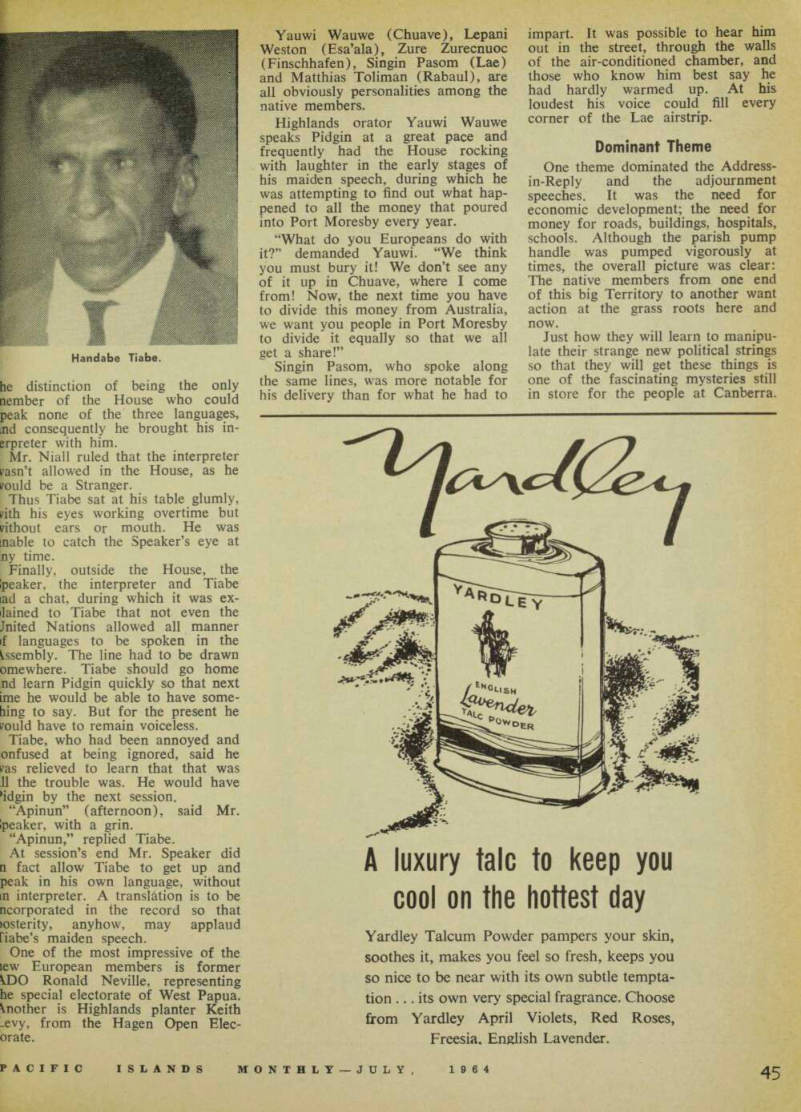
The ruling arose as a result of the presence in the House of Handabe Tiabe, elected from the backwoods of Tari, in the Highlands. Tiabe had
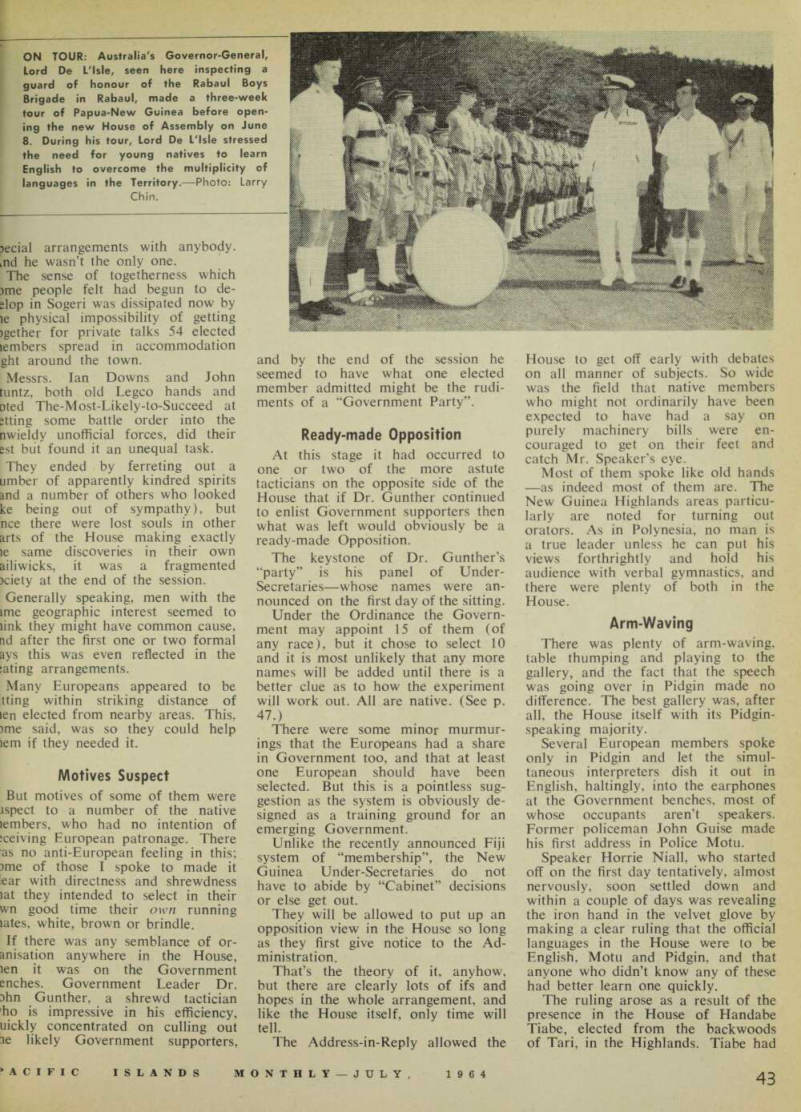
ON TOUR: Australia's Governor-General, Lord De L'lsle, seen here inspecting a guard of honour of the Rabaul Boys Brigade in Rabaul, made a three-week tour of Papua-New Guinea before open ing the new House of Assembly on June 8. During his tour, Lord De L'lsle stressed the need for young natives to learn English to overcome the multiplicity of languages in the Territory.—Photo: Larry Chin.
he distinction of being the only nember of the House who could peak none of the three languages, nd consequently he brought his in erpreter with him.
Mr. Niall ruled that the interpreter wasn’t allowed in the House, as he yould be a Stranger.
Thus Tiabe sat at his table glumly, rith his eyes working overtime but without ears or mouth. He was mable to catch the Speaker’s eye at ny time.
Finally, outside the House, the ipeaker. the interpreter and Tiabe lad a chat, during which it was ex ilained to Tiabe that not even the Jnited Nations allowed all manner if languages to be spoken in the Assembly. The line had to be drawn omewhere. Tiabe should go home nd learn Pidgin quickly so that next ime he would be able to have some ting to say. But for the present he should have to remain voiceless.
Tiabe, who had been annoyed and onfused at being ignored, said he yas relieved to learn that that was 11 the trouble was. He would have •idgin by the next session.
“Apinun” (afternoon), said Mr. ipeaker, with a grin.
“Apinun,” replied Tiabe.
At session’s end Mr. Speaker did n fact allow Tiabe to get up and peak in his own language, without in interpreter, A translation is to be ncorporated in the record so that icsterity, anyhow, may applaud fiabe’s maiden speech.
One of the most impressive of the lew European members is former UDO Ronald Neville, representing he special electorate of West Papua.
Another is Highlands planter Keith evy, from the Hagen Open Elec orate.
Yauwi Wauwe (Chuave), Lepani Weston (Esa’ala), Zure Zurecnuoc (Finschhafen), Singin Pasom (Lae) and Matthias Toliman (Rabaul), are all obviously personalities among the native members.
Highlands orator Yauwi Wauwe speaks Pidgin at a great pace and frequently had the House rocking with laughter in the early stages of his maiden speech, during which he was attempting to find out what hap pened to all the money that poured into Port Moresby every year.
“What do you Europeans do with it?” demanded Yauwi. “We think you must bury it! We don’t see any of it up in Chuave, where I come from! Now, the next time you have to divide this money from Australia, we want you people in Port Moresby to divide it equally so that we all get a share!”
Singin Pasom, who spoke along the same lines, was more notable for his delivery than for what he had to
impart. It was possible to hear him out in the street, through the walls of the air-conditioned chamber, and those who know him best say he had hardly warmed up. At his loudest his voice could fill every corner of the Lae airstrip.
Dominant Theme One theme dominated the Address in-Reply and the adjournment speeches. It was the need for economic development; the need for money for roads, buildings, hospitals, schools. Although the parish pump handle was pumped vigorously at times, the overall picture was clear: The native members from one end of this big Territory to another want action at the grass roots here and now.
Just how they will learn to manipu late their strange new political strings so that they will get these things is one of the fascinating mysteries still in store for the people at Canberra.
Handabe Tiabe.