Fiji's Shopping Tourists
pp. 18-19 · Read in the full issue
Don't Care For Scenery
WHEN the P and O-Orient liner Oriana arrived at Suva on Tuesday, June 16, it rained—but not the stuff the people of Fiji have dubbed “liquid sunshine”.
It rained pennies from heaven, thousands of them, in the biggest tourists’ spending spree ever to gladden the hearts of the city’s shop keepers. More normal tourist attrac tions were neglected, however, and this has become the pattern of Fiji tourism.
The Oriana brought 1,800 Aus tralians who were on an 11-day South Pacific Islands cruise. They were just what Suva shopkeepers have been waiting for, cruises being some what sparse of late, and everyone in Fiji knows that nobody spends like the Australians.
The New Zealanders are ham strung with their currency regula tions, and the Americans already have everything they want from other duty-free ports before they get round to thinking about the South Pacific.
But Australians! To them Fiji with its duty-free transistors, cameras, watches, binoculars, projectors and even television sets, has become the Aussies’ Mecca.
They poured off the Oriana for an overnight stay and almost cleaned out Suva’s shops.
It was, said the satisfied shop keepers, probably the best 24 hours they had ever had, and the banks echoed that because they were busy as never before channelling the golden rain.
One shopkeeper, who usually banked a few hundreds after a “ship
day”, brought in £3,000 and travelling bank on the wharf chanj more than £A6,000 into Fijian c rency in less than two hours.
One surprising thing, one sh< keeper said, was the large amount fishing gear sold and that’s not du free.
But, what was gained on roundabouts was lost on the swin The taxi proprietors and tour p moters are beginning to think t duty-free goods might not be a gc thing after all.
Fiji’s reputation for its duty-f goods is beginning to overshad its reputation from a sightseei paradise-seeking tourist’s point view. The tourists are spending their time and money in the sh( and ignoring the very attractive to and entertainment available for the Children and parents at the Fij Ratu Sir Lala Sukuna Memoi School staged an entertainment Fijian dances and songs, rehears for days to make the event someth the Australians would never for* Seats were provided for 1,00( but, alas, only 100 turned up! A this is becoming the pattern ev time a cruise ship carrying A tralians and New Zealanders cor in.
The same thing happened on smaller scale two days later vvl the Cogedar Line cruise ship Fla called in for the day on her first v
■iji- She brought only 440 passen , however; most were New Zea ers, and bad weather on the way i Australia delayed her arrival five hours. lie pattern of duty-free trade in is mirrored in the 1963 annual “ report just published. There is ntling increase in imports of the ist-type of goods compared with ■ when the “drawback” system ated. Value of imports of all Is of duty-free type imported t>een about doubled. due of radios imported at over million was more than £300,000 er than in 1962; value of photo lic apparatus—mostly cameras— from £103,961 in 1962 to ,920 in 1963. ports of watches and clocks were than three times greater at ,532; and imports of gramo es and record players increased old. tal value of all “duty-free” items rted by Fiji was £1,163,196 in compared with £462,883 in Most are taken out of the ry again by tourists and become lible exports”, because there is ncial record of their leaving the >y. far as shopkeepers’ tills are med, however, they are any but invisible.
Tongan Watson Returns
T>ACK on Tonga in June for the ■U first time since he published his best-selling account of the Tongan castaways, Minerva Reef, Sydney author Olaf Ruhen got a warm wel come. He and his wife, Madeleine, were given an enormous Tongan feast by the survivors of the Tuaikaepau, headed by Captain Tefita Fifita who had specially built a spacious fale to house his guests. Ruhen and Fifita are to go whaling together—hand harpooning from a 30 ft whale boat.
That Korolevu Church
WE said in June, under a photo graph of a beautiful little church near Fiji’s fine Korolevu Beach Hotel, that the land was given by the late Sir Hugh Ragg, and that it was a condition of the gift that the church might be used for religious purposes by all denomina tions. Well, we were wrong.
The donor of the land was not the late Sir Hugh, but Mr. W. J. Clark, Sir Hugh’s son-in-law. The gift was made without any conditions attached. Lady Ragg donated the crucifix behind the very interesting altar. The church was built by the Catholic community and others in and around the Korolevu area, under the guidance of the parish priest and has been dedicated for Catholic worship.
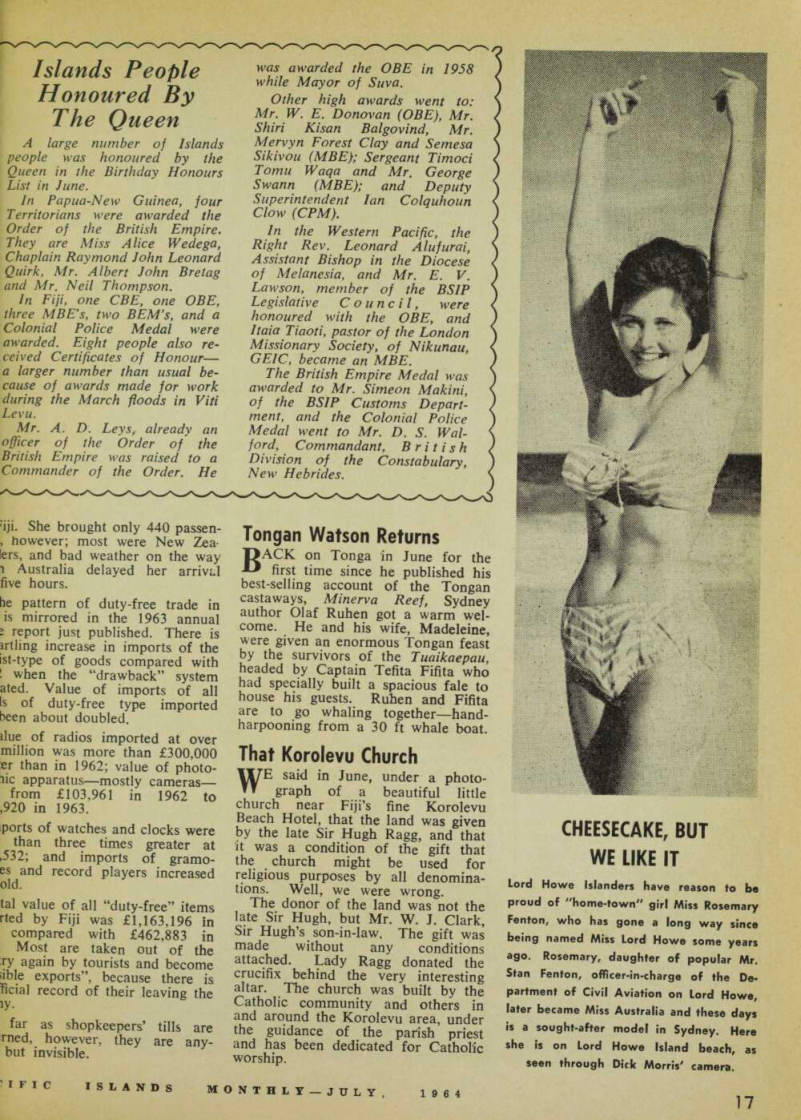
Cheesecake, But
We Like It
Lord Howe Islanders have reason to be proud of "home-town" girl Miss Rosemary Fenton, who has gone a long way since being named Miss Lord Howe some years ago. Rosemary, daughter of popular Mr.
Stan Fenton, officer-in-charge of the De partment of Civil Aviation on Lord Howe, later became Miss Australia and these days is a sought-after model in Sydney. Here she is on Lord Howe Island beach, as seen through Dick Morris' camera.