Tropicalities
pp. 17-18 · Read in the full issue
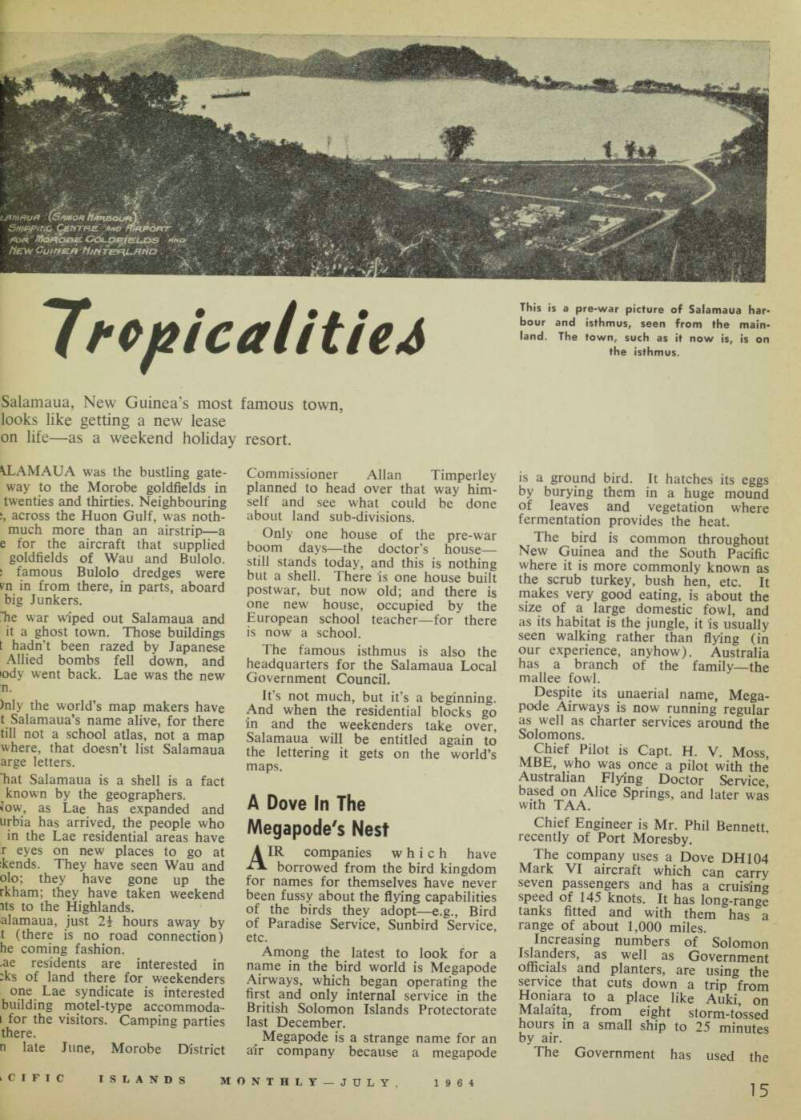
Salamaua, New Guinea’s most famous town, looks like getting a new lease on life—as a weekend holiday resort.
VLAMAUA was the bustling gate way to the Morobe goldfields in twenties and thirties. Neighbouring ;, across the Huon Gulf, was noth much more than an airstrip—a e for the aircraft that supplied goldfields of Wau and Bulolo. 5 famous Bulolo dredges were vn in from there, in parts, aboard big Junkers.
"he war wiped out Salamaua and it a ghost town. Those buildings t hadn’t been razed by Japanese Allied bombs fell down, and iody went back. Lae was the new n. )nly the world’s map makers have t Salamaua’s name alive, for there till not a school atlas, not a map where, that doesn’t list Salamaua arge letters.
'hat Salamaua is a shell is a fact known by the geographers, low, as Lae has expanded and urbia has arrived, the people who in the Lae residential areas have r eyes on new places to go at kends. They have seen Wau and olo; they have gone up the rkham; they have taken weekend its to the Highlands, alamaua, just 2i hours away by t (there is no road connection) he coming fashion. ,ae residents are interested in :ks of land there for weekenders one Lae syndicate is interested building motel-type accommoda i for the visitors. Camping parties there. n late June, Morobe District
Commissioner Allan Timperley planned to head over that way him self and see what could be done about land sub-divisions.
Only one house of the pre-war boom days—the doctor’s house— still stands today, and this is nothing but a shell. There is one house built postwar, but now old; and there is one new house, occupied by the European school teacher—for there is now a school.
The famous isthmus is also the headquarters for the Salamaua Local Government Council.
It’s not much, but it’s a beginning.
And when the residential blocks go in and the weekenders take over, Salamaua will be entitled again to the lettering it gets on the world’s maps.
A Dove In The
Megapode's Nest
AIR companies which have borrowed from the bird kingdom for names for themselves have never been fussy about the flying capabilities of the birds they adopt—e.g., Bird of Paradise Service, Sunbird Service, etc.
Among the latest to look for a name in the bird world is Megapode Airways, which began operating the first and only internal service in the British Solomon Islands Protectorate last December.
Megapode is a strange name for an air company because a megapode
is a ground bird. It hatches its eggs by burying them in a huge mound of leaves and vegetation where fermentation provides the heat.
The bird is common throughout New Guinea and the South Pacific where it is more commonly known as the scrub turkey, bush hen, etc. It makes very good eating, is about the size of a large domestic fowl, and as its habitat is the jungle, it is usually seen walking rather than flying (in our experience, anyhow). Australia has a branch of the family—the mallee fowl.
Despite its unaerial name, Mega pode Airways is now running regular as well as charter services around the Solomons.
Chief Pilot is Capt. H. V. Moss, MBE, who was once a pilot with the Australian Flying Doctor Service, based on Alice Springs, and later was with TAA.
Chief Engineer is Mr. Phil Bennett recently of Port Moresby.
The company uses a Dove DHIO4 Mark VI aircraft which can carry seven passengers and has a cruising speed of 145 knots. It has long-range tanks fitted and with them has a range of about 1,000 miles.
Increasing numbers of Solomon Islanders, as well as Government officials and planters, are using the service that cuts down a trip from Honiara to a place like Auki, on Malaita, from eight storm-tossed hours in a small ship to 25 minutes by air.
The Government has used the
This is a pre-war picture of Salamaua har bour and isthmus, seen from the main land. The town, such as it now is, is on the isthmus.
plane for medical mercy flights and a number of forestry survey flights have been carried out.
Operations are, at present, limited by the fact that apart from the two airstrips near Honiara, the Group has only four other operational strips —Munda, New Georgia; Yandina, Russell Island; Auki, Malaita; and Barakoma, Vella Lavella. A strip at Segi Point, on New Georgia, is expected to be rehabilitated; and a new strip at Kira Kira, San Cristoval, was commenced in 1963.
The airline’s future expansion naturally depends on the construction of more airstrips, and as soon as new ones are opened up they will be included in the service.
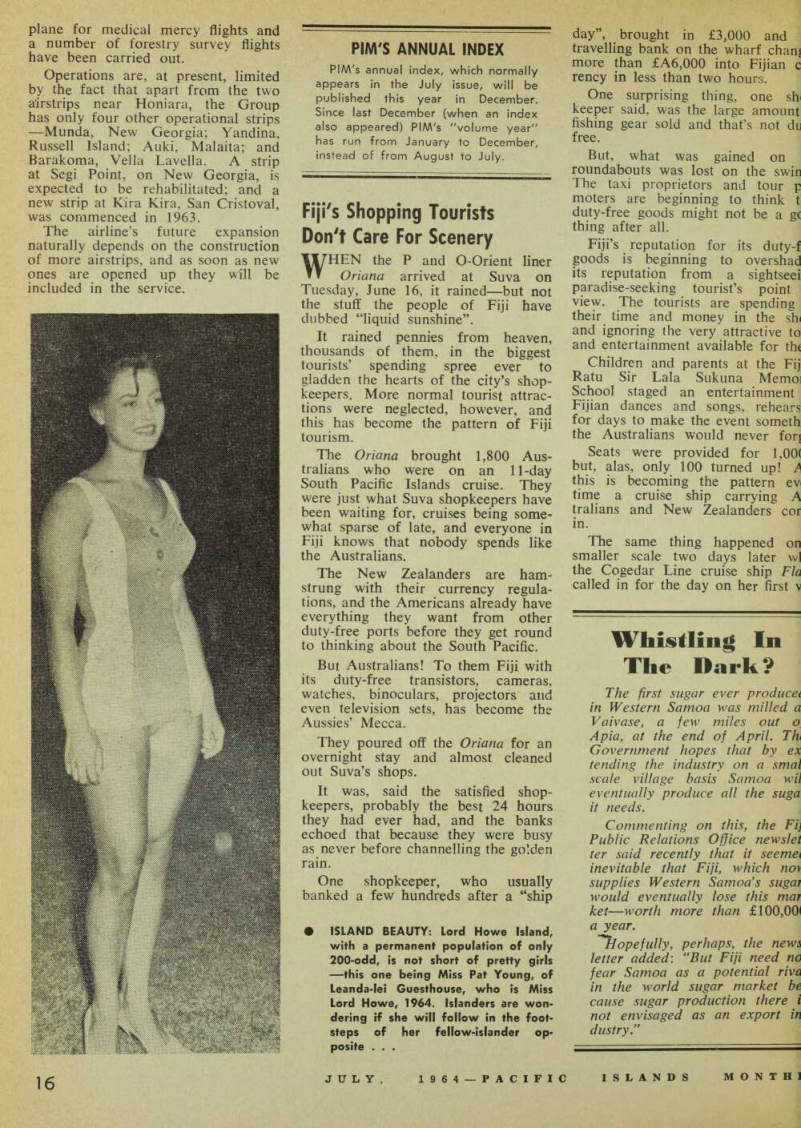
ISLAND BEAUTY: Lord Howe Island, with a permanent population of only 200-odd, is not short of pretty girls —this one being Miss Pat Young, of Leanda-lei Guesthouse, who is Miss Lord Howe, 1964. Islanders are won dering if she will follow in the foot steps of her fellow-islander op posite . . .