Fiji Takes A (Cautious) Step
pp. 12-13 · Read in the full issue
Towards Self-Government
From a Special Correspondent After years of discussion of ways in which the Government of Fiji might be changed from a British Colonial Office autocracy to a system under which representatives of the Fiji communities could be given an authoritative share in policy-making and administration, the new “Member-Minister System” has been introduced. It began to function on July 1.
IN future, the Executive Council will consist of 11 members— seven of whom, in effect, will be ministers with specific portfolios.
Three of these “ministers” are elected members of the Legislative Council, and this is the first time that such members have had portfolios allotted to them.
The old-established Legislative Council, hitherto advisory to the extent that the Governor could refuse to implement any of its acts or recommendations, was reformed in 1963. It now consists of 37 mem bers —19 ex-officio; six Europeans (four elected and two nominated); six Fijians (four elected by the Fijian people, two elected by the Council of Chiefs); and six Indians (four elected and two nominated).
Hitherto, administrative power has lain in the hands of the Governor and an Executive Council of official and non-official members, with final power in the hands of the Governor.
Under the new system, the follow ing is the structure of the Colony’s administration:
Legislative Council
Thirty-seven members, as above.
Executive Council
Member Ratu K. K. T. Mara, Minister for Natural Resources, who will have responsibility for agri culture, co-operatives, crop process ing, fisheries, forestry, geology, lands, livestock, marketing, mining and soil conservation.
Member A. D. Patel, Minister for Social Services, who will be re sponsible for cultural activities, education, health, prisons, social welfare and societies.
Member J. N. Falvey, Minister for Communications and Works, who will be responsible for civil aviation, electricity, hotels, marine, meteoro logy, postal services, roads, tele communications, tourism, transport, \yater-supplies, works. (Officially, the above three are called “Members”, but they are virtu ally acting as “Ministers”.)
The Colonial Secretary, Mr. P. D.
Macdonald, who will be responsible for ceremonial, civil service, con stitution, consular, defence, external affairs, immigration and emigration, information, labour, passports and visas, police, printing, publications and records.
The Financial Secretary, Mr. H. P.
Ritchie, who will be responsible for the Budget, commerce, industry, currency, Customs, economic plan ning, exchange control, fiscal policy, loans, statistics, stores, taxation, weights and measures.
The Attorney-General, Mr. Justin Lewis, who will be responsible for law and order, in particular criminal proceedings, civil claims, drafting of legislation and giving legal advice to all offices and departments.
The Secretary for Fijian Affairs,
Mr. A. C. Reid, who will be respo sible for Fijian affairs, housing ai local government.
These seven “Member-Ministei become, ex officio, members of t Executive Council which, with t Governor, actually is the Cabinet the Government.
There are three other “Membei on the Executive Council, selected the Governor from among the r official members of the Legislati Council, They are Mr. R. 1 Kermode (European) Ratu Pens Ganilau (Fijian) and Mr.
Madhaven (Indian). They do r rank as high as “Member-Minister
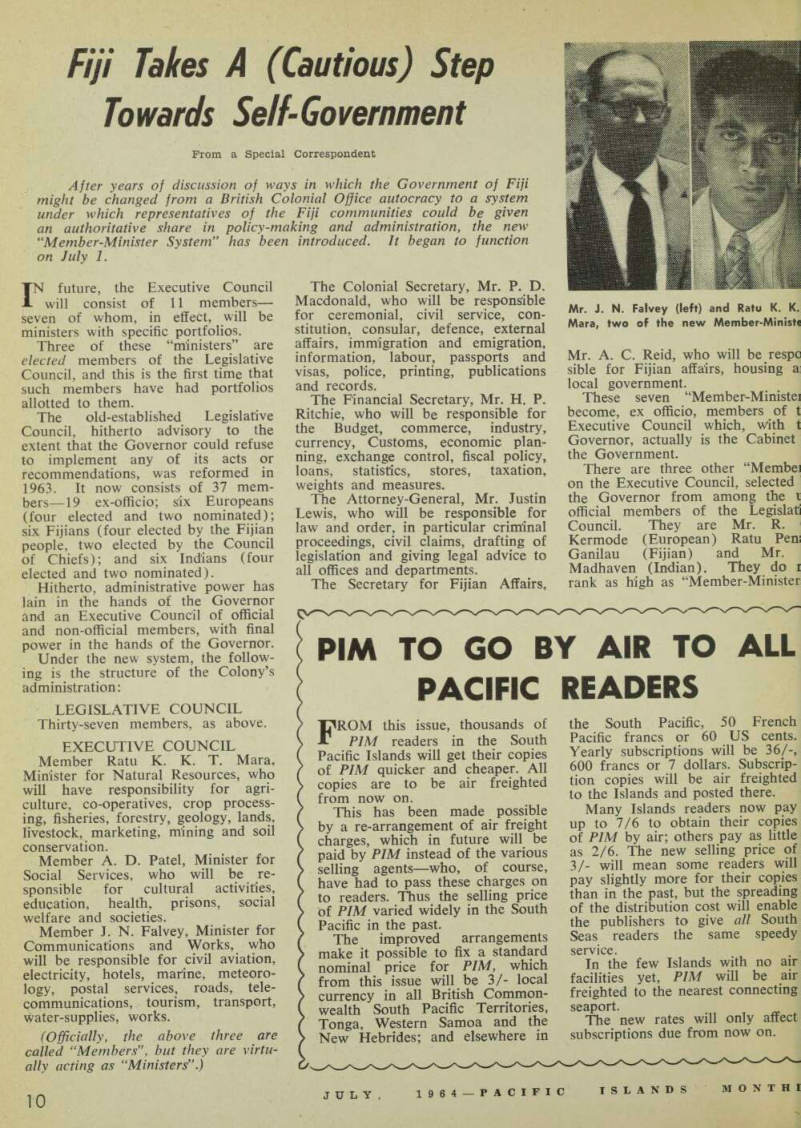
Mr. J. N. Falvey (left) and Ratu K. K.
Mara, two of the new Member-Ministe
ut they appear to have higher status lan other MLC’s.
The Development Commissioner Colonel W. B. Rogers) also is a lember of the Executive Council smporarily, until the functions of •evelopment Commissioner become lerged in those of the new Minister” for Natural Resources Ratu Mara), Mr. Patel and Ratu Mara are full tne Members, on £3,000 a year, us housing allowances of £75 a onth, plus a Legislative Council lowance of £275 a year, and trans it and subsistence allowances.
Mr. Falvey, who is now senior irtner in the legal firm of Cromp ns, is unable to devote himself full ne to his portfolio and has been cepted on a part-time basis, on :,000 a year, plus the other allow ices. He will become a full-time ember, when “reasonably practic le”. If he finds he cannot keep at undertaking, he will relinquish ice.
The three Member-Ministers will ve direct access to the Governor, le office of each will have a sec ;ary, who will be in charge of the ice. He will be the link between ; “Member-Minister” and the partments, and will be responsible • ensuring that policy decisions ; conveyed and implemented on : one hand, and that the Members : adequately advised and informed the other.
Heads of departments will retain 1 internal control of their depart nts; they will look to the Colonial :retary on all matters relating to ; civil service; to the Member nister for all functional operations; 1 to the Financial Secretary for financial matters.
No Power Of Direction fhe “Member-Ministers” will have power of direction over staff in i departments with which they are ociated, and instructions to mrtmental officers will remain the rogative of the head of depart nt. fhat does not mean, however, that Member is in no way concerned h the internal organisation and ordination of his office with de tments that may be associated with subjects. fhe Member will be required to wer to both the Executive and pslative Councils on matters affect his office and associated depart tits.
Vll members of the Exe ,utive ancil, official and non-official, will r collective responsibility for all vernment policy decisions made the Council. If any non-official
One of the big objections to the old system was the concentration of all administrative power in the hands of the top bureaucrats who, by tradition and in fact, are responsible only to the British Colonial Office.
It was thought that the new system would transfer at least some of that power from the hands of bureaucracy ■ to control by the elected representa tives.
But—as is shown by an examina tion of the detailed functions of the : “Member-Ministers” and the top officials—the bureaucrats appear to * be as firmly seated in the administra five saddle as ever, and if the new “Members” wish to unseat them in any particular, they probably will have a fight on their hands.
The other side of the picture, of course, is that Fiji, as a British Colony, enjoys considerable gifts and privileges, and so should bear cheerfully with its share of British bureaucracy.
However, the new system is in being, and functioning. Like all new structures, it probably will creak a bit—but it has to be given a trial.
There may not be much time for trial. A change of Governmental authority in Britain in October might quite soon produce a new policy for Fiji—“tell those people in Fiji to change over to self-government, and let’s get this Colony and its everlasting problems out of our hair!”, or something like that.
The world-wide tendency to throw all colonial empires into discard is not growing less.
member of Executive Council dis agrees with any policy decided in the Council to the extent that he is not prepared to bear his share of collective responsibility, then it will be for him to resign.
The system is new and untried and is expected to have many “kinks” in it. One was discovered actually before the thing functioned.
It was shown, in an official hand out, that Member-Minister Patel would be in charge of “broadcasting”.
This caused a slight panic. Broad casting is a major and a sensitive instrumentality in Fiji public rela tions; and Mr. Patel still is an un known quantity in the field of govern ment.
Until he has had a chance to demonstrate his quality, Mr. Patel Will be regarded by the Fiji public, on his long record, as politically dangerous, ... So the Government followed up the distribution of its hand-out with the urgent instruction, “Delete broadcasting”.
Bureaucracy's Powers
The Governor’s action in nominat ing Mr. Madhaven as the second Indian elected member for the Executive Council has been criticised, on the ground that Mr. Madhaven is a Patel man; and that leaves the great majority of Fiji Indians, and especially the non-Gujerati sections, unrepresented in the Executive Council.
There also has been criticism of the internal organisation of personnel connected with the “Member- Minister” system.
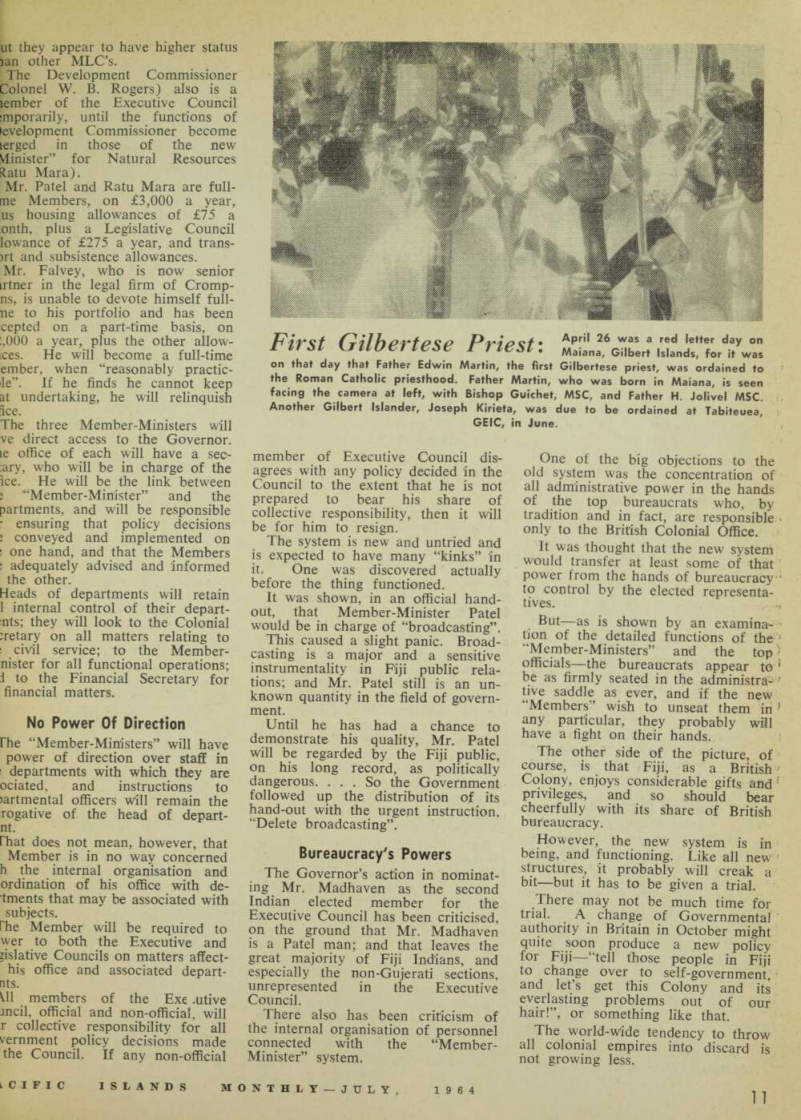
First Cilbertese Priest: Ap r il 26 was a red letter day on Maiana, Gilbert Islands, for it was on that day that Father Edwin Martin, the first Gilberlese priest, was ordained to the Roman Catholic priesthood. Father Martin, who was born in Maiana, is seen facing the camera at left, with Bishop Guichet, MSC, and Father H. Jolivel MSC.
Another Gilbert Islander, Joseph Kirieta, was due to be ordained at Tabiteuea, GEIC, in June.