High Drama In Rarotonga
p. 11 · Read in the full issue
At Formation Of First Cook Islands Political Party
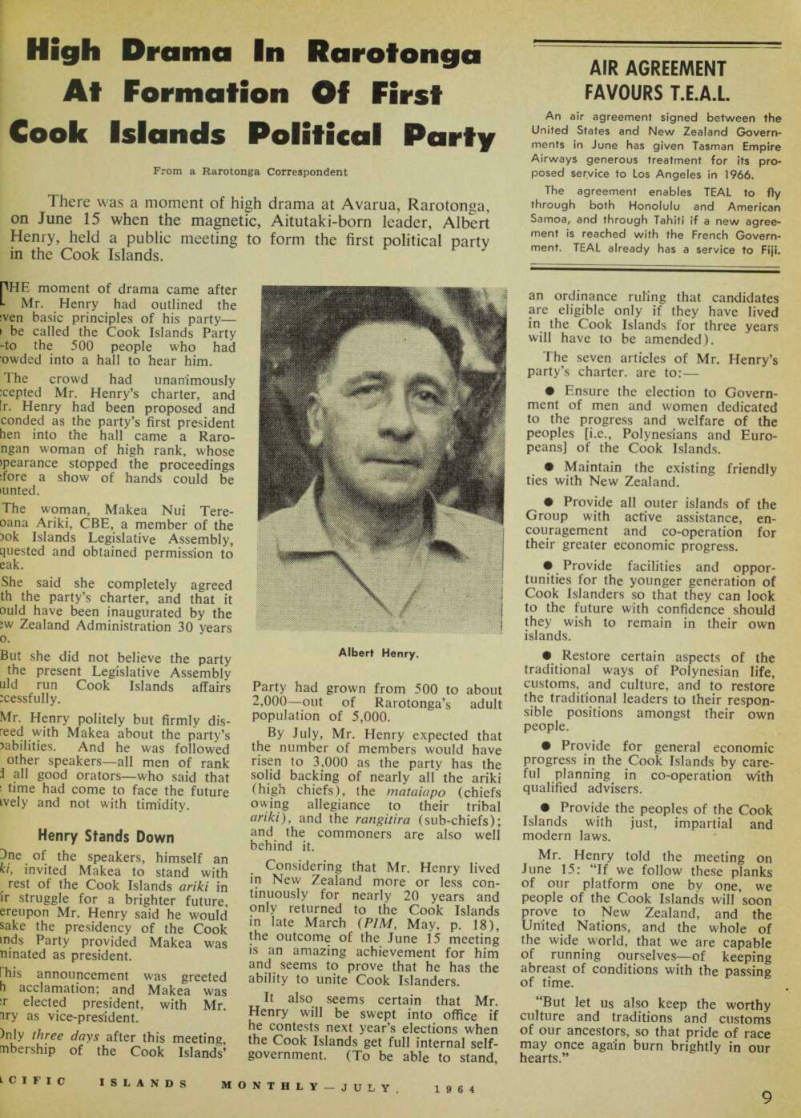
From a Rarotonga Correspondent There was a moment of high drama at Avarua, Rarotonga, on June 15 when the magnetic, Aitutaki-born leader, Albert Henry, held a public meeting to form the first political party in the Cook Islands.
HHE moment of drama came after L Mr. Henry had outlined the wen basic principles of his party— t be called the Cook Islands Party -to the 500 people who had owded into a hall to hear him.
The crowd had unanimously :cepted Mr. Henry’s charter, and tr. Henry had been proposed and conded as the party’s first president hen into the hall came a Raro ngan woman of high rank, whose ipearance stopped the proceedings :fore a show of hands could be runted.
The woman, Makea Nui Tere oana Ariki, CBE, a member of the )ok Islands Legislative Assembly, quested and obtained permission to eak.
She said she completely agreed th the party’s charter, and that it ould have been inaugurated by the ;w Zealand Administration 30 years o.
But she did not believe the party the present Legislative Assembly □ld run Cook Islands affairs :cessfully.
Mr. Henry politely but firmly dis ced with Makea about the party’s 3abilities. And he was followed other speakers—all men of rank i all good orators—who said that 1 time had come to face the future ively and not with timidity.
Henry Stands Down 3ne of the speakers, himself an ki, invited Makea to stand with rest of the Cook Islands ariki in ir struggle for a brighter future, ereupon Mr. Henry said he would sake the presidency of the Cook inds Party provided Makea was ninated as president. rhis announcement was greeted h acclamation; and Makea was :r elected president, with Mr. iry as vice-president. >nly three days after this meeting mbership of the Cook Islands 5
Party had grown from 500 to about 2,000 —out of Rarotonga’s adult population of 5,000.
By July, Mr. Henry expected that the number of members would have risen to 3,000 as the party has the solid backing of nearly all the ariki (high chiefs), the mataiapo (chiefs owing allegiance to their tribal ariki), and the rangitira (sub-chiefs); and the commoners are also well behind it.
Considering that Mr. Henry lived in New Zealand more or less con tinuously for nearly 20 years and only returned to the Cook Islands m late March ( PIM, May, p. 18), the outcome of the June 15 meeting is an amazing achievement for him and seems to prove that he has the ability to unite Cook Islanders.
It also seems certain that Mr.
Henry will be swept into office if he contests next year’s elections when the Cook Islands get full internal self government. (To be able to stand,
an ordinance ruling that candidates are eligible only if they have lived in the Cook Islands for three years will have to be amended).
The seven articles of Mr, Henry’s party’s charter, are to: — • Ensure the election to Govern ment of men and women dedicated to the progress and welfare of the peoples [i.e., Polynesians and Euro peans] of the Cook Islands. • Maintain the existing friendly ties with New Zealand. • Provide all outer islands of the Group with active assistance, en couragement and co-operation for their greater economic progress. • Provide facilities and oppor tunities for the younger generation of Cook Islanders so that they can look to the future with confidence should they wish to remain in their own islands. • Restore certain aspects of the traditional ways of Polynesian life, customs, and culture, and to restore the traditional leaders to their respon sible positions amongst their own people. • Provide for general economic progress in the Cook Islands by care ful planning in co-operation with qualified advisers. • Provide the peoples of the Cook Islands with just, impartial and modern laws.
Mr. Henry told the meeting on June 15: “If we follow these planks of our platform one by one, we people of the Cook Islands will soon prove to New Zealand, and the United Nations, and the whole of the wide world, that we are capable of running ourselves—of keeping abreast of conditions with the passing of time.
“But let us also keep the worthy culture and traditions and customs of our ancestors, so that pride of race may once again bum brightly in our hearts.”
Albert Henry.