Of Assembly
pp. 12-13 · Read in the full issue
And What Kind
For New Guinea?
From a Port Moresby Correspondent On the eve of the opening oi
Papua-New Guinea’s majority
elected House of Assembly or June 8 the big interest in New Guinea is in what kind of legis lature it will be.
WILL it be a tame cat, or will il shape up from the beginning as something, at last, with a bite to it?
On the strength of past experiences most people predict that things will be tame, but they could be wrong.
There were some reasons for think ing so at the end of a seminar held near Port Moresby in May and at tended by the elected members of the House, who were brought togethei for a lesson in parliamentary pro cedure. The school was conducted by Dr. D. Bettison, director of the P-NG Research Unit of the Australian National University. During the week members were presented with dummy copies of bills and a suggested form of Standing Orders for the new House.
It quickly became apparent that in some cases the members were a jump ahead of their teachers.
Mr. Graham Pople, elected mem ber for Gumine, who is a European, commented that the new memben obviously weren’t going to be led by the nose.
The first headache for the Admin istration came when the members in dicated they felt that the P-NG Director of Native Affairs, Mr. J. K McCarthy, should be elected Speakei of the new House. Trouble is thal Mr. McCarthy is one of the ten official members and can’t be re leased, and also the Administration has made no secret of the fact thal it would like to see former Morobe District Commissioner Home Niall, who is an elected member, in the Speaker’s chair.
On learning of the decision Six Donald Cleland hurriedly called Can berra and had his doubts confirmed, Mr. McCarthy could not get the job, So the members reconsidered.
Names mentioned were those of Mr. Don Barrett, Mr. John Guise, the Rev. Percy Chatterton and New
luinea member Matthias Toliman rom Rabaul.
Lepani Watson (Esa ’Ala Losuia) idicated Mr. Guise had instructed im to inform members he was not vailable for either the Speaker’s hair or that of his deputy. Mr. ’hatterton also declined the post and o did Toliman.
But finally, it was agreed that Mr. hall should be elected when the me came. Why the opposition to im in the first place?
“We all knew he would be an leal man for the job,” explained one European private member, “but we esented the Government’s blind as umption we would all support him or it.”
That was one indication that the lew House is not going to be led by tie nose as the Administration has xpected. The other, and just as sig ificant, was the objection raised by irivate members to the proposition hat the Administrator should ap point the Under-Secretaries.
Members felt strongly that they hould have a hand in appointments ud said they wanted the Administra or informed of their objection. Sir Jonald was not impressed.
Standing Orders also came in for nuch criticism at the seminar and nembers decided to simplify them as ime goes on.
The new House will be opened by he Governor-General, Viscount De ./Isle, who in May was making an :xtensive tour of P-NG.
He will give the Queen’s Address, ifter which a delegation from the Australian Parliament will present a Vlace (see p. 17), and the Minister ’or Territories, Mr. C. E. Barnes, will iddress the House. There will be a narch past of troops and an RAAF ly past.
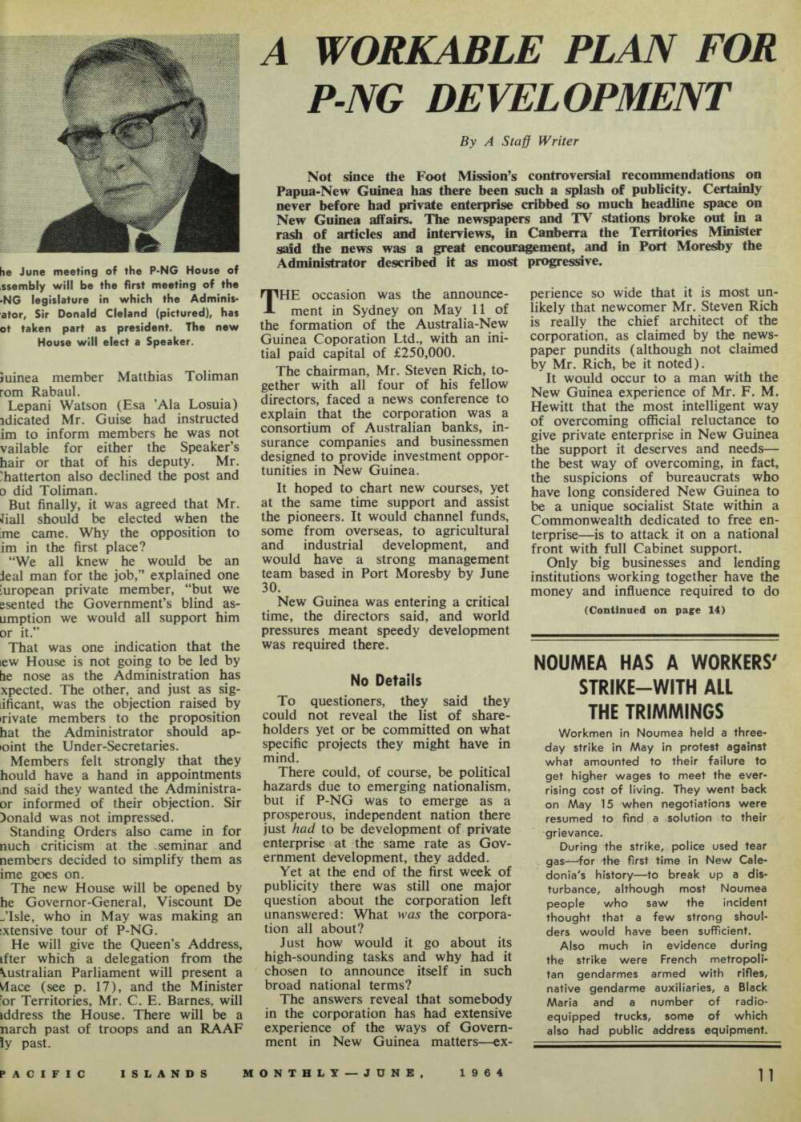
[?]he June meeting of the P-NG House of [?]ssembly will be the first meeting of the P-NG legislature in which the Adminis [?]ator, Sir Donald Cleland (pictured), has [?]ot taken part as president. The new House will elect a Speaker.