"Sovereignty Or No Deal"
pp. 11-12 · Read in the full issue
The Nauruans Still Say
By a Staff Writer
The Nauruans still want a guarantee of sovereign inde pendence from the Australian Government before they will agree to any plan to resettle them in or near Australia.
\ SPECIAL representative from l*- Nauru, Austin Bernicke, is ex acted to say this bluntly at a meet ng of the United Nations Trustee ihip Council in New York early in hme. However, the Australian Gov :rnment has already stated categoric dly that it will not entertain the idea )f a sovereign Nauruan nation with n or near its borders.
Nauru’s special representative to he UN is a member of the Nauru Government Council which liscussed the question of attaining ndependence for Nauruans “as soon is is practicable” at its monthly meet ng on April 29.
At this meeting, which was pre ;ided over by the Australian Admin strator, Mr. R. S. Leydin, Head [Thief Hammer Deßoburt said that lie council wished “to aim at lovereign independence for Nauru by 1967.”
“We have at times discussed the late of January 18, 1967,” he said.
He went on to say that, “to en lance and promote and pave the way 'or the eventual achievement of self government,” the Council thought it accessary to elevate the status of the
Council and increase its responsi bilities to those of a Legislative Council.
Mr. Leydin replied readily that he would be glad to discuss the question of a legislative council with a com mittee of the local government coun cil at any time.
But he was probably somewhat taken aback by the Head Chief’s statements, as members of the coun cil had not breathed a word about independence or resettlement for months; and when resettlement was last mentioned, the council stated that it intended to submit counter proposals to the Australian Govern ment’s stand that sovereign in dependence for the Nauruans could not be entertained.
Will Buy Curtis Meanwhile, the Australian Gov ernment has decided to acquire all the residential leaseholds at Southend on Curtis Island—in case the Nauruans finally decide to accept this island for resettlement on its terms.
Curtis is an island of 180 square miles which forms part of the port for Gladstone, Queensland. It is sep
arated from the mainland by a narrow channel, which, at one point, at low tide, is virtually dry land.
The Nauruans have told the Aus tralian Government that this would be a suitable place for their resettle ment, but they have not agreed to the Government’s terms that they should become Australian citizens, subject to Australian laws, etc., if they do accept it.
In announcing that the Australian Government would acquire the re sidential leaseholds on Curtis, Aus tralia’s Territories Minister, Mr. C. E.
Barnes, said that the Government had decided to do this “knowing that it could, in the final event, transpire that Curtis Island was not used for Nauruan resettlement.”
He added: “Nevertheless, this de cision would be justified if it served to convey to the Nauruans and the international community that Aus tralia was deeply concerned to honour its obligations under the United Nations Trusteeship Agreement to
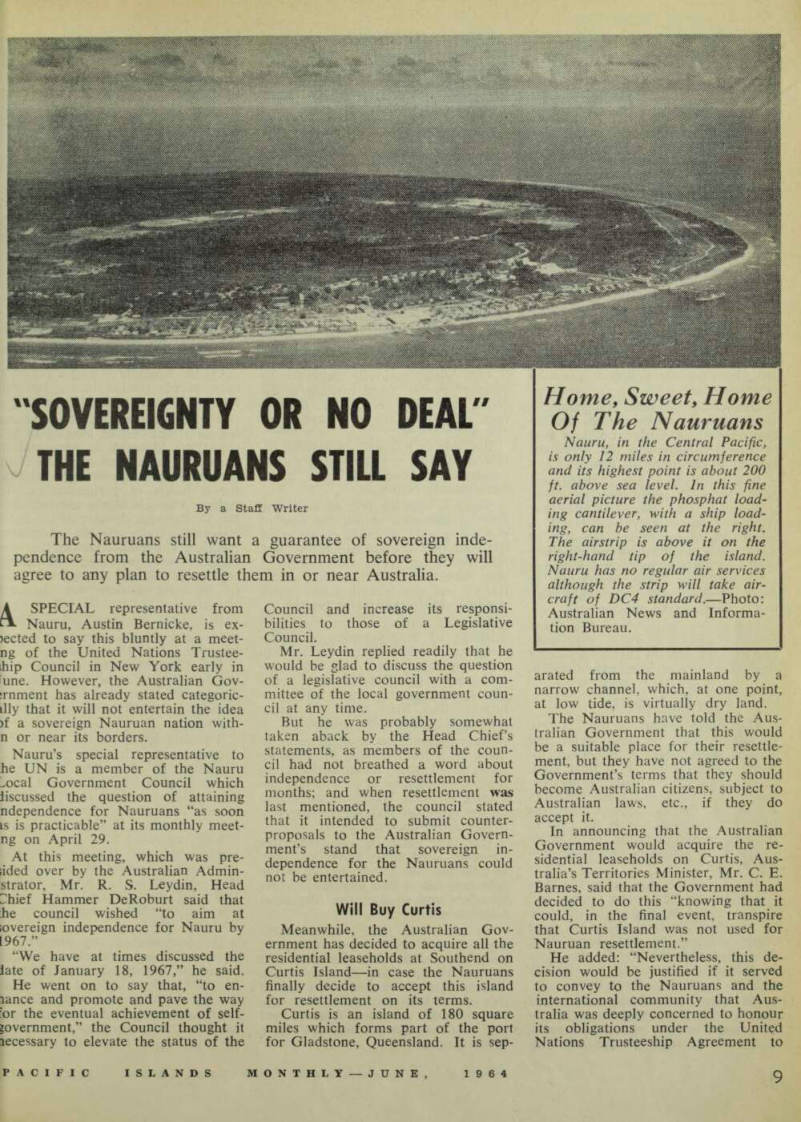
Home, Sweet, Home
Of The Nauruans
Nauru, in the Central Pacific, is only 12 miles in circumference and its highest point is about 200 ft. above sea level. In this fine aerial picture the phosphat load ing cantilever, with a ship load ing, can be seen at the right.
The airstrip is above it on the right-hand tip of the island.
Nauru has no regular air services although the strip will take air craft of DC4 standard. —Photo: Australian News and Informa tion Bureau.
safeguard the future of the Nauruan people, and was prepared to back its offer by whatever preliminary action is practicable.”
Despite Mr. Barnes’ statements, it would appear that the Australian Government is fairly confident that it will eventually win the Nauruans around to accepting its terms.
It would also appear that most Nauruans don’t really want sovereign independence as much as they say they do—they simply don’t want to make the irrevocable decision of accepting Curtis Island or anything else, and so they keep on asking for what they know they won’t get to ward off the dreaded day when they will have to make the decision.
There are probably half-a-dozen reasons—some of which they may not have recognised themselves—why they are reluctant to make a decision.
No Support
The basic reason is that Nauru, despite its lack of fresh water and general barrenness, is the Nauruans’ home, sweet, home. It is their land.
It has always been theirs. It has be longed to them and their ancestors for so long that the present-Nauruans have no traditions—as is the case in most parts of Polynesia, for example —that their ancestors ever lived any where else.
This being the case, some islanders —particularly the older ones—feel that it would be ungrateful of them to abandon the land that God gave them; yet, on the other hand, they know that once the island’s phosphate is exhausted, there will be virtually nothing to support them there.
However, as it is frequently stated that the phosphate deposits will not be worked out for at least 30 years, many of the older people say they
want to live out their lives where they are.
This view naturally inhibits the younger people from making a de cision to move elsewhere because they are reluctant to leave their elders.
But this is just one of several in hibiting factors for the young people —especially those who have never been outside Nauru.
There is also the fear of venturing into an unknown world; the fear of not being able to make a living of the kind they are accustomed to; the fear of being social outcasts in a new environment (in White Aus tralia); and the fear that any move would result in their being broken up.
Next to leaving Nauru itself, the question of fragmentation probably weighs more heavily on the average Nauruan mind than any other re settlement problem because the islanders are such a closely knit com munity that they speak of being members of the same family.
Anyway, with so many reasons to deter them from making the decision that would cast them adrift from their homeland for ever, it is not sur prising that the Nauruans do dream up the problems they do for the Aus tralian Government.
But they can’t go on doing this for ever—and they know it. They also know that Curtis Island is the best new island that anyone is likely to offer—and so does the Australian Government.
So whatever their representative says in the* United Nations this year, next year or the year after for that matter, it’s not likely to make much difference to the situation that existed this time last year—i.e. that the Nauruans can move into Curtis Island any time they like but they can’t have sovereignty over it.
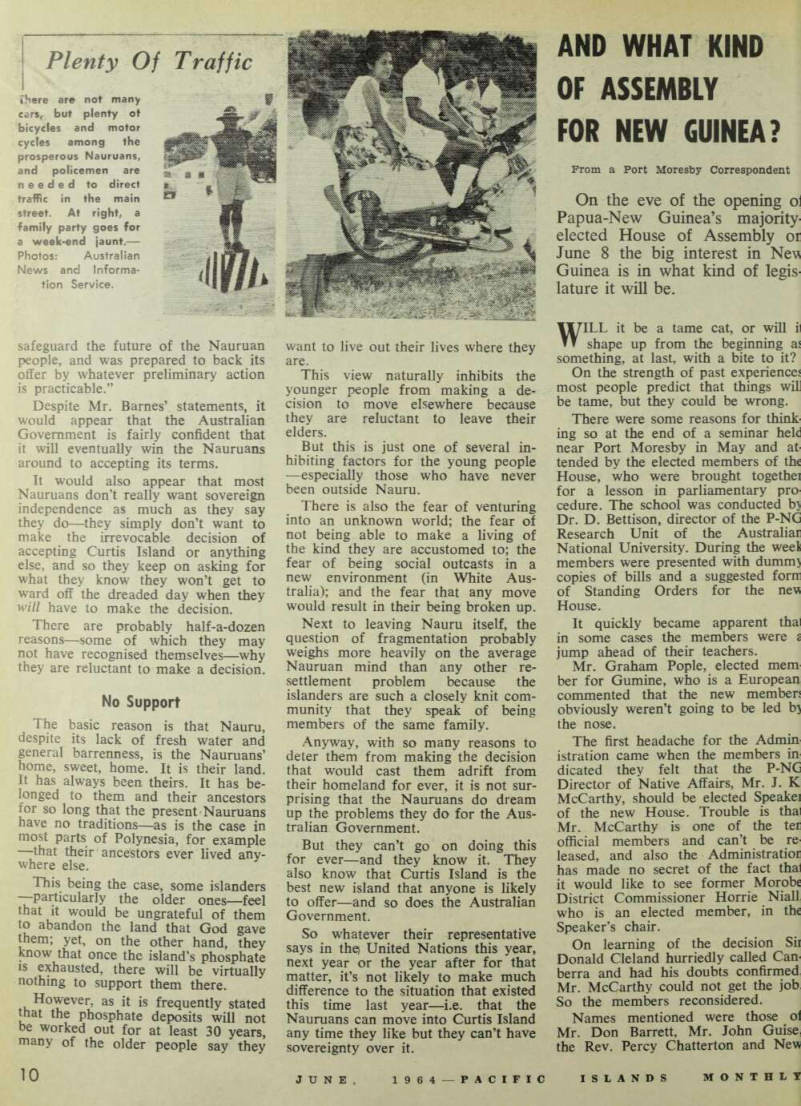
Plenty Of Traffic
There are not many cars, but plenty of bicycles and motor cycles among the prosperous Nauruans, and policemen are needed to direct traffic in the main street. At right, a family party goes for a week-end jaunt.— Photos: Australian News and Informa tion Service.