Rugged, Lonely Kermadecs
pp. 85-89 · Read in the full issue
May Guard "Treasure"
From Early Convict Ship
By Robert Langdoh
A relic of one of the ships of Australia’s First Fleet, which Australian historical societies would probably regard as a treasure beyond price, may still be awaiting a finder on one of the islands of the isolated Kermadec Group.
rHE relic is a quart bottle contain ing a message on parchment fom the first Europeans to land on ugged, uninhabited Macauley Island, he second largest island in the Ker nadecs.
It was left on the island on June I, 1788, by the captain and first mate }f the ship Lady Penrhyn, which was an her way to China after dischargng i cargo of women convicts in Syd ley.
The captain, William Cropton Sever, and the mate, Nicholas Anstis, •isked their limbs and lives to get ashore to leave the bottle there.
Besides being the first Europeans, hey were possibly the first humans jver to see Macauley Island, and in ;rue-blue explorer style, they wanted ;o leave their “visiting card” on it.
It could well be that their “visiting :ard” is still there because: • Macauley Island is so isolated and steep-to that few people have landed on it since 1788. • This article is the first to pub licise the existence of the Lady Pen rhyn's “treasure”, so it is almost
certain that no one has ever gone looking for it. • In the scanty literature on Macauley Island that I have been able to find, no mention is made of anyone ever having found the bottle.
The story of the discovery of Macauley Island and of the bottle that was left there is told in the un published journal of Arthur Bowes, the Lady Penrhyn’s surgeon. The journal is one of the treasures of Sydney’s Mitchell Library.
The journal covers the Lady Pen rhyn's voyage from the time she left England for Australia in May, 1787, to her return to England about two years later.
Bottle Not Mentioned The only other known account of this voyage is that of Lieutenant John Watts, RN, who was a pas senger in the ship. Watt’s account was published as an appendix to The Voyage of Governor Phillip to Botany Bay (London, 1789), but Watts’ description of Macauley
Island is brief and he does not speak of the bottle left there.
The Lady Penrhyn, which was owned by Timothy and William Curtis, of London, was chartered by them to the British Government to carry her cargo of women convicts to Australia.
She reached Botany Bay with the other 10 ships of the First Fleet at the end of January, 1788. Three months later she sailed for Macao to pick up a cargo of Chinese goods, but contrary winds forced her far out of her way to eastward.
On May 11, 1788, scurvy broke out in the ship and quickly gained on the crew. A call for fresh provi sions at Lord Howe Island (which had just been discovered) did little to stem the disease. By the end of the month, almost every sailor was suffering from scurvy.
Unknown Then came the discovery of two previously unknown islands which put new heart into everyone.
The two islands—Curtis and Macauley in the Kermadecs—were sighted at 3 p.m. on May 31, 1788, when the Lady Penrhyn was still some six to eight leagues off.
Everyone on board the ship looked forward hopefully to finding vege tables and other anti-scorbutic plants on them. Besides this, according to Surgeon Bowes, “the honour of having been the first to discover an island was no unpleasing circum stance”.
A closer inspection of the southernmost of the two islands next morning proved disappointing, for it was found to be nothing more than two huge rocks “without the slightest appearance of soil upon them”.
Nevertheless, Captain Sever
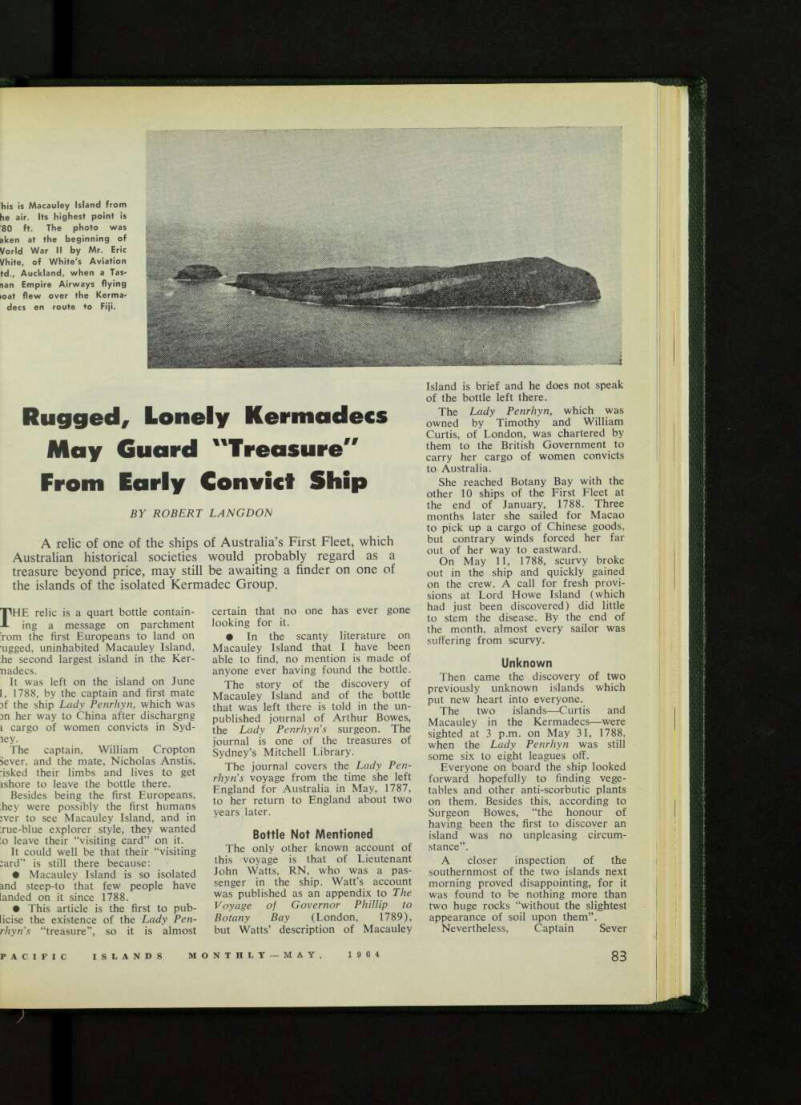
[?] is is Macauley Island from [?]he air. Its highest point is [?] 80 ft. The photo was [?]aken at the beginning of [?]Vorld War II by Mr. Eric [?]hite, of White's Aviation [?]td, Auckland, when a Tas rian Empire Airways flying [?]oat flew over the Kerma decs en route to Fiji.
lought his bosses, Messrs. Timothy id William Curtis, would be flat red if he named it after them. So ; did this, fixed the island’s position > that future navigators could avoid , and sailed northward to have a oser look at the other island that ad been seen the previous afternoon.
This other island, which was about S miles distant, was reached at lout half past one in the afternoon, owes wrote that it had “a very dif irent appearance” from Curtis land, as it was covered with trees, irubs and grass. Except at one small >ot, it was surrounded by rocks, pon which the sea broke in “a readful surf”.
Captain Sever ordered the jolly lat to be lowered so that he and nstis, the mate, could go ashore, owes would have liked to go, too, at when he saw how leaky the boat as through having lain bottom up a the Lady Penrhyn’s deck since aving Sydney, he thought better of Bowes seems to have been wise, >r when the boat pushed off, Sever id Anstis were standing almost lee-deep in water and two sailors ith buckets were baling it out as ist as they could go.
Dangerous Landing
At the one small spot on the island here the surf did not break, Sever id Anstis landed “with the greatest mger and difficulty”. In landing, icy had to “watch their opportunity : jumping out of the boats on the >cks, and there hang by their hands prevent the surf washing them f again”.
Later, having had a look round the land and having deposited their )ttle, Sever and Anstis had to use rope several fathoms long to enable em to descend from the rocks to eir boat.
When they finally got back to the ady Penrhyn, Bowes was all ears to arn what they had seen ashore.
“They found some mangrove trees >on it,” he wrote, “and some low significant shrubs. Many of the ountains were composed of a imice stone, which plainly indicated at the island originated from a >lcano.
“The soil was very sandy, with a
mixture of rotten leaves and the dung of seafowls, many sorts of which resort to this island.
“There were many tropic birds under the trees, some of which were asleep, and those they took by hand and brought on board with them; they also knocked down some parro quetts, several of which they brought on board also.
“Mr. Anstis also brought on board some small pieces of the pumice stone rock mentioned above, and also some of the largest limpett shells I ever saw, “He said also that there were in the standing waters of the cavities of the rocks many crabfish of peculiar
beauty, that he took several of them in order to bring on board, but that they twisted off their legs as soon as he took hold of them. . . .
“They also saw both rats and mice on shore; how these vermin could possibly come there where no ship had ever before been, and situated as this island is in the midst of a prodi gious ocean, is a matter to be con sidered by future naturalists.”
Bowes said that neither Captain Sever nor Mr. Anstis would have at tempted to land on the island had they not wished to hang up a quart
attle with a note in it. This note as written on parchment and the Dttle was “strongly corked up and >sined over the cork, with a bladder ed over all with strong, twisted ire.” The bottle was hung “under rock which projected immediately jposite the only landing place round ie island”.
The note in the bottle was written / Lieutenant Watts, and read as ►Hows; Navis Lady Penrhyn, Ist me, 1788, Jno. Watts, Gulielmus ? ver, Praes. Geo. MI Rex.
Bowes added that soon after Cap in Sever and Mr. Anstis returned i board at about 5 p.m., the Lady znrhyn made sail for Tahiti.
She later touched at Huahine (So ety Islands), Tongareva (Cook lands) and Saipan and Tinian Marianas) before reaching Macao, ongareva, like Curtis and Macauley lands, had not previously been seen / Europeans, and was named mrhyn Island after the ship. It has ;en generally known by that name the years since.
Meanwhile, about the only people ho have landed on Macauley Island e a few whalers and an occasional ival party.
It is on record that the whalers irnt off the scrub and introduced )ats, and that the goats have since ultiplied so greatly that they have ;stroyed all the woody plants ex 'pt those in a few inaccessible aces.
Macauley Island thus seems to be i even less desirable place than it as in 1788. But anyone interested in arching for the Lady Penrhyn’s reasure” could find a visit there re arding.