Yesterday
p. 83 · Read in the full issue
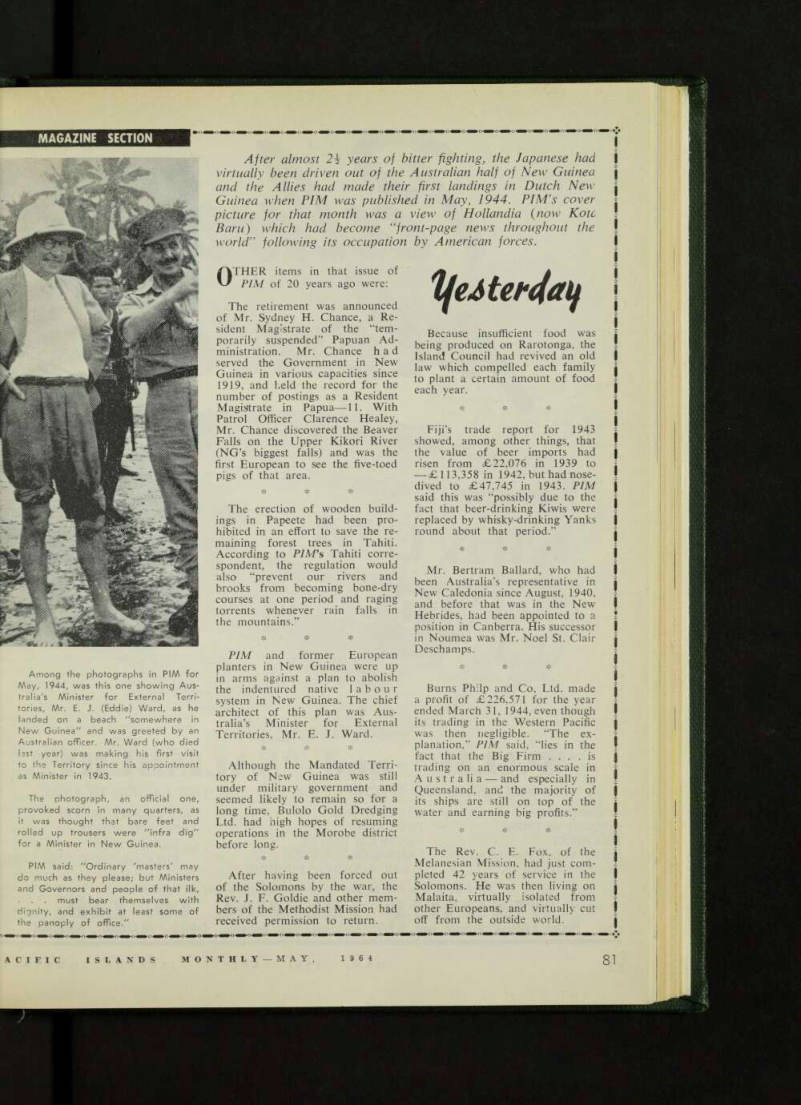
Among the photographs in PIM for May, 1944, was this one showing Aus tralia's Minister for External Terri tories, Mr. E. J. (Eddie) Ward, as he landed on a beach "somewhere in New Guinea" and was greeted by an Australian officer. Mr. Ward (who died last year) was making his first visit to the Territory since his appointment as Minister in 1943.
The photograph, an official one, provoked scorn in many quarters, as it was thought that bare feet and rolled up trousers were "infra dig" for a Minister in New Guinea.
PIM said: "Ordinary 'masters' may do much as they please; but Ministers and Governors and people of that ilk, must bear themselves with dignity, and exhibit at least some of the panoply of office."
After almost 2i years of bitter fighting, the Japanese had virtually been driven out of the Australian half of New Guinea and the Allies had made their first landings in Dutch New Guinea when PIM was published in May, 1944. PI M's cover picture for that month was a view of Hollandia (now Koto Baru ) which had become “front-page news throughout the world” following its occupation by American forces.
OTHER items in that issue of PIM of 20 years ago were: The retirement was announced of Mr. Sydney H. Chance, a Re sident Magistrate of the “tem porarily suspended” Papuan Ad ministration. Mr. Chance had served the Government in New Guinea in various capacities since 1919, and held the record for the number of postings as a Resident Magistrate in Papua—ll. With Patrol Officer Clarence Healey, Mr. Chance discovered the Beaver Falls on the Upper Kikori River (NG’s biggest falls) and was the first European to see the five-toed pigs of that area, ❖ ♦ * The erection of wooden build ings in Papeete had been pro hibited in an effort to save the re maining forest trees in Tahiti.
According to F/M’s Tahiti corre spondent, the regulation would also “prevent our rivers and brooks from becoming bone-dry courses at one period and raging torrents whenever rain falls in the mountains.” :•< * :|: PIM and former European planters in New Guinea were up in arms against a plan to abolish the indentured native labour system in New Guinea. The chief architect of this plan was Aus tralia’s Minister for External Territories, Mr. E. J. Ward.
Although the Mandated Terri tory of New Guinea was still under military government and seemed likely to remain so for a long time, Bulolo Gold Dredging Ltd. had high hopes of resuming operations in the Morobe district before long.
After having been forced out of the Solomons by the war, the Rev. J. F. Goldie and other mem bers of the Methodist Mission had received permission to return.
Because insufficient food was being produced on Rarotonga, the Island Council had revived an old law which compelled each family to plant a certain amount of food each year. 5fC * * Fiji’s trade report for 1943 showed, among other things, that the value of beer imports had risen from <£22,076 in 1939 to —<£113,358 in 1942, but had nose dived to £47,745 in 1943. PIM said this was “possibly due to the fact that beer-drinking Kiwis were replaced by whisky-drinking Yanks round about that period.” * * * Mr, Bertram Ballard, who had been Australia’s representative in New Caledonia since August, 1940, and before that was in the New Hebrides, had been appointed to a position in Canberra. His successor in Noumea was Mr. Noel St. Clair Deschamps. ❖ * ❖ Burns Philp and Co, Ltd. made a profit of £226,571 for the year ended March 31, 1944, even though its trading in the Western Pacific was then negligible. “The ex planation,” PIM said, “lies in the fact that the Big Firm ... is trading on an enormous scale in Austr a li a and especially in Queensland, and the majority of its ships are still on top of the water and earning big profits.” * * * The Rev. C. E. Fox, of the Melanesian Mission, had just com pleted 42 years of service in the Solomons. He was then living on Malaita, virtually isolated from other Europeans, and virtually cut off from the outside world.