Flood Turmoil
pp. 43-45 · Read in the full issue

Fiji's Women Face Up To
From Elspeth Robbins, in Suva What’s it like being a housewife or mother in the middle of devastating floods? It’s no more fun in the South Sea Islands than it would be anywhere else, but thousands of women in Fiji have made the best of a bad lot in the last few weeks as floodwaters brought turmoil throughout many centres of the main island of Viti Levu.
THE flood warnings came with dramatic suddeness at the end of March as housewives were going about their week-end shopping. It had been raining for days, but nobody had taken any more notice of that than usual and had put up with all the inconveniences.
You all know the pattern . . . gardens sodden, mud encroaching into the house, limp breakfast cereals and constant cries of “any dry socks? . . . “Have I got a dry shirt?” . . “I can’t wear this uniform again!” Keeping up with a supply of clean dry clothing presented the usual problem, and many a house wife scorched towels and napkins in a rash endeavour to dry clothes in the oven.
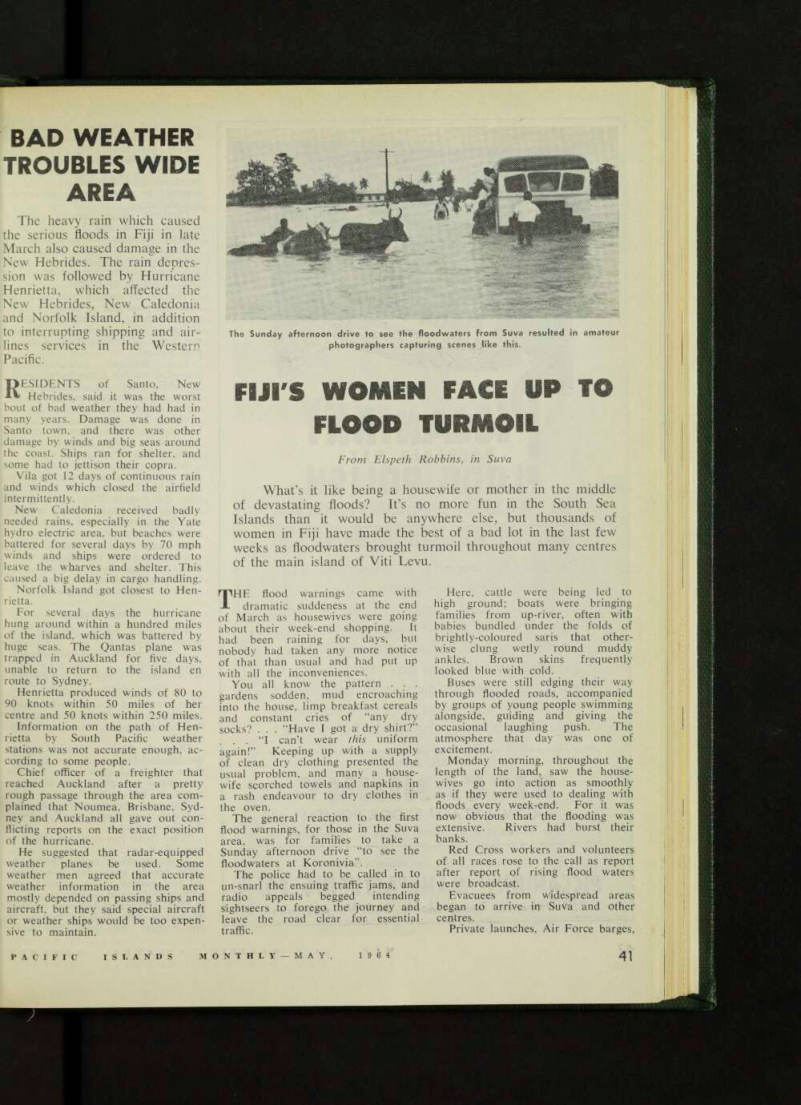
The general reaction to the first flood warnings, for those in the Suva area, was for families to take a Sunday afternoon drive “to see the floodwaters at Koronivia”.
The police had to be called in to un-snarl the ensuing traffic jams, and radio appeals begged intending sightseers to forego the journey and leave the road clear for essential traffic.
Here, cattle were being led to high ground; boats were bringing families from up-river, often with babies bundled under the folds of brightly-coloured saris that other wise clung wetly round muddy ankles. Brown skins frequently looked blue with cold.
Buses were still edging their way through flooded roads, accompanied by groups of young people swimming alongside, guiding and giving the occasional laughing push. The atmosphere that day was one of excitement.
Monday morning, throughout the length of the land, saw the house wives go into action as smoothly as if they were used to dealing with floods every week-end. For it was now obvious that the flooding was extensive. Rivers had burst their banks.
Red Cross workers and volunteers of all races rose to the call as report after report of rising flood waters were broadcast.
Evacuees from widespread areas began to arrive in Suva and other centres.
Private launches, Air Force barges,
punts and dinghies manned by husbands had all played their part during the night, bringing in the homeless. Housewives became trans port drivers, as some schools were overloaded so that others could be emptied to receive evacuees requir ing shelter.
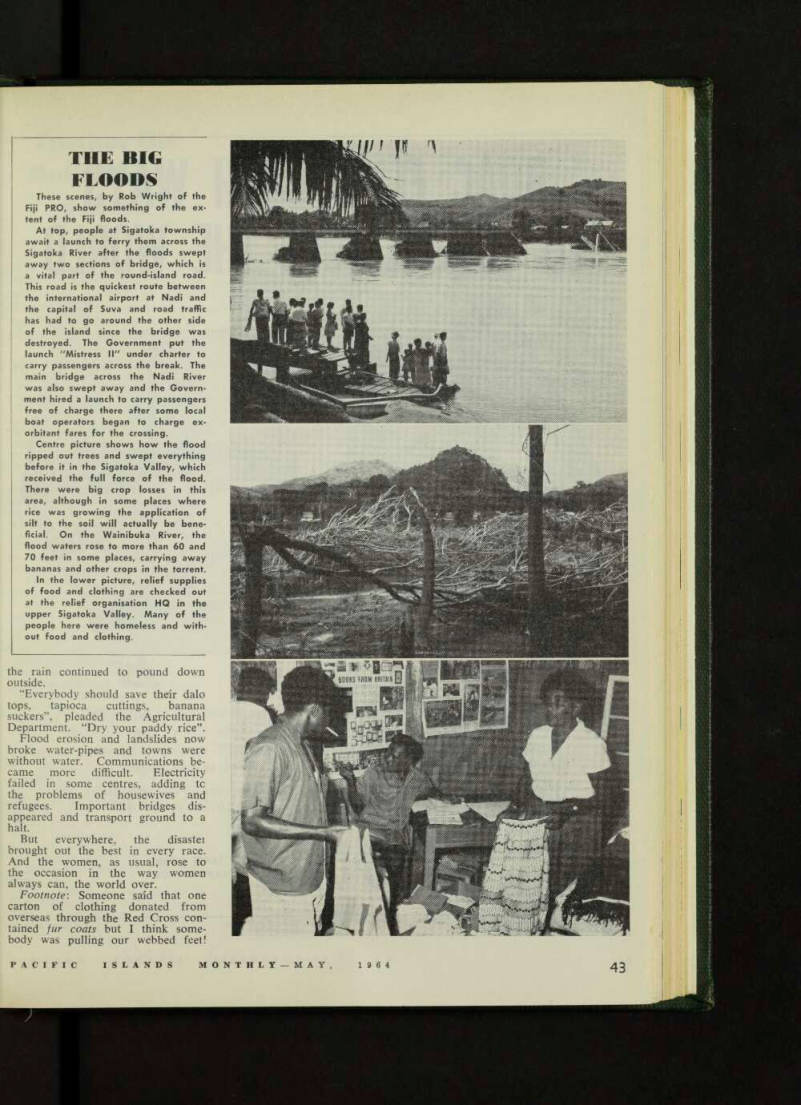
Clothing, sheets, towels, received at Red Cross and St. John head quarters were immediately sorted by volunteers, and rapid calculations were made on how much rice, meat, fish, and sharps were required to feed hundreds of people.
The gift of several cases of tinned beetroot presented a problem, beet root not being a normal item on the Fijian or Indian menu . . . likewise the carton of rapidly thawing, frozen puff pastry!
Five hundred evacuees were landed from Air Force barges at the RNZAF jetty at Laucala Bay.
They were directed to the hangar, where others issued them with dry clothing, hot soup, tea and bread before they were taken by waiting buses and private cars to various points in the city.
Among the tiniest of these exacuees was a seven-day-old baby.
Most of his age-group possessed only the napkin they stood up in!
Any old and worn clothing received at headquarters was torn into squares for use as napkins.
In some cases the Army helped with cooking, but the refugees them selves were usually more than willing to help themselves once they were provided with utensils and food.
Pitiful Tales You heard pitiful tales of how many villagers had lost everything. . . . Their bures, their cooking pots, their bedding. ... All their hard earned little vestiges of civilisation. . . . Those family portraits. . . .
That cardboard box of well-thumbed snapshots. . . . All swirled away in the muddy waters, never to be re placed.
“Boil all drinking water”, warned the Medical Department but many of those marooned on hill tops had not even wood to light a fire, let alone a pot to boil water in.
“Eat any existing root crops first and save your tinned food”, advised the Government.
“Yes, if we can find something to cook them in!”
At the height of rescue operations, 5,000 people every day were being fed and bedded down. One house wife who brought a few magazines to “her” temporary hall was mobbed by people who had sat looking at one another for three days while
the rain continued to pound down outside.
“Everybody should save their dalo tops, tapioca cuttings, banana suckers”, pleaded the Agricultural Department. “Dry your paddy rice”.
Flood erosion and landslides now broke water-pipes and towns were without water. Communications be came more difficult. Electricity failed in some centres, adding tc the problems of housewives and refugees. Important bridges dis appeared and transport ground to a halt.
But everywhere, the disastei brought out the best in every race.
And the women, as usual, rose to the occasion in the way women always can, the world over.
Footnote : Someone said that one carton of clothing donated from overseas through the Red Cross con tained fur coats but I think some body was pulling our webbed feet!