Pacific Commerce and Produce
pp. 123-125 · Read in the full issue
Big Expansion Programme For Fiji Sugar Millers
In one of the trickiest commodity markets in the world the CSR Co. Ltd., through its Fiji subsidiary, South Pacific Sugar Mills Ltd., is planning for tremendous expansion in the Fiji sugar industry in the next two seasons. The 1966 target of 350,000 tons is worth on today’s world market just about £18,500,000.
)NLY three years ago anyone sug gesting that Fiji would soon have sugar crop worth about £20,000,000 Wild have been regarded as a super ptimist. With most market observers pping a stable market without the nduly high prices of recent months 3r the next few years, Fiji can look Drward to several years of pros erity.
A hurricane or some mysterious isease could upset calculations, but PSM Ltd. have frankly admitted ley are taking a calculated risk in reparing to spend the money to ater for the vastly increased output.
The company has already planned i increase crushing capacity in its our mills by 20,000 tons for the 964 season. It will now be neces ary to raise the capacity again to ater for an expected 2,500,000 tons f cane (about 330,000 tons of raw ugar in 1965), and 2,700,000 tons f cane (about 350,000 tons of raw ugar in 1966).
"Confidence”
According to Mr. A. S. Hermes, nanaging director of SPSM Ltd., the ompany will have spent about 15,200,000, when machinery to cater or the 1966 crop is installed, in ibout five years. Included in the xpenditure is provision for extra torage space and normal replace nent needs.
The company’s confidence was ex acted to give the Colony’s economy i quick shot in the arm. Now well m the way to complete recovery ifter the disastrous years of 1960 md 1961, the business sector can )lan ahead for future expansion.
Sugar is the mainstay of the Fiji economy and is likely to remain so or many years to come, in spite of strenuous efforts to diversify and nove into other lines of agriculture.
While sugar is prosperous there is a breathing space to establish and find markets for other primary produce without expecting a profit straight away.
Mr. Hermes, commenting on the decision to expand, said the new targets for 1965 and 1966 were quite significant increases over the 299,000 tons of sugar made in the very favourable 1963 season. He con sidered there were satisfactory sugar marketing opportunities in the im mediate future.
Higher Exports
“A large increase in production will enable early attainment of a higher sugar export level with its consequent benefit to the economy generally,” Mr. Hermes said.
“Increased sugar imports by Fiji in the near future will be of great importance if international sugar quotas are reviewed.
“While there is an element of risk in the future of being denied certain markets, of having to accept some setback in exports and also of the possibility of low sugar prices, it’s considered these risks are out weighed by the prospects and the general desirability of expanding the industry at this time.
“In fact, the world price has fallen considerably lately, indicating that the sugar buyers of the world are rather less concerned about obtain ing their requirements this year than they were.”
Mr. Hermes said that a large part of the extra cane required would come from existing growers. The remainder would come from dis placed efficient cane-growers wishing to re-enter the industry, and new growers. It was planned to bring into production several areas of Crown land at Nadi and Tavua.
They Tote Timber
To The Territory!
THERE’S an awful lot of timber in New Guinea —but unlike Brazil’s coffee, there’s a shortage of it.
Such a shortage, in fact, that since Christmas, Port Moresby builders alone have imported nearly half a million super feet of it from Aus tralia.
That’s only a fraction of the total volume of timber shipped there since the shortage became acute nine months ago.
The builders blame the local saw millers.
“They won’t stockpile,” they say, “with the result that when there’s a fair amount of building work about they just can’t meet the demand.”
And the sawmillers blame the Ad ministration. With words as cutting as their circular saws they accuse Administation of letting tenders all in one big lump, instead of spreading them over the year.
“How can we be expected to operate efficiently if one minute we can’t sell a stick and the next minute we just can’t cope with the orders? they say as one.
And they have a point.
About 18 months ago, according to the P-NG Forestry Department, the Territory’s sawmillers had about
two million super feet of timber in reserve, waiting for the big con struction programmes that usually begin as the new fiscal year plans materialise.
But the Government was later than usual in calling tenders, there were arguments about whether a group of 80 houses should be built in timber or aluminium, and the sawmillers got tired of waiting.
They sold the lot overseas.
But even at the best of times, argue the builders, there’s usually an eight week wait before the sawmillers can fulfil an order.
“You’re inefficient, unreliable and too dear,” said one Port Moresby contractor in a letter to his Rabaul supplier.
He then wrote to a New South Wales timber merchant and ordered 200,000 feet of mixed timber.
Most Port Moresby builders seem to agree it’s easier to deal with Aus tralian suppliers than those in the Territory, and no dearer.
Even some Lae and Rabaul builders have been ordering in Aus tralia lately, and they are closer to the big mills than anyone.
Late in February, the Administra tion had a look at the problem after Port Moresby builders asked for more time in which to complete existing contracts on the grounds the timber shortage had causer long delays.
Acting Assistant Administrator Mr.
W. F. Carter chaired a meeting of interested parties and agreed on an extension of time.
His findings were that there was a timber shortage and because of this the builders, who had no control on the situation, should be allowed the extensions they asked.
But so far nobody has come up with an answer to what seems like one of the most ridiculous situations in P-NG.
“Taking coals to Newcastle” is a pale cliche by comparison with “Tot ing timber to the Territory.”
Fiji Goldmines Want
Further Subsidy
Fiji goldmining industry is
seeking a further subsidy from the Government. The opera tions of the Emperor Gold Mining Co * Ltd at Vatukoula have been profitable, but constantly rising costs are a worry to the management.
The company in the late ’Fifties enjoyed a subsidy of £150,000 a year, and when this ceased it was excused trom the payment of Port and Customs Service Tax. Although the saving was substantial, it was many
thousands of pounds short of the annual subsidy.
The chief general manager of the company, Mr. N. E. Nilsen, on one of his recent regular visits to Fiji from Melbourne, said the company was concerned about the rising cost of producing gold at Vatukoula. He paid a visit to the recently-arrived Governor, Sir Derek Jakeway.
He said the price of gold had re mained static since 1934 and no increase seemed likely in the im mediate future to offset the rising costs. In Canada, the United States and Southern Rhodesia, goldmining companies received subsidies from their Governments.
Long-range plans for Vatukoula involve additional finance from local sources, or the introduction of further outside capital.
Mr. Nilsen made the pointed ob servation that Vatukoula supported a community of 6,000. There were 1,700 on the payroll and of an annual wage bill of £750,000, £600,000 went to Fiji-born workers.
He did not say publicly that it would be quite a headache to absorb all those workers in the present state of Fiji’s economy, even though it is
booming at present, if Empen pulled out. But no doubt those i officialdom got the point.
Mr. Nilsen also gave some interes ing facts about Vatukoula. Since th company started operations there i the late ’Thirties it had won 65 tor of gold, worth £26,300,000. In th same time the company, or associate companies, had spent £5,500,000 o capital and development work.
Production had now reached th stage where the output was wort about £1,500,000 a year.
But too much of that had to g back into operations, particularly a pumping water from the deeper level was an expensive process,
P-NG Coffee Marketing
Board Members
MEMBERS of the Papua-Ne\ Guinea Marketing Board—whicl has been established following stron recommendations from New Guine growers—were announced in March The Australian Minister for Terri tories, Mr. C. E. Barnes, said the ne\ board, with its members providin; managerial capacity, organising ability
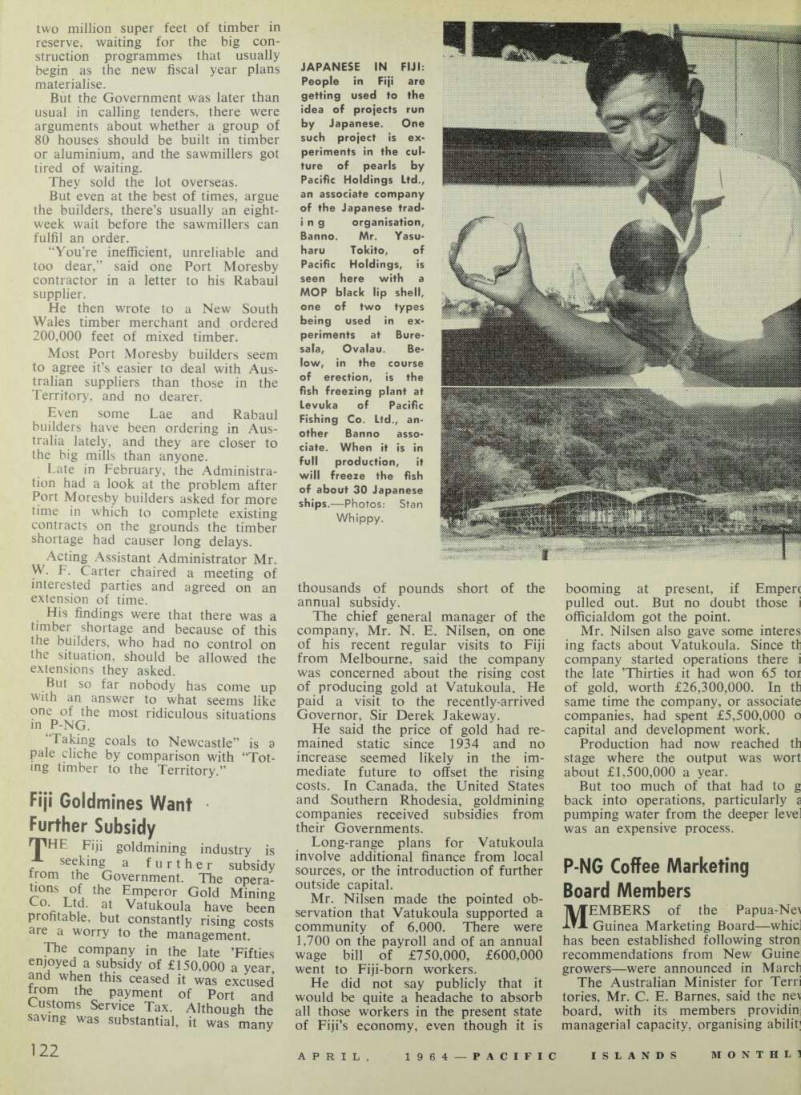
Japanese In Fiji:
People in Fiji are getting used to the idea of projects run by Japanese. One such project is ex periments in the cul ture of pearls by Pacific Holdings Ltd., an associate company of the Japanese trad ing organisation, Banno. Mr. Yasu haru Tokito, of Pacific Holdings, is seen here with a MOP black lip shell, one of two types being used in ex periments at Bure sala, Ovalau. Be low, in the course of erection, is the fish freezing plant at Levuka of Pacific Fishing Co. Ltd., an other Banno asso ciate. When it is in full production, it will freeze the fish of about 30 Japanese ships.— Photos: Stan
Whippy.
id effective knowledge of the in jstry, would help establish a P-NG iffee industry on a sound basis. A reliminary meeting of members ould soon consider draft regulations, nancial arrangements and appoint icnt of an executive officer. When iis had been done the Coffee Market ig Board Ordinance would be rought into effect.
Members of the board will be [essrs. Bono Aganifa, lan Downs, . Hagon, A. L, Hurrell and Sakain. ach member would have a deputy, nd these would be: Messrs. D. alconer, Kup-Ogut, J. L. Leahy, □’So and J. Watts.
V Company Registered
i Fiji
k NEW company, Fiji Television a. Limited, was registered in Suva i March. Mr. R. L. Munro, a Suva arrister and solicitor, said in a state lent that an application for a tele ision licence was made last October nd was still under consideration by le Government.
He said the new company had a ominal capital of £150,000 divided ito 600,000 ordinary shares of 5/ach.
Of this, £lOO,OOO would be offered o the public in Fiji and the balance yould be subscribed by Electronic ndustries Limited, of Melbourne, diich was prepared to underwrite the otal capital issue.
The company’s general objects vere to secure a licence to operate ommercial television stations within he Colony and to carry on the ;eneral business of a commercial elevision company, including the nanufacture and assembling of tele vision and radio components and re vivers, Mr. Munro added.
Mr. Munro is vice-chairman of the lew company. Sir Arthur Warner, of tfeblourae, is chairman.
Other directors were announced in °IM last month (p. 123).
It is unlikely that the Government of Fiji will issue a licence for the operation of a TV station in Fiji until (a) it is considered that the in troduction of such an amenity is de sirable and (b) a general invitation to apply has been extended to all in terests.
Interest in the Fiji idea has been shown by the Thompson newspaper group, of Britain. (This is the group that has been trying to get possession of the New Zealand newspaper, Diminion.) There is a Thompson organisation which specialises in the control and operation of TV stations in British colonies and territories.