Cruising Yachts
pp. 99-107 · Read in the full issue
Pacific Shipping And Cruising Yachts
Fund Launched For New
"Endeavour" Voyage
A trust fund to raise money for a voyage from England to Australia in a replica of Captain Cook’s ship Endeavour was launched in Sydney in March with a gift of $l,OOO (nearly £A4SO) from an American travel magazine. It is hoped to raise about £150,000.
IHE first contribution to the fund was made after Captain Alan lliers, noted Australian sailing ship pper and author, had addressed a seting of the Pacific Area Travel isociation conference in Sydney, le fund is under the chairmanship Vice-Admiral Sir John Collins.
Captain Villiers put forward the *a about two years ago of sailing a jlica of the Endeavour from Eng id to mark the bi-centenary of >ok’s first voyage to the South Paci . He has offered to skipper the ves- Captain Villiers, who is 61, skip red a replica of the Mayflower >m England to the United States reral years ago.
In his address to the PATA con rence, he said that all necessary in rmation for building a replica of 2 387-ton Endeavour was available the plans for Cook’s ship were in e National Maritime Museum in igland.
He went on: “My idea is to build replica of this ship as a memorial Cook and sail this vessel in the me way, but without Joseph Banks i board (or any substitute for Sir iseph Banks), and finally get out ire the way old Cook came.
“There is still a shipyard at r hitby run by quiet, industrious orkshire fellows who know what do with the business end of an Ize and still know where to find an ik tree. They have the skill to build ie vessel.
“As a great seaman, Cook took
The index to ships in the news appears this month on page 111.
Cape Horn in his stride and came round to the windward. To get wind ward is one horrible slog against the westerly gales at their strongest.
“We will have to go that way, too, without power. I still have a nucleus of sailing ship men who are still in the tradition of the square-rigged, engineless ship who can make these passages whatever odds there seem to be against them.
“I have six such men. I had eight when we sailed the Mayflower, but two have died.”
Captain Villiers said his voyage would be a combination of Cook’s first and third voyages. After round ing the Horn, he would call at Tahiti
and would then go on to Hawaii (“I hope no one kills me there,” he said), New Zealand and Australia.
Captain Villiers said that he would like to begin his voyage in August, 1968, as Captain Cook had begun his in August, 1768.
It was therefore necessary to “get moving” at once, as it would take 12 months to select the oak trees re quired to build the ship and at least two more years for the actual build ing.
“I am not concerned about getting the money for this,” Captain Villiers said, “as there have been many offers of substantial sums.
“But until I came here (to Sydney) it was not appreciated that it would take about a year to get suitable oak trees.
“The plan now is to get the money and get the trees down within six months.”
Captain Villiers said that apart from the departure time from Eng land. he would not try to adhere to Captain Cook’s schedule; and he
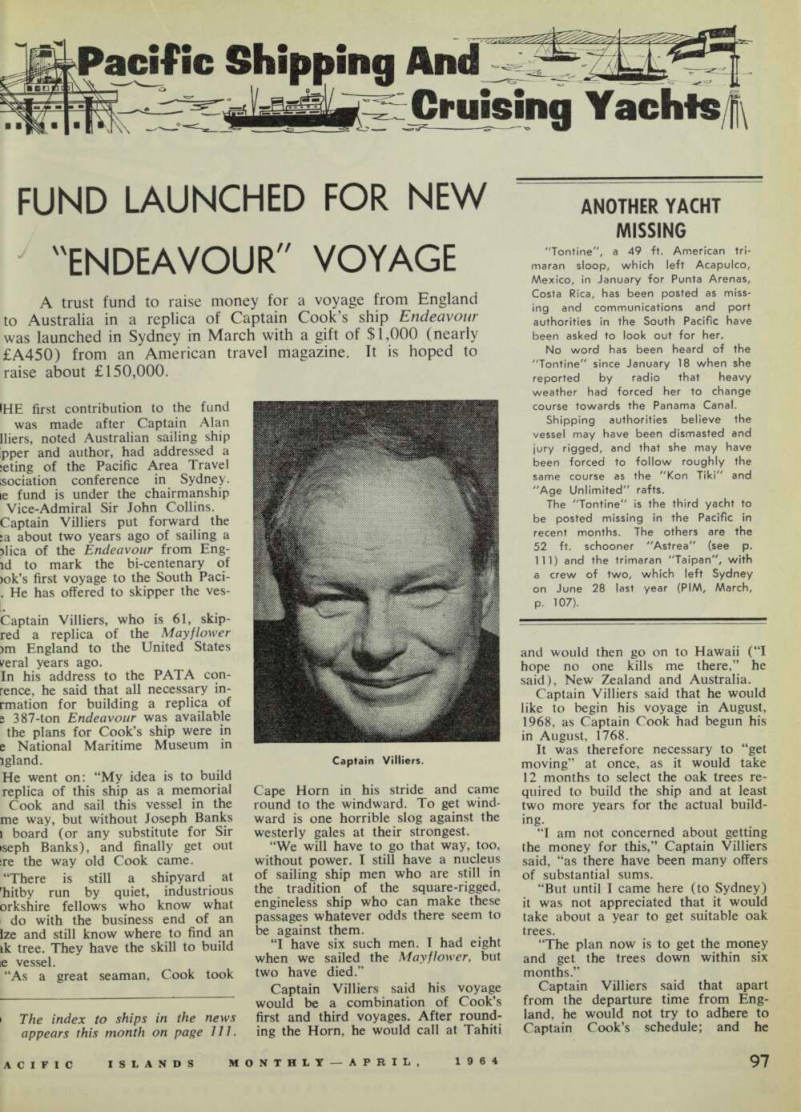
Captain Villiers.
uld settle for a crew of 30 instead Cook’s 90. rhe replica would not have most the refinements of present-day sea vel except for radio transmitter 1 other navigation equipment ich the British Ministry of Trans rt insisted on for safety.
• Service To Tahiti Ends:
e Crusader Shipping Co. Ltd. of dlington, has abandoned its bi mthly service to Tahiti. The npany’s ships began calling at peete about 18 months ago on ;ir northbound voyages from New aland to the West Coast of North nerica. The Knight Templar, iich sailed from Auckland on irch 14, was the last Crusader p to call at Papeete.
Commenting on the abandonment the service, a company spokes m said in February; “Our service Papeete has been given a fair trial t has proved a great disappoint ing The volume of cargo has jwn no sign of developing to the ge which would justify the con ned employment of a vessel of er size on a direct basis”.
• Freight Rates Cut:
:ean freight rates for small boats :re drastically cut in the United ates Trust Territory of the Pacific ands in February in an effort by e Administration to spur greater onomic development in the boat filding centres of the Territory.
The new freight rate provides that larges for the shipment of boats ithin the Trust Territory will be i a measurement ton for craft up to > ft long.
Besides encouraging the expansion boatbuilding, the new rate makes economically possible to ship small >ats throughout the Territory.
• Another Long Drift
OYAGE: Two Papuans, who rifted 280 miles in a canoe in Feb iary from the Laughlan Islands, in -NG’s Milne Bay District, to Mono land, BSIP, provided further evi ;nce—if anyone still needs it—that lost of the islands of the South Paci z were peopled by people who did ot really want to go where they ent.
The drifters in this case were ipilia Puruewa, 35, who is married ith three children, and Abakao fogeia, 18, single.
The two men were on their way to /oodlark Island, 40 miles west of
the Laughlans, to do some trading on February 13 when a strong southwesterly wind blew up and they could not hold their course. They carried only enough food and water ‘ff. then ? v for w should have taken a few hours.
Soon they were blown out of sight of land, and they drifted in a northeasterly direction before the wind for four nights and almost four days.
On the fourth day, February 17, they sighted Mono Island, just south of Bougainville, and paddled for it.
They reached shore that afternoon and were taken on board a Methodist Mission boat which was about to leave Mono for Munda, the mission’s headquarters.
Sipilia and Abakao, who were
“fatigued but in fairly good condi tion” after their ordeal, were cared for at Munda until they could be sent to Rabaul for repatriation, I" ** b hope alive” be fore they reached Mono, Much Qf their voyage had been in heavy seas, high winds and driving ra j n two men were t h e third lot of Laughlan Islanders to drift to the Solomons since the war after being blown off course on their way to Woodlark Island.
The last lot- two men, two boys and a girl—drifted from the Laugn lans to Simbo {PIM, June, 1"59, p. 41). In 1949, a canoe-load ot islanders finished up at Mono, like the latest unwilling voyagers.
• Fishing Boat Sinks: The
panese fishing boat Ibisu Maru No. sank 40 miles off the coast of anua, American Samoa, on the ibruary 29-March 1 weekend. The ip became flooded because of a ulty crankshaft. The crew was ken off by another ship.
The ship was owned by the Nippon a Company, of Japan, and was ider contract to the Van Camp ma Company, in Pago Pago.
• Famous Trading
:HOONER SOLD: The 173-ton ands trading schooner Tiare iporo, which was built for A. B. maid Ltd. in 1913, and which ided for that firm in recent years in ; Cook Islands, was sold in Auck id in March to Mr. W. B. Christo ers, of Rotorua.
The schooner will still be used as trading vessel, but it is not yet cer n where she will trade. However, r first voyage for her new owner is to be from Auckland to Raro iga.
• New Coast Guard
ATION: Admiral C. C. Knapp, unmandant of the US Pacific
Guard Region was due in Pago Pago in March with a staff of experts to conclude arrangements for the new Coast Guard station that will be in operation from about July 1.
• Extensions For School:
Tenders have been called for im provements and extensions to the Administration Nautical School and the Artisan Training Establishment at Napa Napa near Port Moresby.
The Nautical School will be ex tended to accommodate 70 students.
Twenty of the new students will re ceive advanced training and will in clude experienced seamen who will study for examinations for ships’ masters and engineers in the coast ing trade.
The school now accommodates 30 men for pre-sea training.
Extensions to the Artisan Train ing Establishment will include
Designed For
SPEED: This unusual boatshed, built over the water, was photo
graphed recently at
Bora Bora in the Society Islands. Be sides keeping both the top and bottom of the boat dry, it enables the boat owner to make a quick getaway.
Photo: Courtesy of Qantas.
mitories for an expected in ase in apprentices and other nees, and married quarters for e couples. )ther extensions will enable the nber of artisans under training in les connected with ship repair to increased.
> New Colours For
4ERS: The 11 ships of the P&O -ent Line passenger fleet are to be nted in new colours. The ships st affected will be the Orient ves ; whose corn-coloured hulls will be nged to white.
"he first vessel to sail in her new t (green name and boot-topping) ; the 45,000-ton Canberra. The t Orient ship to be affected by the nge will be the 29,000 ton Oron when she returns to the UK in ril. explaining the new colours, a com y spokesman said: “In 1960, the 5 and Orient merged their opera is to form the P&O-Orient Lines. 5 ships of both companies have n programmed and operated as a >le fleet and it now seems right to sent them in a common livery.”
'he revised colours will be: hull— te; boot-topping and name— ;n; funnels, sampson-posts, masts derricks—yellow. lote: Boot-topping is the colour i at a ship’s waterline.
» Trust Territory In
REST IN NEW SHIPS: Prelimin design work and cost estimates two new steel ships and several ity vessels to meet growing needs tiin the United States Trust Terri / of the Pacific Islands have been ed of several shipbuilding yards, 'he largest ship to be considered i steel diesel-powered vessel of 125 130 ft for cargo-passenger service hin the Territory’s three million are miles. Eight ships now operate go-passenger services in the Terri /. i second new vessel, in the 90 to i ft class, is being considered as administrative ship. )ther tentative plans call for two to 80 ft diesel-powered units to it administrative requirements in h large areas as the Truk lagoon. >ign specifications call for the js to be equipped with radio and ar, with a cruising speed of 14 »ts.
> Royal Yacht Pays
SIT; The Royal yacht Britannia ied at Palmerston Island, Northern ak Group, in mid-February to
leave 12 gallons of fuel for the radio station there. The yacht was on her way back to England from Fiji fol lowing the cancellation of the Queen Mother’s visit to New Zealand and Australia.
A shortage of fuel at the Palmer ston Island radio station recently made it necessary to cut schedules to one a day, and there was a danger that they would have to be aban doned. The fuel landed by the Britannia meant that the station could continue with one schedule.
This was the second time the Britannia had visited Palmerston.
• Plea On “Leaking
SIEVES”: A Fiji commercial fisher man, Mr. Fred Simonet, said in March that Fiji should have legisla tion to prevent badly equipped small craft from operating commercially.
Mr. Simonet was a close friend of Mr. Pat Ewins, of Suva, who set sail for New Zealand early in November in the ill-equipped Siga Wale, which is now presumed lost ( PIM, March, p. 109).
Together with Suva marine authorities, who have no powers of compulsion on such matters, Mr.
Simonet did his best to dissuade Ewins from making his voyage to NZ, but Ewins was too stubborn.
Mr. Simonet told a PIM corres pondent that there were far too many small craft operating off Vanua Levu and other Fiji islands that were un safe.
These ships, he went on, were not only a danger to their crews, but
they cost others time, expense and danger when they got into difficulties, Quoting an example, Mr. Simonet said be bad once come across an 18 ft boat with a taking hull at Naso nini Passage, off Kubulau Point, Bau, Vanua Levu, a passage which could be most treacherous at times, The boat was loaded to the gun .
W ales and was in trouble with about a dozen people, including women and children on board . .
On going aboard, the owner told him that the 2i hp outboard motor hd bro k en down . Meanwhile, most of , he occupants were baling to pre vent the craft from going under. c . , T Y • . thtx Mr. Simonet s " d ft® engine and found a , emarnated from a spar p 8* P p£ the proper head at the Pomt where t^ e w J re as con ® magneto, there was a 2 m. naff. A , Mr. Simonet said that he even tually made makeshift repairs to tne engine losing an afternoon s fishing in the process—and told the owner that he should get a new spark plug as soon as could - Next day, he was infuriated to nnd that the owner of the boat intended to run it as he (Simonet) had left it until the spark plug gave out again.
Mr. Simonet said it was obvious that the marine authorities should have some power to control craft which could be a danger to life, On the other hand, care should be taken not to destroy the initiative of those who tried to make a living from the sea. (Over)
Presumed Lost: The
30 ft. yacht "Siga Wale", which is now presumed lost be tween Suva and Auckland, was so badly equipped when she set out on her voyage last November that the Suva port authorities tried to dissuade the owner, Mr. Pat Ewins, from sailing.
Mr. Fred Simonet, who also tried to talk Mr. Ewins out of making the trip, recently appealed for legislation to prevent such ill-equipped vessels from going to sea. (See below.) Photo: Stan Whippy.
Writing to PIM about Pat Ewins, the missing Siga Wale, Fiji PRO otographer Rob Wright says: “Pat vins had a wealth of knowledge island sailing but no ocean-going perience. He was a charter mem r of the old Suva Yacht Club iter the RSYC) in 1932, and fore that was part-owner, with Jack uir and Jim Williams, of the sail at Iris.
The Iris and Vai laid the founda ms for sailing boats in Suva, as • back as the early 20’s. There is scarcely a week end when these ilboats would not be seen at ikulau, or further afield.
“The Siga Wale was as familiar sight in Suva Harbour and Laucala y as the knobby peak known as ske’s Thumb. She was badly maged in Suva’s hurricane in 1952 d was practically rebuilt.
“Both she and her master have peared to come to an untimely d, and were it not for the unfor late fate of the younger personnel, might be said that they followed ; best traditions of the sea and ed with their boots on.’ ”
The Siga Wale was carrying Mr. /ins’ son Robert and his nephew tin Caine when she disappeared.
• All-Papuan Crew: Arona,
new 56 ft P-NG Administration astal vessel, which was delivered to rt Moresby by the shipbuilders in arch, is to have an all-Papuan crew six under the command of a puan master, Tom U. Dokoi.
The ship was built to Administra n specifications at the Bundaberg pways, Queensland.
She will carry Government stores d cargo to stations along the P-NG ast, and will also be used on neral Administration work.
The master is an experienced sea m who has commanded the Gov iment vessel Helcaha.
The Arona has accommodation for nr passengers. Her maiden voyage, )ng the southern coast of Papua, is scheduled for the latter part of arch,
• Strange Sampan In
NG WATERS: A mysterious mpan, similar to those seen in igapore, was reported to have ide two unauthorised landings in pua-New Guinea in March. The mpan is believed to have been trying a party of Malayans, Mr. Bill Hallam, manager of an dated string of coconut plantations
on the Fead Islands, 180 miles north east of Rabaul, reported seeing the sampan and trying to board it from his speedboat.
He said he was unable to reach it because the seas were too choppy, but the men on board called out in broken English: “We all right. We friends of England”.
Mr. Hallam, a former ship’s officer, said he saw no elaborate fishing gear to indicate that the sampan was fish-poaching. But the vessel had about 50 empty fuel
drums lashed on deck suggesting that it had carried fuel for long distances.
The vessel had coloured decora tions and Asian-style symbols on its bow and stern. It was carrying two dinghies, which was unusual for a craft of its type.
• Foreign Vessels Seek
AID IN SAIPAN: Saipan’s Tanapag Harbour became an emergency port of call in mid-February for two foreign vessels, with seamen needing immediate medical treatment.
The Kwangsi, a cargo ship of the China Navigation Company, of Hong Kong, sought aid for a Chinese sea man with suspected appendicitis, and the SS Asavcall, a Liberian tanker with Italian officers and men, trans ferred a seaman suffering pain in the back and abdominal regions.
• New R.A.N. Ship Com
MISSIONED: The RAN’s first specially designed survey ship, HMAS Moresby, was commissioned at Garden Island Dockyard, Sydney, in March.
The ship is of 2,300 tons, and has the most modern available equip ment for hydrographic work, includ ing its own helicopter.
• Groper Gives A Tow: A
giant groper towed a small punt carrying an Indian farmer and his son for four hours in Fiji’s Rewa River in mid-March before they were able to capture it. The groper weighed 225 lb and was caught on a nylon line with a 50 lb breaking strain.
The farmer is Mohammed Azam, of Lokia.
IN HONOLULU: After a cruise in the South Pacific lasting more than 18 months, Dave Goeffney, owner-skipper (left), and Fred Phipp brought the 34 ft. yacht "Fortune" back to Honolulu in February. (See p. 107.) Photo: W. R. Roll.