A Survey Of Australia’s
pp. 91-93 · Read in the full issue
Earliest Artists
Early Artists in Australia, an attractively produced book by Rex Rienits and his wife Thea, is yet another example of the growing interest by Australians in their own early history. Rex Rienits is a well-known writer of dramas for television on Aus tralian historical subjects.
rHE book deals in chronological order with the European rtists who have depicted the Aus ralian scene from the shadowy lays of the continent’s discovery lown to 1821, Rex and Thea Rienits first became urious about Australia’s early artists hrough collecting their drawings, laintings and engravings. Finding hat little had been published about hese artists, they decided to do some esearch about them in Australia ind England and to write a book ibout them.
Their book is a most valuable vork of reference for it includes horoughly researched biographies of he artists covered, details of their tublished work, information on the vhereabouts of surviving collections >r examples of their work, dis cussions on the artistic merit of this
work, an extensive bibliography and a full index.
The first representation of an Australian subject by a European artist that Mr. and Mrs. Rienits have located is a drawing of a female kangaroo, with two young in its pouch, which appeared on the decorated title page of Speculum Or bis Terrae, a geography in Latin published in Antwerp in 1593.
This drawing is of particular interest historically for its publica tion predates by 13 years the first authenticated record of a European visit to Australia —by a party of Dutchmen in the yacht Duyfken in 1606.
“It is true,” the authors say, “that the drawing of the kangaroo is far from accurate. The animal lacks the typical pricked ears, its forelegs are much too long, its pouch is placed
much too high (it is actually on the animal’s chest), and its tail is a mere wisp.
“Yet the pouch and the young in it leave no possible doubt that it is a kangaroo, and we can only suppose that it was drawn by an artist in Europe from a description brought home by a seaman who had actually seen such an animal. . .
The Rienits conclude that this sea man must have been a Portuguese, as the Dutch did not penetrate to the East Indies until 1595, whereas the Portuguese were “masters of the East Indies” from early in that century.
The next examples of Australian art that the authors describe are “six sheets of copperplate engrav ings, comprising 15 illustrations” which appeared in a book published in Holland in 1648 on the wreck of the Dutch merchant ship Batavia off the coast of Western Australia in 1629. This shipwreck, which was followed by a mutiny and many other grisly deeds, is the subject of a recent book by Henrietta Drake-Brockman, which was reviewed on these pages last month.
Other artists who depicted Aus tralian subjects before Governor Arthur Phillip’s First Fleet brought the first permanent European settlers to Australia in 1788 included com panions of the Dutch explorers Tasman and Vlamingh, of the English buccaneer and explorer
William Dampier, and of Captain 3ook.
Although the First Fleet did not iring any professional artists to \ustralia, it did include quite a lumber of passable artists among its laval officers, who, as an aid to cartographical work, learned draw ng as part of their normal training.
As a result, Australia has a emarkably good pictorial record of ts earliest days of settlement, even f its artistic merit is not particularly ligh and even if there is a certain lameness about it because the artists :ither learned from the same master )r were taught “within the one ather formal tradition”.
Australia’s first positively identified irofessional artist was Thomas Watling, a convict, who arrived in Australia on October 7, 1792, under ;entence of transportation for 14 'ears. His crime was that he had orged 12 promissory notes for one ;uinea each —a crime for which the prescribed punishment was death.
The Rienits devote a lengthy hapter of their book to Watling, vho, they say, is an important figure n Australian art because he was ‘the first important artist in the olony whose training had been iway from the rigid conventions of he naval school”.
The authors add that Walling’s 'ision of Australia may have been io clearer than that of the naval officers, but he was able to express t more clearly, and therefore “we ;et from Walling’s work today a nuch more vivid and accurate visual onception of the colony and its >eople than from any of the artists vho preceded him, and indeed from my who followed him for an ippreciable time”.
Spanish Artists Ignored
The main artists the Rienits go on 0 discuss are William Westall, who iccompanied Flinders on his voyage ound Australia; John William Lewin, he first professional artist to seek 1 living from his art in New South Wales; and George William Evans, in adventurous type who yearned to [now what lay beyond the next hill op.
Numerous lesser artists are also liscussed —among them the official irtists who accompanied the various French expeditions which touched at \ustralia before 1821.
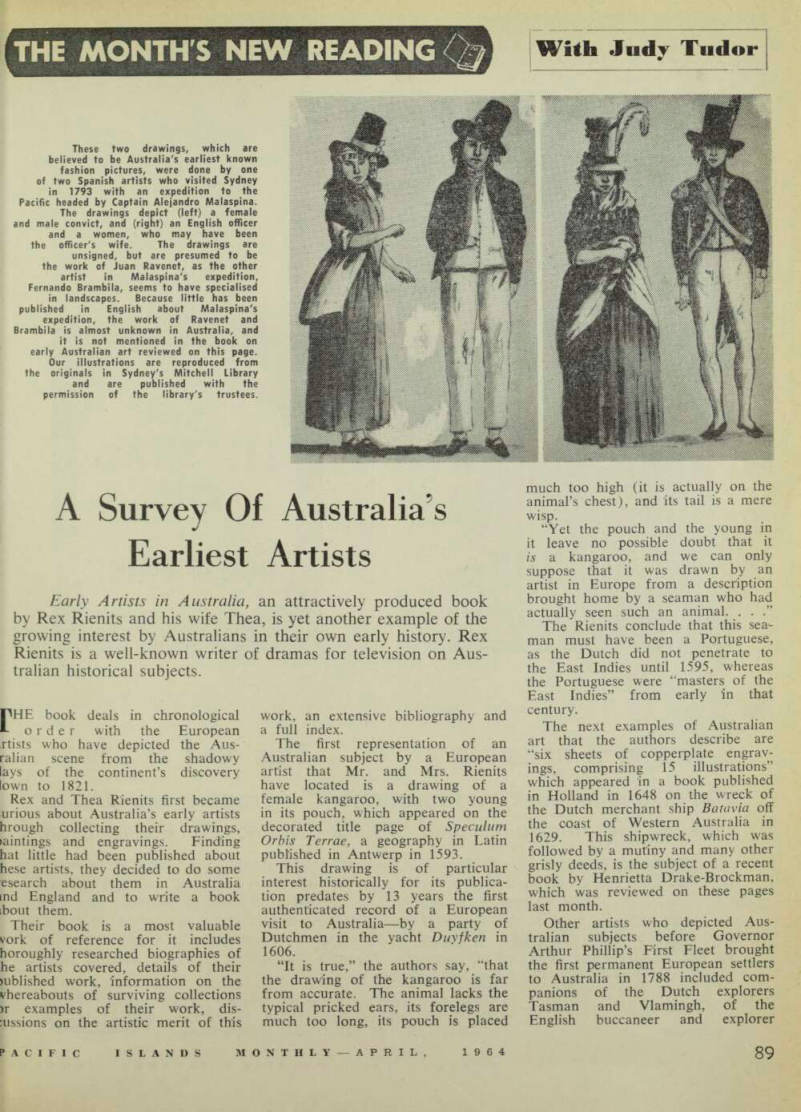
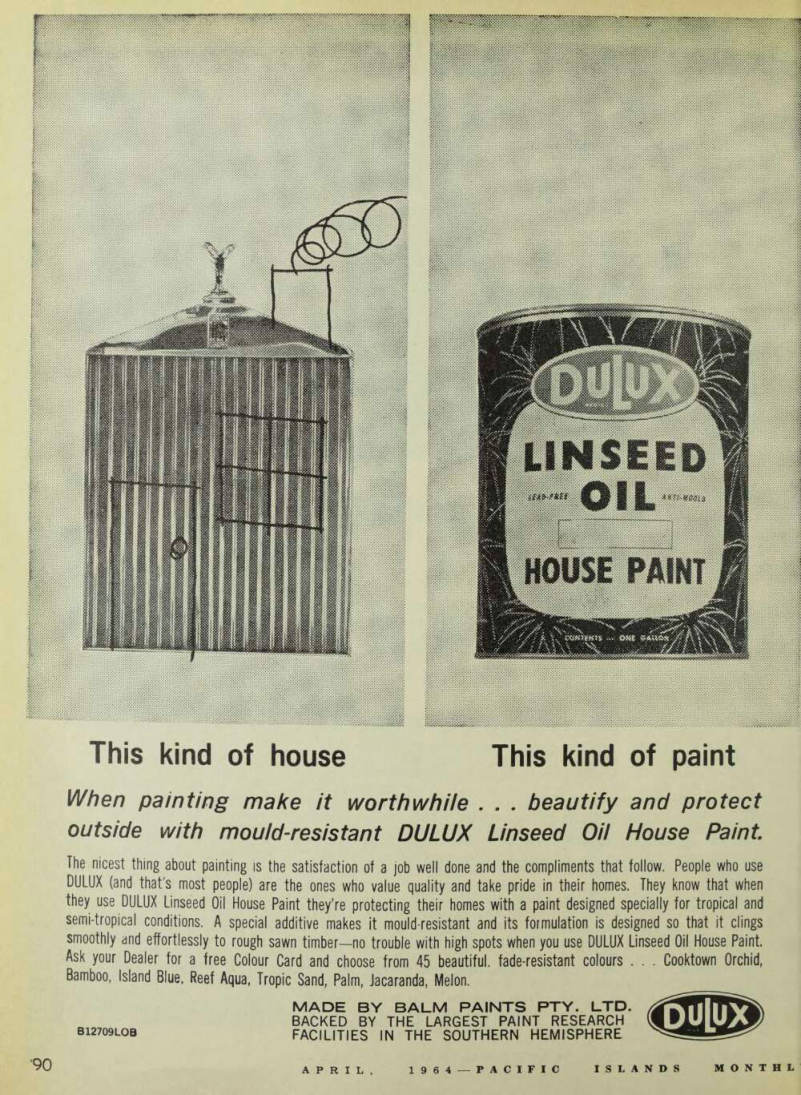
But the Rienits make no mention )f two Spanish artists who visited Sydney in 1793 and who seem to lave been the only artists of the jeriod who thought that convicts md their overlords and ladies were vorth painting.
Twelve drawings and paintings by these artists—four of New South Wales subjects—are in Sydney’s Mitchell Library; others are in the Naval Museum in Madrid.
The two artists were Juan Ravenet and Fernando Brambila. They were members of a scientific expedition, sponsored by the Spanish Govern ment, which spent several years in the Pacific in the ships Descubierta and Atrevida between 1789 and 1794.
As the present reviewer described in an article in PIM in February, 1962 (p. 19), the expedition was headed by Captain Alejandro Malaspina, an Italian by birth, who fell into disgrace on his return to Spain and was imprisoned for nine years.
Simultaneously with Malaspina’s imprisonment, the King of Spain ordered all the journals, charts and drawings of his expedition to be seized and withheld from publication.
The result was that almost nothing was known of the expedition’s work
until 1849 when a journal kept by one of Malaspina’s officers, which had apparently escaped the general seizure, was published in Spanish in the town of Cerrito de la Victoria.
Malaspina’s own journal was not published until 1885, but it has never been translated into English.
The journal contains several entries on the activities of the artists Ravenet and Brambila in New South Wales which the Rienits should be interested to know about.
One entry, under the date March 25, 1793, states that Ravenet had gone overland from Sydney to Botany Bay with two English officers “so that he would have a better chance of meeting some of the aborigines and sketching them with their arms and customs”. The entry adds that the other artist, Brambila, had undertaken “some perspective views” of Sydney.
Other entries describe how; • Brambila accompanied Mala spina and several of his officers on a trip to Parramatta and that Brambila finished several drawings of that settlement that gave “a better idea of the place” than any descrip tion Malaspina could give. • Malaspina gave Acting- Governor Grose two views of Sydney Cove and one of Parramatta which Brambila had drawn with “a masterly hand”. • Ravanet “satisfied the desires” of most of the principal men and women of the colony by drawing miniatures of them they could send their friends in England.
Acquired in 1961 The 12 examples of the two artists’ work in the Mitchell Library were acquired in 1961; those in Madrid’s Naval Museum were found by an Australian scholar, Father Celsus Kelly, in 1956, and were later microfilmed for the Mitchell Library and National Library, Canberra. it is evident from a study of this unpublished material that Brambila and Ravenet were competent rather than brilliant.
But as they were the first foreign artists to visit Australia after the establishment of the penal settlement in New South Wales, they should certainly merit a page or two in Early Artists of Australia if Mr. and Mrs. Rienits ever bring out a revised
edition of their book.
Robert
Langdon.
(Early Artists Of Australia.
Published by Angus and Robertson Ltd. £5/5/-.)