Eager Spades Revealed Clues
pp. 85-87 · Read in the full issue

To Rarotonga’s Past
From W. H. Percival, on Rarotonga
When Dr. Roger Duff and his Canterbury Museum archaeological expedition visited Rarotonga in December. 1962, and January, 1963, the Cook Islanders showed an un precedented interest in their historical sites, long overgrown with bush.
''HE expedition’s work in the Cook - Islands was part of a three-year ogramme designed to trace the igrations to all the Polynesian lands.
The programme is a joint effort stween Honolulu’s Bishop Museum id New Zealand universities and useums. Besides the Cooks, it ivers the Society and Austral lands, Samoa and Pitcairn.
In Rarotonga, Dr. Duffs small am uncovered foundations of old mses and surveyed ancient marae, te open-air temples of heathen mes.
Most of the marae had been jstroyed and their sites were only arked by heaps of stones, but this was off-set to some dent by the enthusiastic help re lived from the Cook Islanders.
Once they understood that the am’s purpose was to try to trace ic origins of their ancestors, every ne on Rarotonga, from the land wning ariki to ordinary villagers, ive all help possible.
House Foundations The sites of the marae were eared of bush and volunteer labour ;lped to uncover foundations of jry old dwellings.
The best-preserved marae is that E Arai-te-Tonga. It is also the oldest id the most famed in Rarotonga, id probably in all the Cook Group.
As in other Polynesian Islands, ook Islands history was handed awn by word of mouth, because lere was no written language.
But the memory of man is illible, and Dr. Duff believes that le reasonable accuracy of the oral lethod does not extend beyond 500 sars.
Many Rarotongans look on the :gend of Tangi’ia and Karika, which ills of events of more than 600 ears ago, as the beginning of their land’s history. But Dr. Duff
pointed out that the island must have been inhabited long before that—and the legend itself suggests that, any way.
About 1300 AD, so legend runs, a chief named Tangi’ia sailed from Tahiti on a marauding and explora tory expedition. His sea-going, twin hulled canoe is reputed to have carried 150 people, and provisions for some weeks at sea.
Off Mauke, in the southern Cook Group, he encountered Karika, a Samoan chief, with a similar canoe.
They prepared to fight, but after sizing each other up, decided to test their prowess by a marine tug-of war.
A line was made fast between the two war canoes and the paddlers were urged into action. Tangi’ia won and, as a mark of respect, Karika gave him his daughter. From that time on, the two chiefs became firm friends.
Their combined forces invaded Rarotonga and defeated its defenders —so the island was already inhabited —and the victorious chiefs divided the mountainous island between them. Then Tangi’ia ordered the building of Rarotonga’s first marae, Arai-te-Tonga.
Open-Air Court
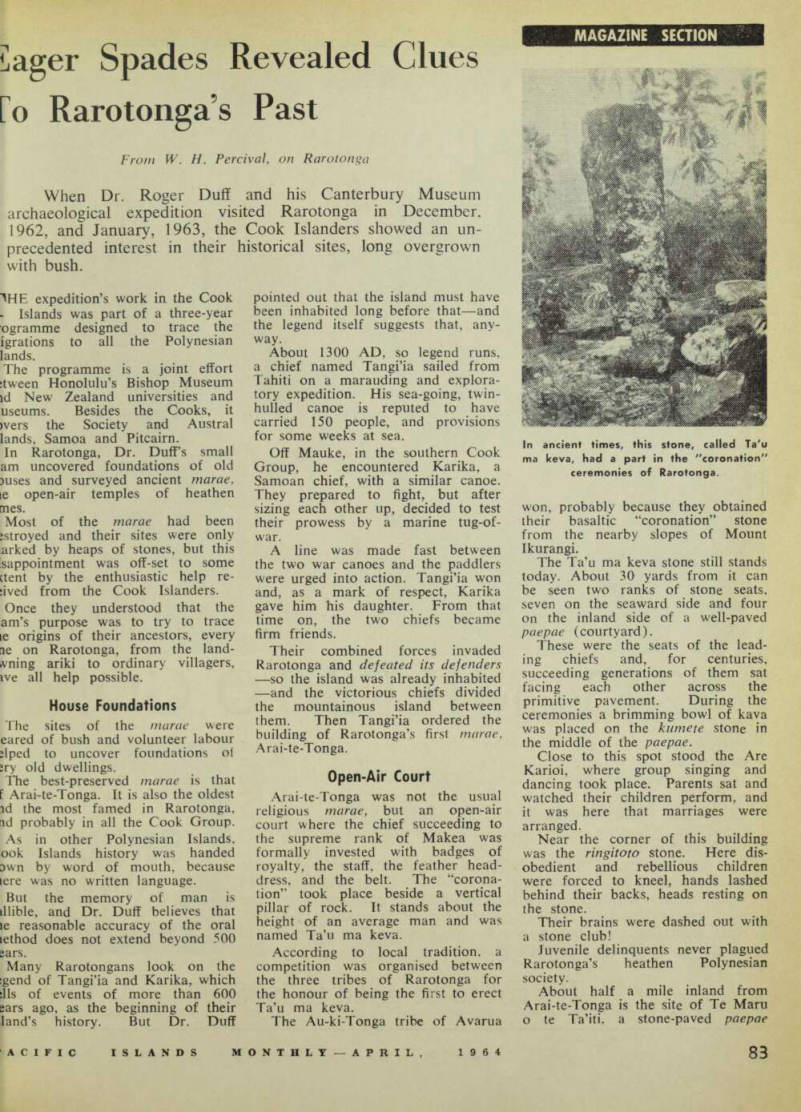
Arai-te-Tonga was not the usual religious marae, but an open-air court where the chief succeeding to the supreme rank of Makea was formally invested with badges of royalty, the staff, the feather head dress, and the belt. The “corona tion” took place beside a vertical pillar of rock. It stands about the height of an average man and was named Ta’u ma keva.
According to local tradition, a competition was organised between the three tribes of Rarotonga for the honour of being the first to erect Ta’u ma keva.
The Au-ki-Tonga tribe of Avarua
won, probably because they obtained their basaltic “coronation” stone from the nearby slopes of Mount Ikurangi.
The Ta’u ma keva stone still stands today. About 30 yards from it can be seen two ranks of stone seats, seven on the seaward side and four on the inland side of a well-paved paepae (courtyard).
These were the seats of the lead ing chiefs and, for centuries, succeeding generations of them sat facing each other across the primitive pavement. During the ceremonies a brimming bowl of kava was placed on the kumete stone in the middle of the paepae.
Close to this spot stood the Are Karioi, where group singing and dancing took place. Parents sat and watched their children perform, and it was here that marriages were arranged.
Near the corner of this building was the ringitoto stone. Here dis obedient and rebellious children were forced to kneel, hands lashed behind their backs, heads resting on the stone.
Their brains were dashed out with a stone club!
Juvenile delinquents never plagued Rarotonga’s heathen Polynesian society.
About half a mile inland from Arai-te-Tonga is the site of Te Maru o te Ta’iti, a stone-paved paepae
In ancient times, this stone, called Ta'u ma keva, had a part in the "coronation" ceremonies of Rarotonga.
riiich lies at the foot of a 965 ft till called Oroenga. The paepae, a ectangle roughly 25 yards by six rards, contains seven stone seats or the ariki. The seats face those if the supreme chieftain and his rife.
This chiefly court is reached by a emarkably well-laid pathway of flat olcanic rocks which extends some 0 ft.
Pre-Christian visitors were met on his path by a deputation of seven nataiapo (noblemen under the rank if ariki).
One of the seven stood at the foot >f the path and greeted the visitor rith a leather-lunged “Oro mai!”
“Welcome!”) The mataiapo spokesman then nelt and invited the guest to step ver his shoulder, signifying that the uest was of greater importance than imself.
Te Maru o te Ta’iti was strictly lit of bounds for all commoners, nd only important and secret latters were discussed there.
Vomen could be present, but all, in luding the “First Lady”, were orbidden to speak.
The marae of Arai-te-Tonga and he court of Te Maru o te Ta’iti are he best preserved marae on Raro 3nga. Dr. Duff intends to continue is survey of them on his next visit.
Stone-Paved Road Dr. Roger Duff believes it likely hat Rarotonga and the southern ►lands of the Cook Group were ihabited by Polynesians 1,500 ears ago.
He has a sound basis for this leory.
For instance, there is an ancient tone-paved road called the Ara ietua, parts of which are still in se today. This road is believed to ave been built by a chief named ’oi 300 years before the Tangi’ia [arika invasion of Rarotonga.
The Ara Metua is situated inland f the modern coastal road and runs Imost completely around the 21lile circumference of Rarotonga.
To build a road this length, Dr. )uff argues, would have required a opulation that only 500 years of rocreation could have produced.
When Dr. Duff and his team re isit Rarotonga they may well un over charcoal from some primitive iven, which, with the aid of the ecently-developed radio-carbon dat ng technique, may help them stablish when man first came to larotonga.