Native Claim To
p. 69 · Read in the full issue
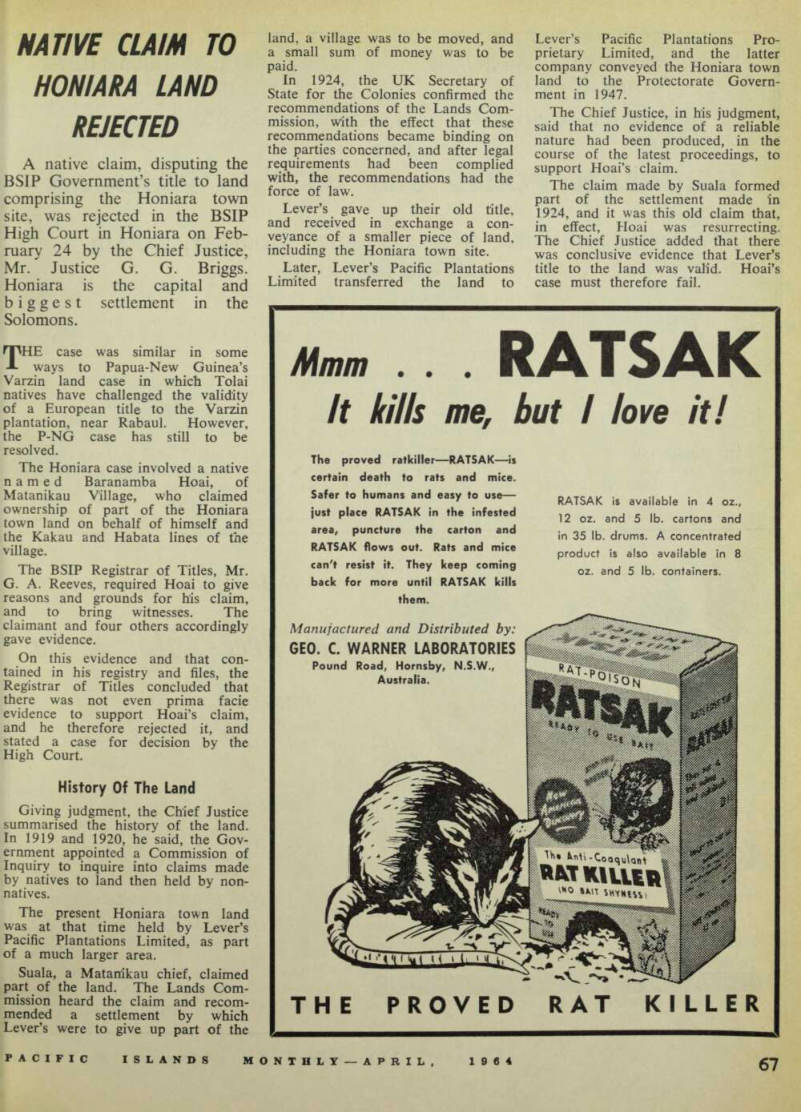
Honiara Land
Rejected
A native claim, disputing the BSIP Government’s title to land comprising the Honiara town site, was rejected in the BSIP High Court in Honiara on Feb ruary 24 by the Chief Justice, Mr. Justice G. G. Briggs.
Honiara is the capital and biggest settlement in the Solomons.
THE case was similar in some ways to Papua-New Guinea’s Varzin land case in which Tolai natives have challenged the validity of a European title to the Varzin plantation, near Rabaul, However, the P-NG case has still to be resolved.
The Honiara case involved a native named Baranamba Hoai, of Matanikau Village, who claimed ownership of part of the Honiara town land on behalf of himself and the Kakau and Habata lines of the village.
The BSIP Registrar of Titles, Mr.
G. A. Reeves, required Hoai to give reasons and grounds for his claim, and to bring witnesses. The claimant and four others accordingly gave evidence.
On this evidence and that con tained in his registry and files, the Registrar of Titles concluded that there was not even prima facie evidence to support Hoai’s claim, and he therefore rejected it, and stated a case for decision by the High Court.
History Of The Land Giving judgment, the Chief Justice summarised the history of the land.
In 1919 and 1920, he said, the Gov ernment appointed a Commission of Inquiry to inquire into claims made by natives to land then held by non natives.
The present Honiara town land was at that time held by Lever’s Pacific Plantations Limited, as part of a much larger area.
Suala, a Matanikau chief, claimed part of the land. The Lands Com mission heard the claim and recom mended a settlement by which Lever’s were to give up part of the
land, a village was to be moved, and a small sum of money was to be paid.
In 1924, the UK Secretary of State for the Colonies confirmed the recommendations of the Lands Com mission, with the effect that these recommendations became binding on the parties concerned, and after legal requirements had been complied with, the recommendations had the force of law.
Lever’s gave up their old title, and received in exchange a con veyance of a smaller piece of land, including the Honiara town site.
Later, Lever’s Pacific Plantations Limited transferred the land to
Lever’s Pacific Plantations Pro prietary Limited, and the latter company conveyed the Honiara town land to the Protectorate Govern ment in 1947.
The Chief Justice, in his judgment, said that no evidence of a reliable nature had been produced, in the course of the latest proceedings, to support Hoai’s claim, . . , . c , - , The claim made Suala formed part Qf the settlement made in 1924, and it was this old claim that, j n effect, Hoai was resurrecting, The Chief Justice added that there W as conclusive evidence that Lever’s title to the land was valid. Hoai’s case must therefore fail.