Big Task
pp. 52-54 · Read in the full issue
After 160 Years, Famous Bible Society Still Has Big Task In The Pacific
By Staff Writer Robert Langdon
After 160 years of effort, during which it has circulated translations of the Bible or parts of the Bible in 1,213 languages, the British and Foreign Bible Society is still faced with the job of circulating the Bible among the people of some 950 language groups in New Guinea whose languages have not been translated.
THE society, which has just cele brated its 160th anniversary, was founded in England on March 7, 1804. Its object is “to encourage the wider distribution of the Holy Scriptures without note or comment.”
The 1,213 languages in which the society has so far circulated the Scriptures represent just over one third of the world’s languages. But this impressive figure includes only 44 of New Guinea’s estimated total of 1,000 languages, of which about 700 are spoken in Papua-New Guinea and the others in Indonesian West New Guinea.
However, the task of getting the Bible into print in the unpublished languages of New Guinea, is now be ing tackled with greater energy and method than at any other time, and many more NG languages -will have their Scriptures within the nex* decade.
Translations Adviser In November last year the Bible Society appointed a translations adviser to its Australian headquarters in Canberra to assist translators in New Guinea and other parts of Oceania—Australia, Polynesia, Micro nesia and the rest of Melanesia.
The translations adviser is the Rev.
W. J, Culshaw, a Methodist minister, who was born in India and who was previously translations adviser for India, Pakistan and Ceylon.
Individual translators or translat ing teams are now working on about 150 languages in New Guinea and other parts of the Pacific, with Mr.
Culshaw’s assistance, where they are beyond the learning stage.
About 130 of the languages are tongues of New Guinea. Of these, 54 are being handled by the Wycliffe Bible translators of the Summer In stitute of Linguistics. Missionaries of various denominations are working on the rest.
The Bible Society, or associated bodies, will eventually publish the work of these various translators.
The Summer Institute of Lingu istics, a non-profit organisation sup ported solely by gifts, has been estab lished in New Guinea since 1957.
Its objects are to: • Make a study of Pacific languages and to translate into them books of high moral and cultural value, par ticularly the Bible, and to prepare introductory reading materials for these languages and to promote the reading of it. • Seek to carry out its linguistic investigation in co-operation with Government agencies and su c h organisations as pursue related objec tives to those of the institute.
The institute trains its translators to study languages scientifically—by recording them phonetically—and, according to the Bible Society’s Com monwealth Deputy Secretary, the
Rev. R. A. Hickin, they are doing “a very good job”.
However none of their Bible translations, has yet reached the stage of publication.
Mr. Hickin says it is the aim of his society to publish translations of the Bible in every language of the world.
But as many of the small language communities, particularly in New Guinea, will inevitably link up with larger language groups as communica tions improve, it is the society’s policy “not to perpetuate the tiny languages by unwise Scripture translation.”
Explaining this further, Mr. Hickin says: “Broadly, we try to concentrate on those languages where we can do the most good in the shortest pos sible time. In other words, we work on thd languages of the biggest tribal groups first and progress towards the smaller ones.”
Mr. Hickin says that missionaries, working in the field, are usually the first to realise the need for a trans
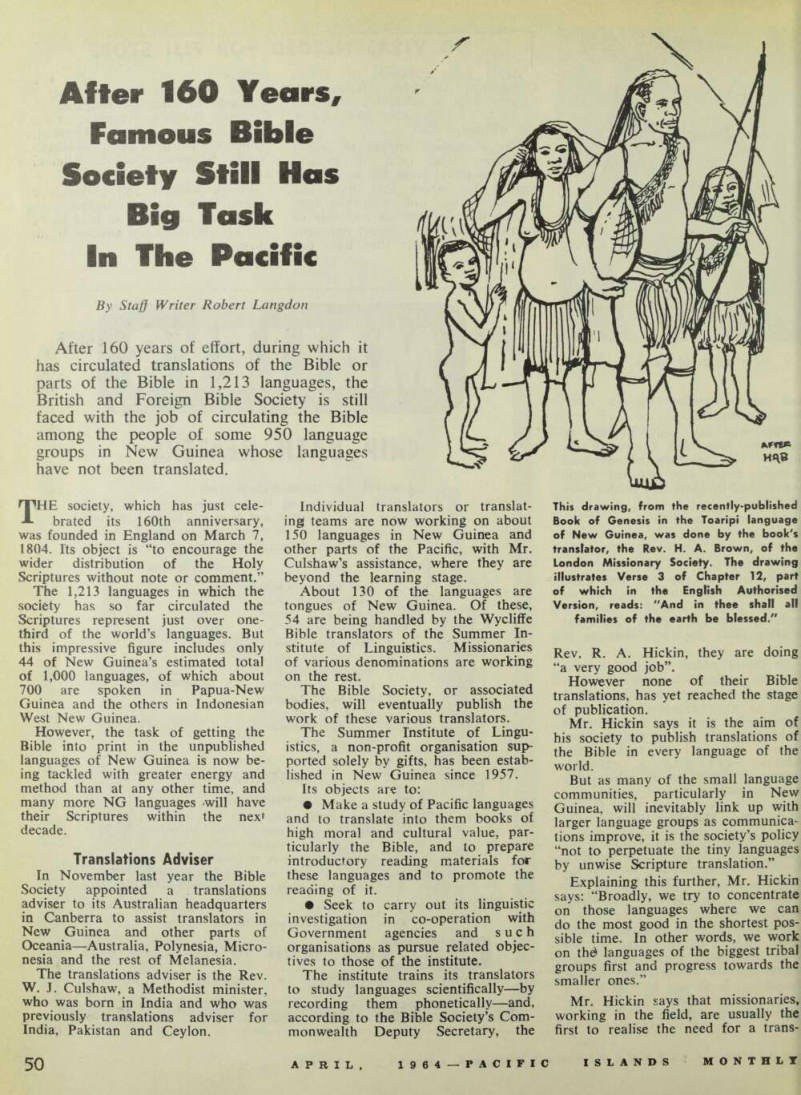
This drawing, from the recently-published Book of Genesis in the Toaripi language of New Guinea, was done by the book's translator, the Rev. H. A. Brown, of the London Missionary Society. The drawing illustrates Verse 3 of Chapter 12, part of which in the English Authorised Version, reads: "And in thee shall all families of the earth be blessed."
lation of the Scriptures into a par ticular language.
Usually, they then begin to trans late a portion of the Bible them selves. But sometimes, after having got the job well in hand, they become so busy with other matters, that they :annot devote adequate time to it.
In such cases, the Bible Society sometimes arranges to have the missionaries seconded to its own staff until the task of translation is com pleted.
This means that the Bible Society substantially subsidises the salaries and expenses of the missionaries con fined.
The Rev. Percy Chatterton, of the London Missionary Society, and the
Rev. A. H. Hall, of the Methodist Church in New Zealand, are two translators working on Oceanic languages who are now on second ment to the Bible Society.
Both are working on translations of the Old Testament—Mr. Chatter ton is doing the Motu language of southern Papua, and Mr. Hall is do ing the Roviana language of the Solomons. The New Testament has already been translated into those languages. 11l Pacific Languages Mr. Hickin says that the Bible or parts of it have now been translated into and published in 111 Pacific languages. This figure includes the 44 New Guinea languages, but excludes Australian aboriginal languages.
The Bible Society has been associ ated with the publication of the Bible in Pacific languages since the very beginning, as it provided the paper to print the first South Seas Scriptures—the Gospel of St. Luke in Tahitian.
This Gospel, which was translated by the Rev. Henry Nott, of the Lon don Missionary Society, was printed at Afareaitu on the island of Moorea in 1818.
Nott went on to translate the whole of the New Testament into Tahitian, and this was published in 1829. The complete Bible followed in 1838.
The Tahitian Bible was the first in a South Seas language, and, of course, the first in a Polynesian language.
The first Melanesian language to have a complete Bible was Fijian.
This Bible appeared in 1864. The translators were J. Calvert and E.
Hazlewood.
Only 14 other Pacific languages— six Polynesian and eight Melanesian —have complete Bibles. The Poly nesian languages are those of Tonga, Samoa, Rarotonga, Hawaii, Niue and New Zealand. The Melanesian languages are those of Uvea, Lifu and Mare (New Caledonia’s Loyalty Islands), Mota (Banks Islands, New Hebrides), Marovo (eastern part of New Georgia, BSIP), Mukawa and Dobu (New Guinea) and Aneityum (southernmost island of the New Hebrides).
Dedication Translations of the complete New Testament have appeared in 31 Pacific languages, and several others will be published soon.
It goes without saying that the translation of the complete Bible, or even a Testament or Gospel calls for
endless patience, energy and dedica tion.
Yet the names of the translators never appear on the title pages of their work when it appears in print, and their names seldom become known outside a limited circle.
One such translator is Mr. Norman C. Deck, who now lives in Sydney, after spending much of his life with the South Seas Evangelical Mission on Malaita, BSIP. Mr. Deck trans lated the whole of the New Testa ment into the Mwala Kware’ae language of Malaita.
Another translator is the Rev.
H. A. Brown, ' of the London Missionary Society, who is working on a translation of the Old Testa ment into the Toaripi language of Southern Papua. Mr. Brown lives at a lonely spot about 30 miles in from the Gulf of Papua.
His translation of the Book of Genesis was recently printed by the British and Foreign Bible Society. It was unusual in having an attractive
cover design and illustrations by the translator. These caused it to be singled out for high praise from friends of the Bible Society, Except for complete Bibles, which are published in London, the Aus tralian branch of the Bible Society (founded in 1817) handles the publica tion G f a \\ Testaments or portions of the gjble in the languages of New Guinea and the Solomons, Polynesian and other Melanesian languages are dealt with by the society’s New Zealand branch.
As the major Polynesian languages b 4n , ra * slated the B ra *, n °* rev,sl ° n - According to the latest (1963) annual report of the society, two of the Polynesian translations of the Bible are now being revised—Samoan a nd Tongan.
The report says that the Tongan revision, under the direction of Dr.
John Havea, an outstanding Tongan
leader, “may lead eventually to over coming divisions in the Tongan Church.”
This is understood to be a refer ence to the breach that developed back in 1885 when Tonga’s King Tupou I, with the assistance of the Rev. Shirley Baker, seceded from the Wesleyan Church and established the Wesleyan Free Church of Tonga.
Subsequently, the Tongan Govern ment forbade the use in schools of a translation of the New Testament by the Wesleyan (but not Free Church) missionary, the Rev. J. Egan Moulton, which was published in London in 1880. But it approved the use in schools of another version of the New Testament by the Rev, T. West, which was published in London in 1884.
The rift between the Wesleyan Church and the Wesleyan Free Church of Tonga remained until 1924 when Queen Salote (the head of the Free Church) persuaded 12,000 mem bers of her faction to unite with 4,000 Wesleyans.
New Body
However, some 6,000 members of Queen Salote’s Church refused to unite with the Wesleyans, and many of these formed a new body called the Free Church of Tonga.
Meanwhile, the members of the various bodies have used one or other of the two available Scripture trans lations as their “Authorised Versions”, and this has hindered further reconciliation among Tonga’s churchgoers.
A conference on the revision of the Tongan Bible, presided over by Tonga’s Premier, Prince Tungi, and attended by Tongan church repre sentatives, was held in Tonga in 1962.
Interestingly, the meeting was at tended by the Rev. Harold Moulton, of the Bible Society’s London trans lations department, who is a great nephew of the Rev. J. Egan Moulton, whose translation of the New Testa ment into Tongan is one of the points at issue in Tonga’s Church rift.
During the same year, the Rev.
Harold Moulton also visited Fiji where, according to the Bible Society’s 1963 report, a need was ex pressed for Fijian Bibles in a bold clear print “because of the poor eye sight of many Fijians”.