Tourism Prospects
pp. 37-40 · Read in the full issue
South Seas Awaken To Tourism Prospects
By a Staff Writer
The South Pacific took its closest ever look at the tourist industry in March, and went back home again a little sobered at what it had seen.
THE occasion was the 13th annual conference of the Pacific Area Travel Association, an organisation of 23 governments, and scores of air lines, shipping companies, hotels and travel agents, dedicated to promote tourism in the Pacific.
The conference had a record at tendance of more than 700 delegates, no doubt due to the big proportion of hotel and travel people from Aus tralia, New Zealand and the South Seas who turned up to get the latest Pacts on bed and butter prospects for 1964.
When PATA last held a meeting in Australia, in 1957, South Pacific tourism was hardly taken seriously.
This time, many South Pacific people learned something they hadn’t realised before—that the PA in PATA takes in a hunk of the world that Antipodeans normally refer to as South East Asia, and that the South Seas are at present the country cousins of what the rest of the world thinks of as the Pacific area. This fact brought about some kind of awakening.
Tahiti, Fiji and New Caledonia are members of PATA, but so are Korea, Taiwan, Japan, Hong Kong, Singa pore, Indonesia and even India.
Korea will be host country for next year’s conference, and the one after that will be held in Delhi—
which to many South Pacific dele gates seemed a million light years from the kind of tourist problems presented by Pago Pago.
None of the conference executives was even sure just what sort of image popped into the average American’s mind when you yelled
“Pacific!” (surely it didn’t conjure up the Taj Mahal?).
Nevertheless, the new season’s publicity drive will make an effort to sell specific areas in the wide Pacific, instead of diluting the pro motion over the whole brimming basin of sights and smells.
As one of the advertising men told the conference: “The campaigns we have run since the inception of PATA’s advertising programme in 1958 have been aimed toward de veloping an awareness of the Pacific as a whole as a holiday area, as opposed to the far better known travel areas such as Europe and the Caribbean.
“In this our campaigns have suc ceeded remarkably well. The trend is towards the Pacific. Now is the time to move to the next step and get specific about the attractions of the Pacific.”
The best clue available to the South Seas delegates about their own chances was the report of a survey last year in America which found
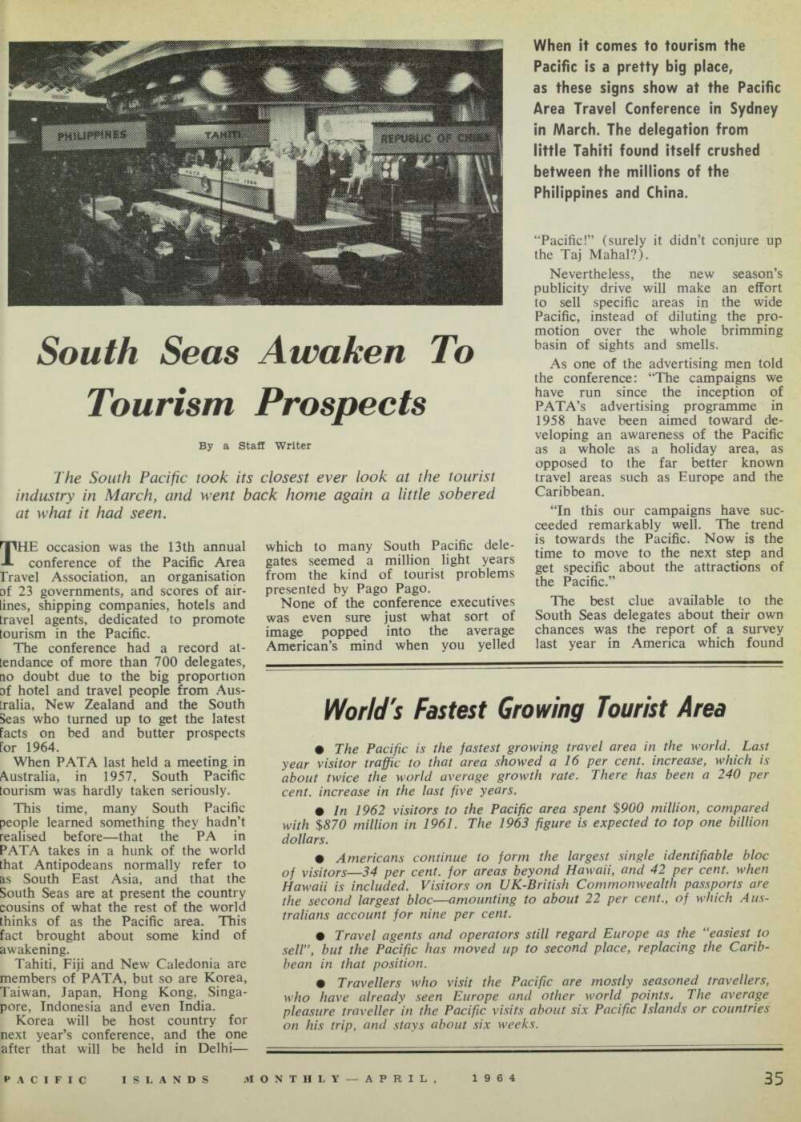
When it comes to tourism the Pacific is a pretty big place, as these signs show at the Pacific Area Travel Conference in Sydney in March. The delegation from little Tahiti found itself crushed between the millions of the Philippines and China.
that the countries most frequently mentioned when asked “What in terests you most about the Pacific?” were: Japan, Australia, Hong Kong, New Zealand, Hawaii and the South Pacific Islands. But three of these countries—Hawaii, Japan and Hong Kong—had the lion’s share of actual visitors, for between them these North Pacific countries accounted for more than 50 per cent, of total visitors to 22 PATA member areas.
Thailand, India, Australia, Singa pore and New Zealand between them could account only for another 32 per cent.
Pacific 'Amateurs 7 And two other sets of facts made an impression, for better or worse, on South Seas’ minds: One was the information that de
spite the big increase in tourism in the whole of the Pacific area (240 per cent, in the last five years) the Pacific people are still amateurs when it comes to getting the tourist dollar away from competitors else where.
"Remarkable Results"
Tourist countries of Europe, the Caribbean and North and South America receive more visitors by chance than the Pacific gets by de sign. On the basis of percentage in creases the Pacific can still speak only in hundreds of visitors while Europe speaks in thousands.
The second impressive fact was that Fiji has had “remarkable results” with one of the smallest budgets of any national tourist office, thus prov ing just what can be done if you try. Fiji in January had the largest number of tourists ever to come to the Colony in one month (with the exception of the South Pacific Games month last year), with a 35 per cent, increase on the figures for January, 1963.
Also, instead of arriving in Fiji mainly between November and March, as in previous years, Ameri cans are now arriving throughout the year.
PATA quite clearly has had much to do with this, But Mr. Don Lane and Miss Iris Hunt, both represent ing Fiji, also gave warm credit to a special promotion, “Destination South Pacific”, which the Australian National Travel Association launched in America last year with the help of NZ and the big carriers.
This promotion, which will be continued this year, ties in various South Pacific territories with NZ and
Australia, and the main business it has generated has yet to come.
The scheme will probably be the forerunner of similar South Pacific co-operative promotions, meaning even closer South Pacific liaisons.
Some people see it as the begin ning of a South Pacific promotions organisation which may eventually take the place of PATA in this area.
Undoubtedly such an organisation will appear as Pacific tourism is stepped up (in only eight or nine years’ time, the conference was told, supersonic jets will bring Sydney within 5i hours of San Francisco and 3i hours of Hong Kong).
But despite its disadvantages of having to splash about in a very big pond, PATA even in this sub sonic and piston-driven age is selling the South Seas far more cheaply and efficiently than can any South Pacific organisation, including ANTA, going it alone—a fact of life gladly con ceded by the South Seas people at the conference.
But that doesn’t mean that the South Seas aren’t—now—interested in discovering all the tricks of at tracting the tourists to the South
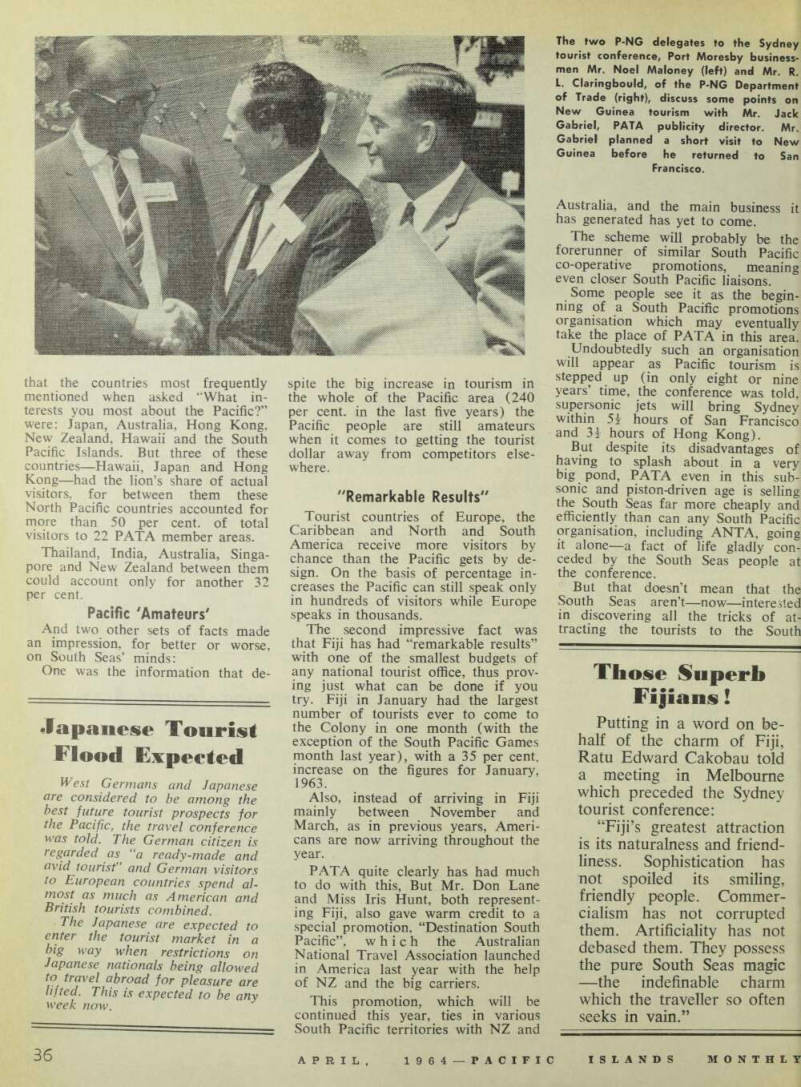
The two P-NG delegates to the Sydney tourist conference, Port Moresby business men Mr. Noel Maloney (left) and Mr. R.
L. Claringbould, of the P-NG Department of Trade (right), discuss some points on New Guinea tourism with Mr. Jack Gabriel, PATA publicity director. Mr.
Gabriel planned a short visit to New Guinea before he returned to San Francisco.
icific—and at the expense of The 'g Three up north, if need be. And e problem doesn’t end with Fiji, ahiti and New Caledonia —for these rritories are better off than most, anks to the fact that they are on e existing tourist routes.
As PATA investigations have und, most tourists want to see as uch for their money as they can, id if they head for Australia they e just as likely to stop-over in ahiti, Fiji and New Caledonia if eir transport touches down at ose points.
But territories such as Papua-New uinea have to start from the begin ng. New Guinea’s enormous oblems were summed up in a para aph for his fellow delegates by [r. Noel Maloney, of Port Moresby, ho commented: “Firstly, we have a Government iat is not inclined towards tourism, jcondly, we have hotels that are not 3 to standard. Thirdly, very few Dtels have been built in the last 10 *ars. Our problem is this: How can ATA, or the members of PATA, ;lp us to become a tourist country?”
How, indeed?
NG Tourist Scheme The first requisite, obviously, had > come from New Guinea itself— iat is, Government co-operation. A :cond requirement is transport ser ices, and New Guinea certainly eeds something better than the pre ;nt poor air roads in from Australia nd Fiji via the Solomons, and it eeds an outlet to the north, so that avellers can get in and out without oing through Australia twice.
As a matter of fact, sponsorship as already arrived in New Guinea, nd some people think it will get an dded fillip soon when the report of
last year’s World Bank survey of New Guinea is released. The report is expected to suggest, among other things, that P-NG develop its tourist potential.
And Canberra is at the moment pondering the merits of a Govern ment-sponsored tourist development scheme for New Guinea which would be designed to promote the building of new hotels using com bined Government and private enter prise capital.
The Government would have its
own representatives on the boards of directors, but the hotels would be conducted by private enterprise. The Government money, it has been sug gested, could also be used to support other tourist ventures.
One of the merits of Government sponsorship, as the Government sees it, is that official participation is a guarantee of security for private capital which might otherwise not be prepared to risk money in New Guinea’s uncertain political climate.
It was noted at the conference that
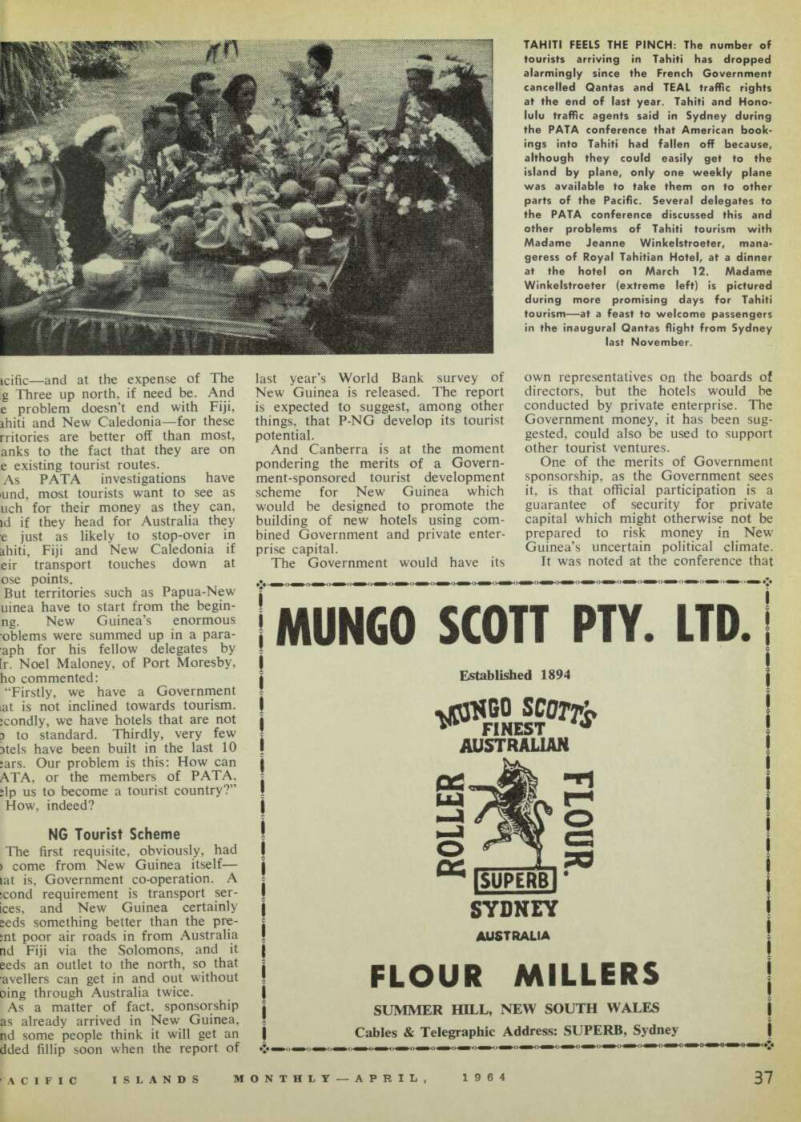
TAHITI FEELS THE PINCH: The number of tourists arriving in Tahiti has dropped alarmingly since the French Government cancelled Qantas and TEAL traffic rights at the end of last year. Tahiti and Hono lulu traffic agents said in Sydney during the PATA conference that American book ings into Tahiti had fallen off because, although they could easily get to the island by plane, only one weekly plane was available to take them on to other parts of the Pacific. Several delegates to the PATA conference discussed this and other problems of Tahiti tourism with Madame Jeanne Winkelstroeter, mana geress of Royal Tahitian Hotel, at a dinner at the hotel on March 12. Madame Winkelstroeter (extreme left) is pictured during more promising days for Tahiti tourism—at a feast to welcome passengers in the inaugural Qantas flight from Sydney last November.
although from the tourist point of view New Guinea has so far even less to show than has, say, the in dependent State of Western Samoa, at least P-NG is doing something at the Government level, which is more than Western Samoa is.
Western Samoa, Where?
New Guinea did have a Govern ment man at the PATA conference, as did Fiji, Tahiti, New Caledonia and American Samoa, but Western Samoa didn’t, and this fact was noted by those in Apia who can see the value of the tourist industry to the South Pacific. Western Samoa’s
official attitude is shared by a num ber of other South Sea territories.
The weekly Apia newspaper, Samoana, the week of the conference in Sydney, commented rather bitterly that the Government’s diffident atti tude towards tourism was hard to explain.
“While planters are exhorted to grow more and are given assistance from the Government to increase production,” it said, “those in the tourist business who are doing just as much to earn foreign exchange to the benefit of the country as a whole are ignored by the Government.
“In increasing the welfare of the people of this country it is just as
important to build up a tourist in dustry as it is to sell more bananas —and from the experience of othei countries tourism offers faster and easier profits than most other de velopment projects.
“In co-operation with America!
Samoa these islands could offer the most unique and enjoyable tours available in the whole of the Pacific However until the Government plays its part in actively promoting tourism and generally supporting the tourisl industry, Western Samoa will con tinue to play its role of poor relatior to American Samoa, standing by anc hoping to catch some crumbs.”
Agitation and internal pressures foi action like this can be expected tc increase in the South Seas as the tourist figures rise. As the trickle widens to a stream all territories wili be forced to evaluate tourism as ar industry, and an industry that the> probably cannot afford to be with
out, notwithstanding the frequentl>
expressed fear that tourism coulc harm what is loosely termed the ole way of life.
The fear is a real one.
Problem of Traditions Yet tourism does not mean thal traditional values have to be blowr away in the wake of the jet trails, as conference speakers stressed or several occasions.
It is as much in the interest of the tourist business as the Islanders themselves that Miamisation does nol take over the South Pacific, foi people and their customs, rather than places, are what the Soutl Seas have to sell.
The next 10 years might well be trying ones in the South Seas as the pressures build up, but it is becoming daily more obvious to many Islanders that the pressures will build up, and none of the problems will be over come by failing to acknowledge their existence.