New Guinea Has Lost Its
pp. 33-36 · Read in the full issue
Sydneysider Goes Walkabout
New Guinea Has Lost Its Lead In The Air
There may be something poetic in the fact that although New Guinea was air-minded while the rest of the Pacific was getting about on metaphorical high-bikes, the Territory's link with the outside world is now a decade behind the times. But there isn’t much justice in it.
Papua-new guinea was due for modern planes on the service o Australia years ago but as things ire working out, it will still likely be the end of the year, or even longer, jefore the two airlines operating the service can introduce Electras.
This depends now, not so much >n the lengthening of Lae airport— vhich is currently going on—but the irrival for service in Australia of the Boeing Ill's which the domestic drlines will introduce into Australia services. This will release Electras for the Sydney-Lae route.
Inadequate Service
The DC6B aircraft put on the service by the two operating air companies, Ansett-ANA and TAA, when Qantas withdrew its Super- Constellation service between Sydney and Port Moresby in 1960 were not adequate then and are far less so now even though the number of services has been stepped up to eight a week plus a weekly Fokker-Friendship be tween Lae and North Queensland air ports.
The high rate of seat occupancies on the Australia-NG service no doubt delights the air companies, but under
present circumstances it can be sheer discomfort for the customers.
The aircraft are divided into first class and tourist, but the first class is about on a par with international economy class and the tourist class is somewhere down below that.
This would have little significance on a journey of a couple of hours, as between Brisbane and Sydney or Sydney and Melbourne. But because of the equipment the elapsed time of the journey between Sydney and Port Moresby is more than eight hours, and on the north-bound trip it takes place between 9.45 p.m. and 6 a.m.
Furthermore, these planes have only two lavatories, placed just for ward of the tourist compartment.
Without putting too fine a point on it, that isn’t enough to go round on a service which carries about 70 people, of whom a high proportion are children and an even higher pro portion men who drink large quanti ties of beer!
This present set-up is probably not the fault of any one instru mentality. Up to date it has been a matter of not getting the right kind of aircraft until there were the right
kind of airports to land them on while at the same time no one has got very busy providing the right kind of airports because those already there are adequate for the planes already on the route.
For the world traveller, this journey, in its way, provides a good introduction to a territory which, despite all rumours to the contrary, still retains many of its old Wild West ways. And, having reached Port Moresby, only one more surprise awaits the traveller: That in the Territory the present policy of non discrimination applies also to first and tourist airline seats.
A couple of weeks ago, when I re sumed my journey to Lae after hav ing spent several days in Port Moresby, I was shown into one of the tourist seats, although I held a first-class ticket. As no doubt dozens of first-class ticket holders had done before me, I protested. The hostess finally produced a beardless youth from the ticket office.
Only One Class “What,” he said in tones one might employ to a moronic kindergarten child, “appears to be the trouble, madam?”
I told him. But, I was mistaken, he said. In New Guinea there was only one class and there was no reason why I should not be put in what were the tourist seats on the way up. However, no doubt the hostess could find me a seat in the first-class seats at the back after take-off.
It is possible that the captain of the aircraft felt, on that occasion, that he would be unable to get the plane into the air unless my 1\ stone
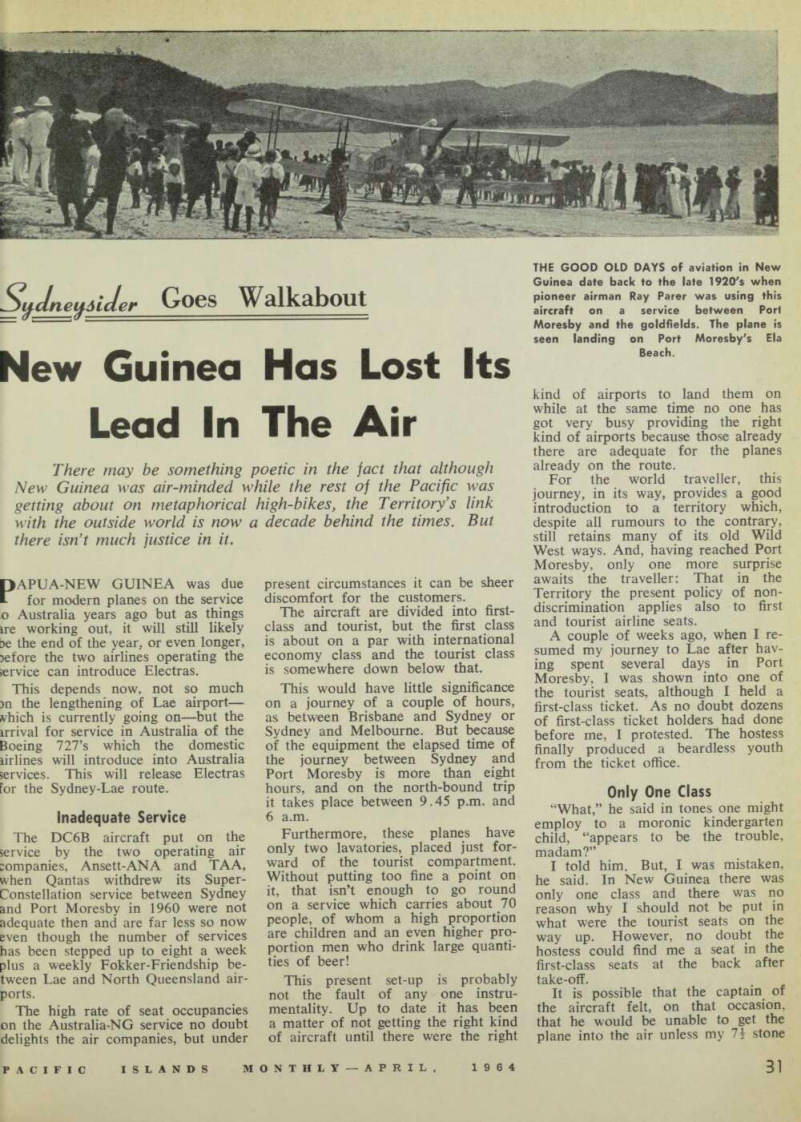
THE GOOD OLD DAYS of aviation in New Guinea date back to the late 1920's when pioneer airman Ray Parer was using this aircraft on a service between Port Moresby and the goldfields. The plane is seen landing on Port Moresby's Ela Beach.
fere stowed up forward instead of i one of the several vacant seats I ould see in the erstwhile first-class action, but at the time I didn’t be eve it.
Wedged into a window seat along ide a Papuan and his wife, two xldlers, a babe in arms and two appy bags, I reflected on the fact hat if the metamorphosis must take lace in the DC6 once it reaches loresby, there were two things an irline could do in the interests of ood customer relations: Change all ne seats over at that point; or let veryone scramble for what there fas, as the airlines do in Europe.
I was also uncomfortably aware lat the Papuan probably thought I 'as putting on my big act because was forced to travel in the bosom f his family.
"Gesture To Freedom" 1 was still so mad at Lae that I opped out and booked my passage ack to Sydney by the “other airline”, ven though while doing it I knew lat it was inconveniencing no one ut myself.
But, with this gesture to freedom nder my belt, I continued on to loroka and Madang appeased. * * * If travel between the Territory and aistralia continues to be the mixture s-before, civilisation has hit internal jrvices in the Territory with a lump. Gone are the days when you it side-saddle in metal seats, with le unlined fuselage boring holes in our back; or rode with galvanised inks, rolls of barbed wire or hens i crates. And nobody speaks of le “boong run” any more.
To be sure, the rumours of four ;ars ago that turbo-prop aircraft ere to replace the old DC3’s has jmained just that—except for weekly irties of Fokker Friendships out of forth Queensland, But the old work orses have been prettied up, have
hostesses (who can show the southern variety a lot of points), and food.
No longer is it necessary to go the long way round to anywhere and starve to death in the process —if you couldn’t manage to pinch the pilot’s lunch in Madang or Momote. Now they serve out break fasts and lunches and tea at the drop of a hat; likewise cold towels and magazines.
True to the rule for non-discrimi nation, indigenous travellers come in for their full cut, with a pretty hostess asking solicitously if they take milk with their coffee or would care for a magazine.
However, even this occasionally misfires. There is the story of the savage straight from the bush who, having just polished off a mess of fruit and cornflakes and two fried sausages, was offered, along with everyone else, a cold towel so that he could clean up a little.
It was one of those small blue and white affairs of artificial fibre mesh and it nestled on the tray with all the others, neatly folded and covered with melting ice-cubes.
The fellow obviously didn’t know what it was but he took it gingerly and, keeping his head in the forward position, rolled his eyes first to the left and then to the right. He couldn’t get a clue so at last popped it in his mouth and thoughtfully chewed it up. As his introduction to civilisation it was guaranteed to set racial relationships in the Territory
back a hundred years, I should think.
With the rejuvenated DC3’s are coming new terminals, with coffee bars and bookstalls. One is being started in Rabaul, another is nearing completion in Madang and Lae’s terminal is being extended.
The work at Lae is running about three months behind schedule and even when completed will probably still be inadequate for the tre mendous number of people who pass through this airways junction.
It will have about three times the public space of the old building, plus better “amenity” blocks which have dispensed with the time-honoured
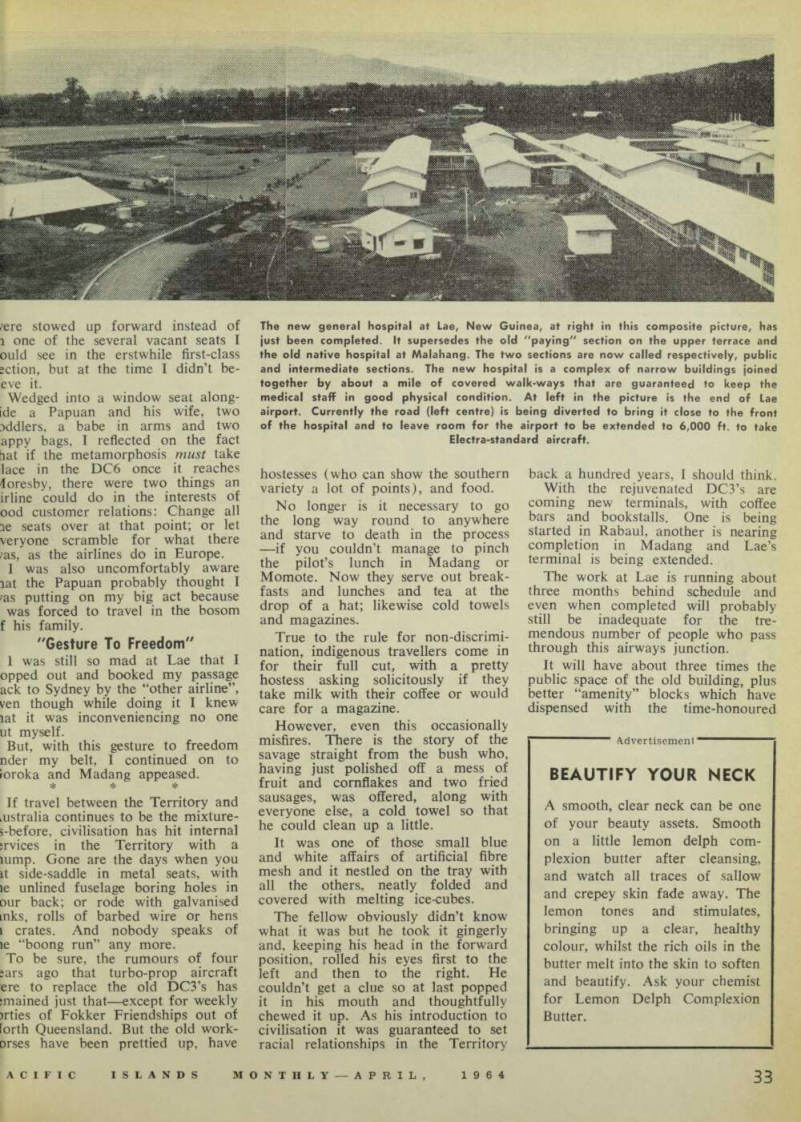
The new general hospital at Lae, New Guinea, at right in this composite picture, has just been completed. It supersedes the old "paying" section on the upper terrace and the old native hospital at Malahang. The two sections are now called respectively, public and intermediate sections. The new hospital is a complex of narrow buildings joined together by about a mile of covered walk-ways that are guaranteed to keep the medical staff in good physical condition. At left in the picture is the end of Lae airport. Currently the road (left centre) is being diverted to bring it close to the front of the hospital and to leave room for the airport to be extended to 6,000 ft. to take Electra-standard aircraft.
Australian Ladies and Gents and got down to fundamentals more fit ting to P-NG in its present mood b> being labelled simply Male and Female.
A year ago it was decided tc lengthen the present Lae airstrip tc bring it up to Electra standard rathei than build a new airport up the Markham Valley. About 300 feet oi runway have already been added and trees lopped in the approaches. Wori is now in progress diverting Mark ham Road to the north where it wil join Milfordhaven Road at a nev roundabout and so leave room foi the airstrip to be extended to 6,00( ft.
Long before it was decided tc lengthen the existing strip, anothei set of planners decided to place the new Lae Base Hospital on the fla land on the northern side of Mark ham Road. The hospital is just beinj completed and with the new roac diversion and airstrip extension wil find itself not only with a main roac on its doorstep but placed in the approaches of the Territory’s busies airport.
In an air-minded place like Nev Guinea this is probably consideree fitting, but in most other places towi planners would consider it prett] eccentric.