Letters To The Editors
pp. 27-31 · Read in the full issue
[?]Atives Sold Down
[?]He Drain
Sir, —American diplomacy is
:e a lottery on a grand scale, herein you sometimes win, but ostly lose. The Americans
iven’t the calm, logical long-
of the older Euro jan nations.
MdE Americans sold the indigenes • of West New Guinea down the ain. But for that, those natives, a very short time, would have ined their independence under the tidly Dutch rule.
Why do the Australian and New laland Governments, and the Press both countries, handle the threat om Indonesia with delicate kid oves, and half shut eyes, instead a bold declaration by both •untries of full military support in ly crises that might arise? Only ich a firm stand is likely to give mse to Soekarno.
The editorials of The Fiji Times, jva, are the only firm and clear [pressions on the situation that I ave read, and I heartily concur ith their views.—Yours, etc.
H. S. Faddy.
adroga, iji.
"Old Glory"
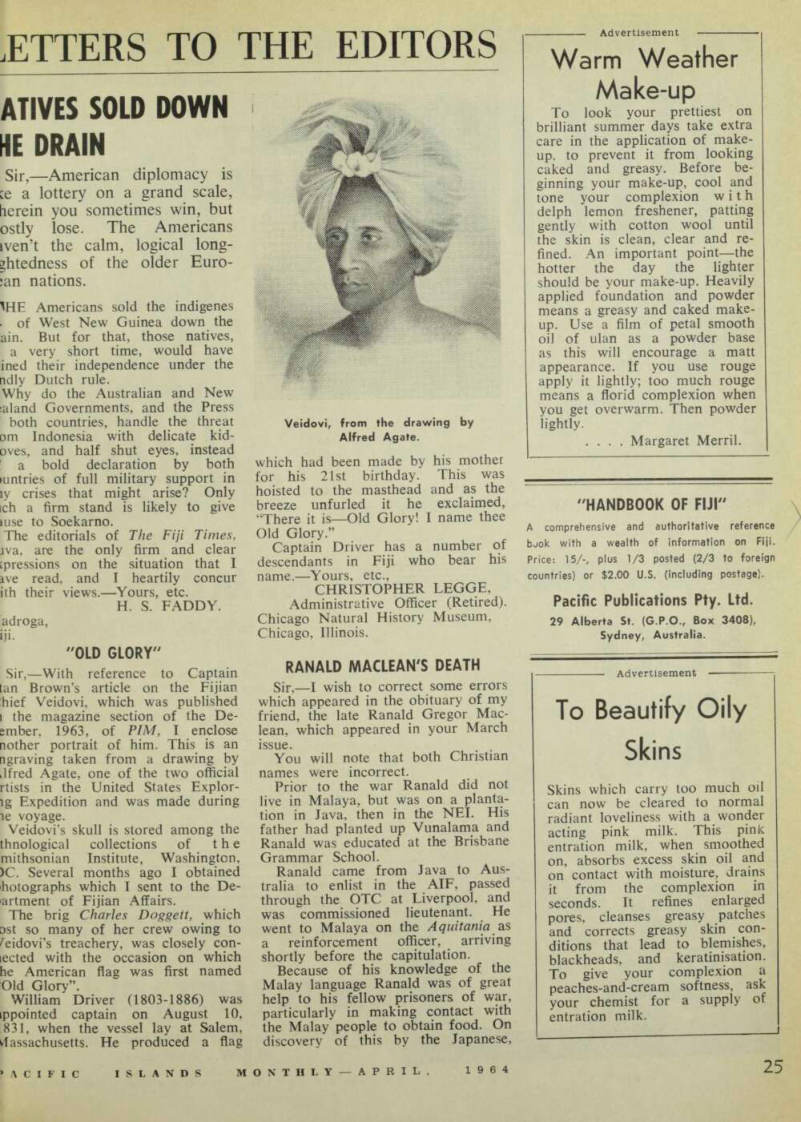
Sir,—With reference to Captain tan Brown’s article on the Fijian hief Veidovi, which was published i the magazine section of the De ember, 1963, of PIM, I enclose nother portrait of him. This is an ngraving taken from a drawing by dfred Agate, one of the two official rtists in the United States Explor ig Expedition and was made during le voyage.
Veidovi’s skull is stored among the thnological collections of the mithsonian Institute, Washington, )C. Several months ago I obtained holographs which I sent to the De triment of Fijian Affairs.
The brig Charles Doggett, which ost so many of her crew owing to feidovi’s treachery, was closely con iccted with the occasion on which he American flag was first named Old Glory”.
William Driver (1803-1886) was ippointed captain on August 10, 831, when the vessel lay at Salem, Massachusetts. He produced a flag
which had been made by his mother for his 21st birthday. This was hoisted to the masthead and as the breeze unfurled it he exclaimed, “There it is—Old Glory! I name thee Old Glory.”
Captain Driver has a number of descendants in Fiji who bear his name. —Yours, etc.,
Christopher Legge,
Administrative Officer (Retired).
Chicago Natural History Museum, Chicago, Illinois.
Ranald Maclean's Death
Sir, —I wish to correct some errors which appeared in the obituary of my friend, the late Ranald Gregor Mac lean, which appeared in your March issue.
You will note that both Christian names were incorrect.
Prior to the war Ranald did not live in Malaya, but was on a planta tion in Java, then in the NEI. His father had planted up Vunalama and Ranald was educated at the Brisbane Grammar School.
Ranald came from Java to Aus tralia to enlist in the AIF, passed through the OTC at Liverpool, and was commissioned lieutenant. He went to Malaya on the Aquitania as a reinforcement officer, arriving shortly before the capitulation.
Because of his knowledge of the Malay language Ranald was of great help to his fellow prisoners of war, particularly in making contact with the Malay people to obtain food. On discovery of this by the Japanese,
Veidovi, from the drawing by Alfred Agate.
anald was put in solitary confine ent. The ill-health which led to his sath had been ascribed by the Re itriation Department to his war rvice.
Ranald went to New Guinea after ie war to manage and rehabilitate unalama. Subsequently he served veral years at the Lowlands Agri iltural Station, Keravat, and then signed to go back to Vunalama and i supervise Kleinwata. 111-health msed him to resign as manager of unalama several years ago. lan succeeded Ranald on Vuna ma but went to Sydney over two ;ars ago and now lives at Suther nd.—Yours, etc.
Dudley Jones.
ownsville, ueensland.
Solomons Old Hands
Sir, —The letter from Mr. A. H. rreen, of St. Helena Island, about le old days in the Solomons ( PIM , larch), revived memories for me nd doubtless for many ex-Solomons ands who will recall him as “Sol” rreen, one of W. R. Carpenter’s lanagement men who frequently did stint as supercargo in the com any’s ships.
I remember him in the Mascot , in diich he made several voyages in 923, and he may be interested to ear that some of her old crew are till on deck.
Walter Buckley was skipper in 923 and ran her as skipper-super argo. He now is living at Faulcon ridge, NSW. Buckley ran the trad ig station at Graciosa Bay, “Big” ianta Cruz, for many years before e came to Sydney just before World Var II began.
Dave Lazarus, Mascot's mate, yhen last heard of was on the NSW Coast after 30 years in the jroup, during which he ran several hips and traded at Ontong Java.
Cliff Welsh, onetime Mascot man, etired in March last as Deputy Chief if the Sydney Metropolitan Fire brigade.
Carpenter’s Solomon Islands mana ;er, Harry Chaperlin, was for years n the Taxation Department in Sydney and on being retired took )n a job at Vanikoro.
Buckley, Lazarus, Sim (engineer), Jill Russell and myself were in Vtascot when she was wrecked at Jtupua in March, 1924. Lazarus md Sim sailed back to Tulagi in the ;hell boat, Arethusa, then owned by ;he Korean diver, Ito. The rest of us stayed on at Utupua (about six iveeks) until picked up by Lever’s steamer Kobiloko, then skippered by Captain Dreever.
Kobiloko, about 100 tons, was on her annual recruiting voyage to Santa Cruz and with her full complement of 100 recruits and the Mascot’s castaways had more than 140 of us on board. By a strange co incidence the then resident Commis sioner of the Solomons, Broadhurst- Hill, arrived at Utupua in the Govern ment yacht Tulagi about half an hour after Kobiloko. He had been attracted by the strange wreck on the reef. So two ships arrived at once at an island that was visited only once a year.
“Strewth, it’s getting like Circular Quay,” Buckley said as Tulagi’s mast head appeared over the point near our camp on the beach.
After we got back to Tulagi, Buckley and I went into the Vella but after about a month Buck left her for, I think, the Royal Endeavour or one of the Malaita Company’s other ships, and that great old pioneer Jack Newman and I punched Vella round the Solomon coast. Last I saw of her was in 1928 in Rabaul.
She piled up a year or so later in the Fead Group.
Lou Austin salvaged Mascot’s engine, which was later installed in the Duranbah in Sydney.
Bill Russell later left the Solomons for the New Guinea goldfields and died at Wau.
We distributed tons of junk from
the Mascot’s trade room so it is gratifying to learn that at least one item we sold, Sol Green’s safety razor, is still in daily use 40 years later. I still have one souvenir of the old ship—her engine-maker’s plate.
Reminiscences of the old Solomon days are always interesting, but what intrigues me even more is what the devil Sol Green is doing at St.
Helena. Island life certainly has got him!—Yours etc.
Bill Baverstock.
Mosman, Sydney.
Future Of American Samoa
Sir,—The article by the Honolulu lawyer, Mr, John Alexander, about the difficulties in American Samoa (PIM, March, p. 63) was an intelli gent piece of work. However, no doubt many other people on this side of the Pacific noted that while America is happy to give immediate independence to the rest of the world’s so-called colonies, she sees her own territories in a somewhat different light.
Mr. Alexander makes the comment that the final solution in American Samoa will call for the nicest possible adjustment of competing values “probably over a longish transitional period”.
There aren’t any long transitional
periods any more. The Americans are always telling us that! The pressure is on, and while most of us hate it, because things are going too fast for people’s own good, there doesn’t seem anything that anybody can do about it.
Who of us in New Guinea five years ago could have foreseen a 64member House of Assembly elected on a common roll with an over whelming native majority! And look what is happening in the Cook Is lands, the Solomons and Fiji—as re ported from month to month in PlM’s pages. Look what has hap pened to Western Samoa, right next door to the American “unincor porated” territory.
Certainly the American Samoans owe America a great deal, just as Fijians owe a great deal to Britain and the New Guineans owe a great deal to Australia. But what has that got to do with nationalism?
Even though they can’t afford it, I can’t believe that the American Samoans won’t insist on going their own political way also, and anybody who thinks there is going to be a “longish transitional period” which will enable all the problems to be sorted out is just asleep.
America ought to fix a few political tar Bet dates in Samoa, and do some thing specific about giving it auto nomy. before that infamous UN committee of 22 gets its hooks in.
Yours, etc
“Winds Of Change”.
Port Moresby, P-NG.
P| M In A Packing Case
Sir,—May I congratulate you on the ‘‘set up” and writings in the Pacific Islands Monthly. I find it instructive and most interesting, How did I “discover” the maga
zine? Well, I found an old copy j some packing that came froi the Islands. I read what I could, ar my mind went back to the time lived on some of them. Maybe will go back some day to get aws from the “rat race”.
However I am glad I found tl old copy, and have instructed m newsagent to deliver the magazine.
Should you have time to come 1 my Studio I would be pleased to r ceive you and show you a lar| ceramic-mosaic “light, sound an vision that will be erected i Sydney shortly. I have been commi; sioned to execute the murals on tli Empress of Australia. Maybe will work in something of the Island Meanwhile, here’s to the old copy i the packing case!—Yours, etc.
Byram Mansell.
Sydney.
A Complaint
Sir, —I would like you to publis this transaction which I have had wit the Public Works Department of th British Solomons.
I recently purchased a Bedfor truck from the Public Works Deparl ment. They are the only people wh< use Bedford trucks.
When overhauling it was foun< that a new clutch plate was require* and I applied to them for a new plate This is the account I received:—
Bsip Government Store
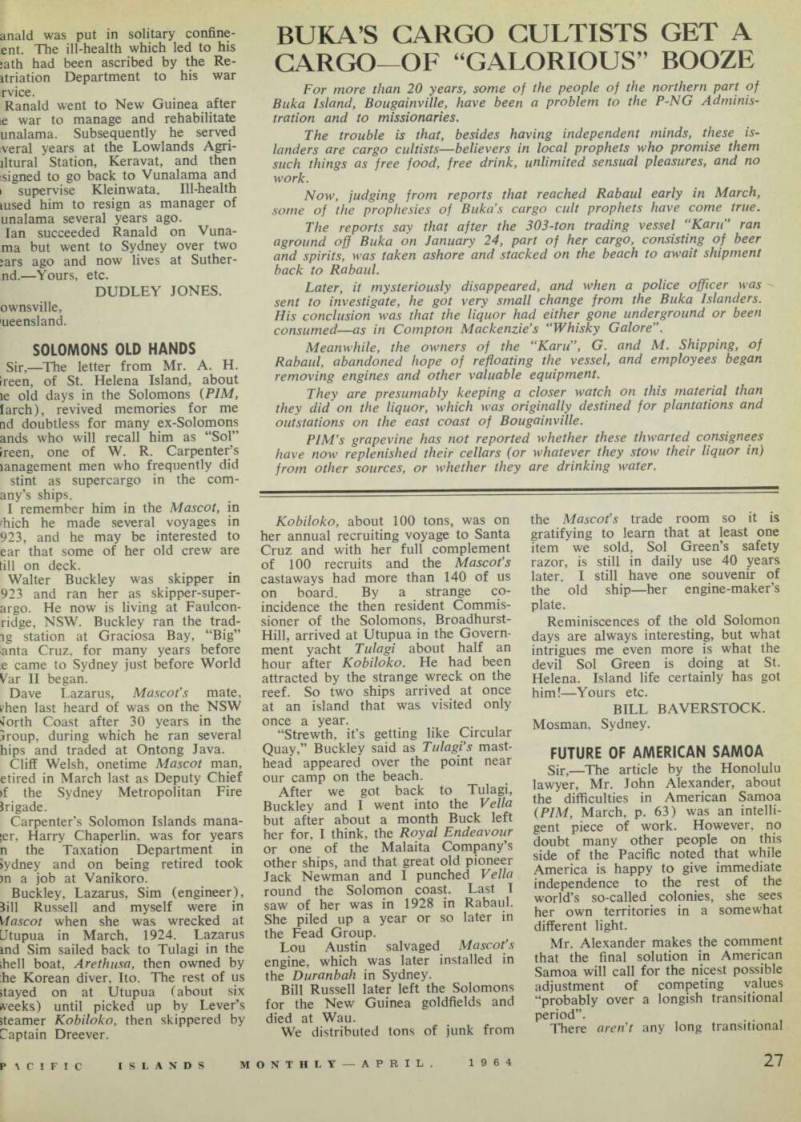
1 Only Clutch Plate—cost £3 10 < plus 25% duty . £ 1 17 ( 4 7 ( plus 100% ... 4 7 ( Total £8 15 ( This is a fair example of profiteering by Government.—Yours, etc.,
K. H. Dalrymple Hay
Honiara,
Bsip
Rotuma's Tombstones
Sir,—The article on Rotuma, plus Rob Wright’s pictures ( PIM , March, p. 37) were of great interest to me as I have just been reading The Western Pacific and Mashonaland by H. H. Rom'illy, who was Britain’s first Commissioner on Rotuma after the island became part of the Crown Colony of Fiji.
Romilly’s book throws some interesting light on how Rotuma be came a “land of tombstones” for he was there when the first tombstones arrived.
In an extract from his journal for November 10, 1880, he said that
a trading ship bound for Sydney had just arrived whose cargo for Rotuma consisted “almost entirely of tombstones”.
“The chiefs were much excited some time ago,” Romilly went on, “when they heard of the existence of such things, and have ordered a lot, which have now arrived.
“The Rotuman names are almost all wrong, but to a man who can’t read that is a trifle. The price was rather a staggerer to some of them.”
Romilly also explained why the Rotumans have “an almost Oriental reverence for their dead”.
The Rotumans, he said, are “quite a distinct race from any other South Sea Islanders, being a mixture of the Chinese and Samoan races, hav ing the faces of the Chinese with the enormous bodies of the Samoans”.
Yours, etc.,
J. G. Peters.
Parramatta, New South Wales.
Bsip Rice Plan
Sir, —In your February issue there was a short article on our operations in the Solomon Islands. Some of the information given was inaccurate and I would like to make the following points clear: (1) I am the Common wealth Development Corporation’s representative in the Solomons and not the manager; (2) The Corpora
tion has its headquarters in London, but is not a company as stated in your article; (3) The tractor is be ing used for general agricultural culti vation, such as ploughing, etc., and not for pulling up stumps.—Yours, etc.
R. H. W. Johnson.
Commonwealth Development Corporation, Honiara.