Tropicalities
pp. 19-22 · Read in the full issue
Although the new Papua-New Guinea Liquor Ordinance provided for the establishment of taverns — which would serve food and drink but not provide accommodation —the idea has caught on slowly.
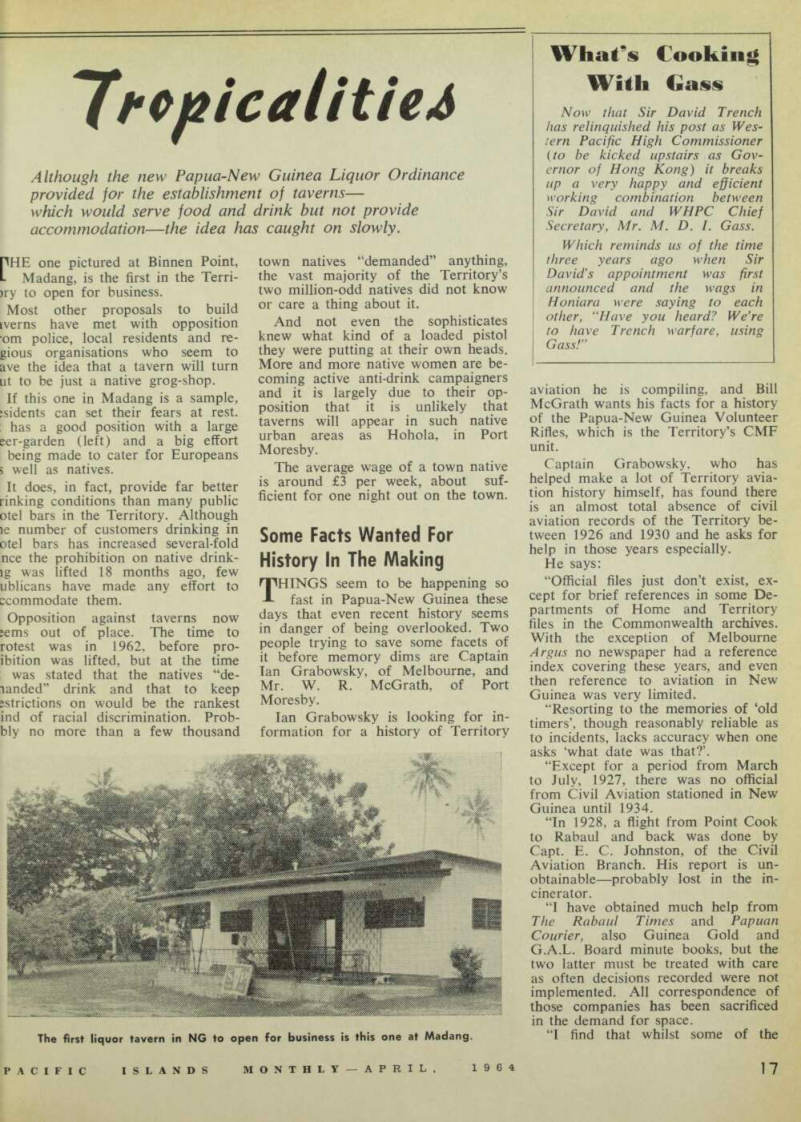
CHE one pictured at Binnen Point, Madang, is the first in the Terri )ry to open for business.
Most other proposals to build iverns have met with opposition om police, local residents and re gions organisations who seem to ave the idea that a tavern will turn ut to be just a native grog-shop.
If this one in Madang is a sample, ssidents can set their fears at rest. ; has a good position with a large eer-garden (left) and a big effort being made to cater for Europeans i well as natives.
It does, in fact, provide far better rinking conditions than many public otel bars in the Territory. Although le number of customers drinking in otel bars has increased several-fold nee the prohibition on native drink ig was lifted 18 months ago, few üblicans have made any effort to ccommodate them.
Opposition against taverns now ;ems out of place. The time to rotest was in 1962, before pro ibition was lifted, but at the time ; was stated that the natives “de landed” drink and that to keep jstrictions on would be the rankest ind of racial discrimination. Prob bly no more than a few thousand
town natives “demanded” anything, the vast majority of the Territory’s two million-odd natives did not know or care a thing about it.
And not even the sophisticates knew what kind of a loaded pistol they were putting at their own heads, More and more native women are be coming active anti-drink campaigners and it is largely due to their op position that it is unlikely that wlll a PP ea I J such native urban areas as Hohola, in Port Moresby.
The average wage of a town native jf .around £3 per week, about suf ficlent for one nl B ht out on ,he town ' C nmo Carte Wanted For iome raCTS VVaniea POr
History In The Making
1 v PPHINGS seem to be happening so A fast in Papua-New Guinea these days that even recent history seems m danger of being overlooked. Two people trying to save some facets of d before memory dims are Captain lan Grabowsky, of Melbourne, and Mr. W. R. McGrath, of Port Moresby. lan Grabowsky is looking for in formation for a history of Territory
aviation he is compiling, and Bill McGrath wants his facts for a history of the Papua-New Guinea Volunteer Rifles, which is the Territory’s CMF unit.
Captain Grabowsky, who has helped make a lot of Territory avia tion history himself, has found there is an almost total absence of civil aviation records of the Territory be tween 1926 and 1930 and he asks for help in those years especially.
He says: “Official files just don’t exist, ex cept for brief references in some De partments of Home and Territory files in the Commonwealth archives.
With the exception of Melbourne Argus no newspaper had a reference index covering these years, and even then reference to aviation in New Guinea was very limited.
“Resorting to the memories of ‘old timers’, though reasonably reliable as to incidents, lacks accuracy when one asks ‘what date was that?’.
“Except for a period from March to July, 1927, there was no official from Civil Aviation stationed in New Guinea until 1934.
“In 1928, a flight from Point Cook to Rabaul and back was done by Capt. E. C. Johnston, of the Civil Aviation Branch. His report is un obtainable—probably lost in the in cinerator.
“I have obtained much help from The Rabaul Times and Papuan Courier, also Guinea Gold and G.A.L. Board minute books, but the two latter must be treated with care as often decisions recorded were not implemented. All correspondence of those companies has been sacrificed in the demand for space.
“I find that whilst some of the
The first liquor tavern in NG to open for business is this one at Madang.
books written make excellent reading, for historical use they are not of much assistance.
“Most unfortunately, the records of transport other than by G.A.L. were not kept or have been destroyed. Be cause so many miners, mining syndi cates or companies financed the air operators, it is necessary to refer at some length to these interests and what I term the battle of transport philosophies, i.e., the road versus the rail, versus the air.
“And does anyone know what hap pened to W. E. Goff? I think his initials were W. E. He was Guinea Airways’ agent in Sydney and it seems to me that if still alive he might have some useful information.”
You can write to Grab care of the Department of Civil Aviation, Box 1839 Q, P.O. Elizabeth Street, Mel bourne, C.l.
Mr. W. R. McGrath, who can be reached through the Department of Lands, Port Moresby, is a PNGVR officer and former patrol officer who is writing an unofficial history of the PNGVR and the little-known 126 Heavy Battery RAA, which was formed in Port Moresby in 1939 to man the guns on Paga Hill, over looking Moresby harbour.
The PNGVR started life as the NGVR in September, 1939, and was disbanded in early 1943. It became the PNGVR in 1951. There were no war diaries except for one minor one in 1942 so that the history of this unit is largely in the memories of its many members. Bill McGrath wants to hear from former members or their associates who can supply unit details and activities, including photographs.
In Apia, Too Little
And Too Late
South Pacific Commission has . been working lately to improve its public relations and gain some much-needed publicity for the vital job it’s doing in the South Seas, but much is still wrong with the work ings, and it showed up during the plant quarantine conference held in Apia in March. As a result we can’t give you any information about the decisions of this significant meeting.
We don’t know any of them.
We do know that just about every body attended the conference (which was called to see what can be done to stop the big economic losses caused m the Islands by accidentally intro duced crop diseases and pests) be cause when we wired our man in Samoa for the details we finished up with nothing but a list of their names.
But it seems that nobody was mak ing any detailed statements.
In an editorial, the Samoa Bulletin got a little short-tempered about it.
It commented: “All sessions are closed and the findings will only be learned through emasculated newsletters and slow policy decisions at some time in the future. . . . Unless the present visitors wish to be classified in the public imagination as more experts, who have come, gone and left no im pression, they should make some effort to capture the people’s imag ination and goodwill.”
But we don’t think the lack of information is the fault of the delegates. The blame is with the SPC, which should arrange a Press coverage of its own big meetings as intelligently and as speedily as it covers its three-yearly South Pacific Conferences. Or else make it easy for somebody to cover them. The time and place to get the news out is when it’s happening, and at its source. The SPC is still far too involved with useless protocol on these matters.
How To Make Money
Without Even Trying
/'\NE day recently, while walking ” through one of Sydney’s shop
ping arcades, we noticed in a stamp dealer’s window a complete set oi Tonga’s circular postage stamps foi £B/10/-.
This seemed rather a lot for a sei of stamps issued less than a year ago so we did a little mental arithmetic to figure out the dealer’s profit on the stamps’ face value. The result was 566-2/3 per cent.—the face value of the stamps being £l/10/-.
A little further along in the same arcade, we came to another stamp dealer who was offering the seven lowest denominations in the same series for 21/-. More mental arith metic revealed that this dealer— reckless fellow—was contenting him self with a mere 484-2/3 per cent, profit, the face value of his stamps being 4/4.
Back at the office, we looked up the story we published on these circular stamps last July (p. 39) and found we had quoted a Nukualofa correspondent as saying that the local Post Office had sold out of the stamps within two days of their go ing on sale.
The correspondent added: “So it looks a profitable business for dealers in this latest Tonga Government venture in a most unconventional lot of stamps.”
To which we say: “ You can say that again!”
The stamps, by the way, were issued in three sets: Ordinary mail, airmail and official airmail. The de nominations were: Ordinary mail.
Id, 2d, 6d, 9d, 1/6 and 2/-; airmail, lOd, lid, 1/1, 2/1, 2/4 and 2/9; and official airmail, 15/-.
Madang's Beauty Falls
To the Axe
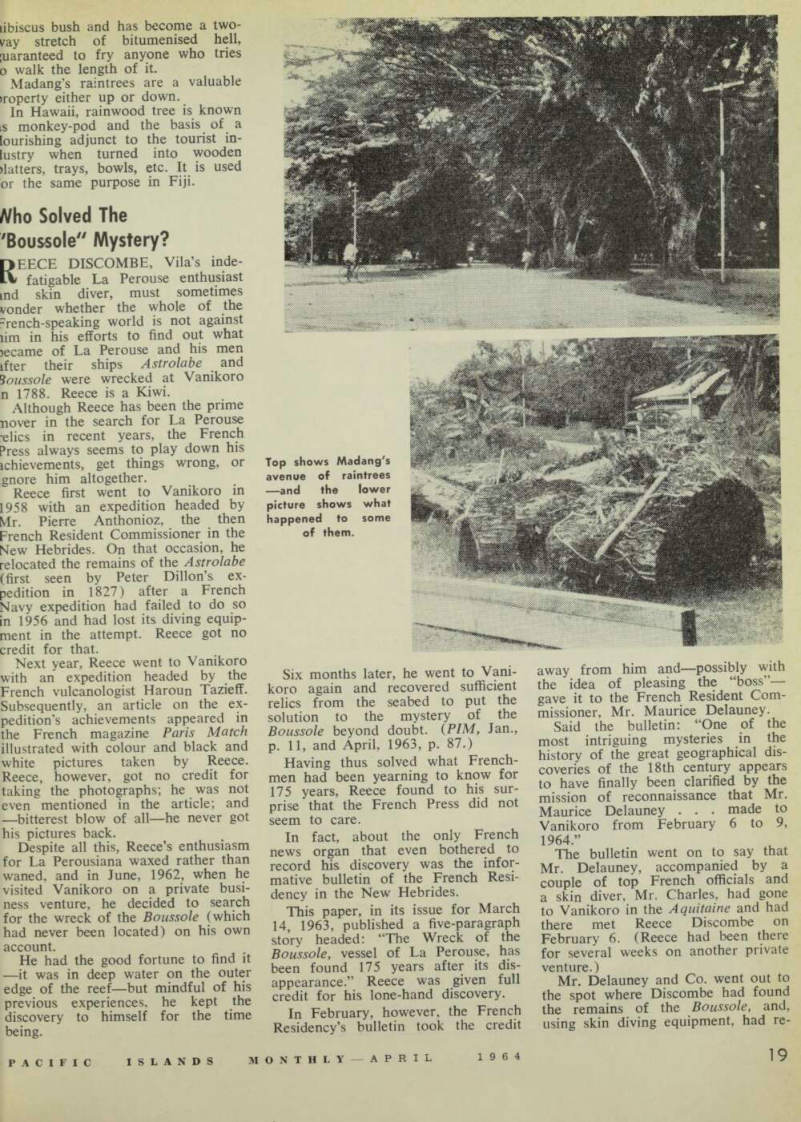
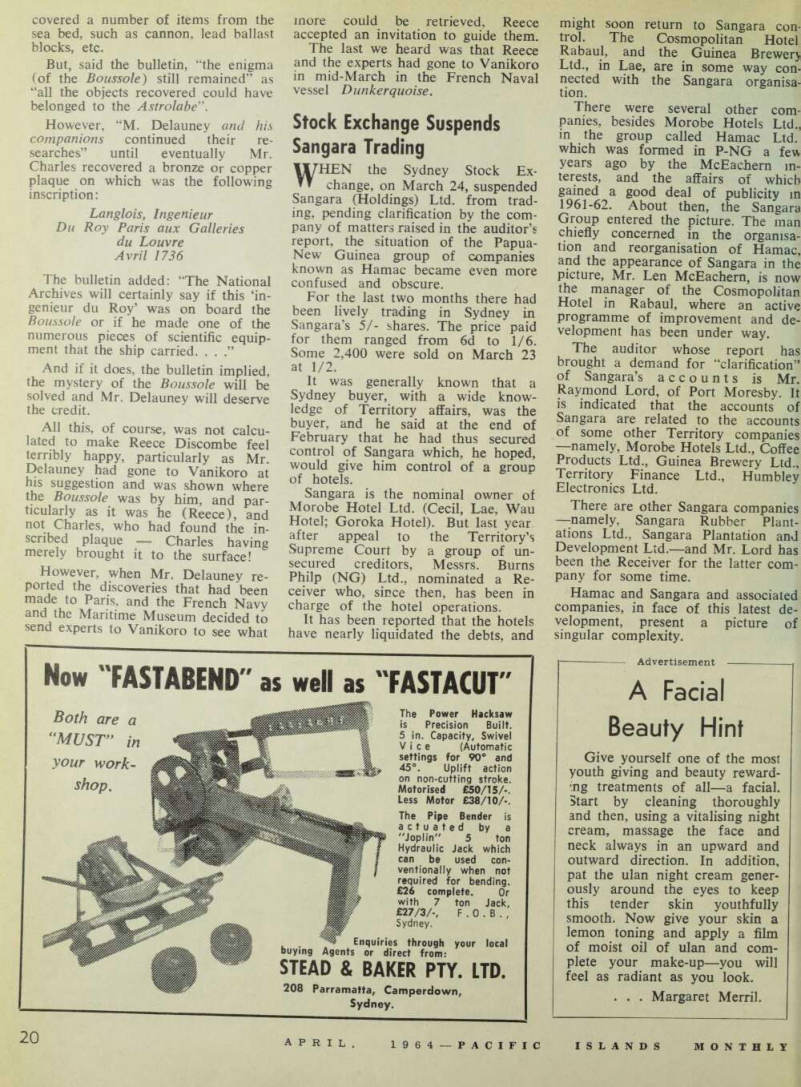
THOSE beautiful old raintrees that have been the pride of Madang, New Guinea, are coming down and ending up as butts of timber in a local joiner’s yard. Before and aftei photographs are opposite. The trees are 60 to 70 years old and were planted by the Germans.
There are two reasons for this execution—firstly, they are said to be unsafe and that branches drop oft them; secondly, Madang is getting sealed roads, and sealed roads and tree roots don’t go together.
Madang is the most beautiful town ship in P-NG and a lot of its charm depends on its shade trees.
At one time Rabaul ran into second place in the beauty stakes but things used to drop off Rabaul’s trees, too, and most of those have been cut down The result is that Rabaul’s main busi ness street, Mango Avenue, has noth ing growing in it now larger than a
libiscus bush and has become a two vay stretch of bitumenised hell, [uaranteed to fry anyone who tries o walk the length of it.
Madang’s raintrees are a valuable >roperty either up or down.
In Hawaii, rainwood tree is known is monkey-pod and the basis of a lourishing adjunct to the tourist in lustry when turned into wooden datters, trays, bowls, etc. It is used or the same purpose in Fiji.
A/ho Solved The
'Boussole" Mystery?
REECE DISCOMBE, Vila’s inde fatigable La Perouse enthusiast md skin diver, must sometimes vender whether the whole of the French-speaking world is not against iim in his efforts to find out what jecame of La Perouse and his men ifter their ships Astrolabe and Soussole were wrecked at Vanikoro n 1788. Reece is a Kiwi.
Although Reece has been the prime never in the search for La Perouse •dies in recent years, the French Press always seems to play down his ichievements, get things wrong, or gnore him altogether.
Reece first went to Vanikoro in 1958 with an expedition headed by Mr. Pierre Anthonioz, the then French Resident Commissioner in the New Hebrides. On that occasion, he relocated the remains of the Astrolabe (first seen by Peter Dillon’s ex pedition in 1827) after a French Navy expedition had failed to do so in 1956 and had lost its diving equip ment in the attempt. Reece got no credit for that.
Next year, Reece went to Vanikoro with an expedition headed by the French vulcanologist Haroun Tazieff.
Subsequently, an article on the ex pedition’s achievements appeared in the French magazine Paris Match illustrated with colour and black and white pictures taken by Reece.
Reece, however, got no credit for taking the photographs; he was not even mentioned in the article; and —bitterest blow of all—he never got his pictures back.
Despite all this, Reece’s enthusiasm for La Perousiana waxed rather than waned, and in June, 1962, when he visited Vanikoro on a private busi ness venture, he decided to search for the wreck of the Boussole (which had never been located) on his own account.
He had the good fortune to find it —it was in deep water on the outer edge of the reef—but mindful of his previous experiences, he kept the discovery to himself for the time being.
Six months later, he went to Vanikoro again and recovered sufficient relics from the seabed to put the solution to the mystery of the Boussole beyond doubt. (P/M, Jan., p. 11, and April, 1963, p. 87.) Having thus solvedcoveri prise that the French Press did not seem to care.
In fact, about the only French news organ that even bothered to record his discovery was the infermative bulletin of the French Residency in the New Hebrides.
This paper, in its issue for March 14 1963, published a five-paragraph story headed; “The Wreck of the Boussole, vessel of La Perouse, has been found 175 years after its disappearance.” Reece was given full credit for his lone-hand discovery.
In February, however, the French Residency’s bulletin took the credit
away from him and—possibly with the idea of pleasing the boss gave it to the French Resident Corn missioner Mr Maurice Delauney Said the bulletin. One of the most intriguing mysteries in the
es°of ‘appears
Maurice Delauney . . . made to Vanikoro from February 6 to 9, 1954”
Tb e bulletin went on to say that j^ r D e i aune y, accompanied by a COU pi e 0 f top French officials and a s fi n diver, Mr. Charles, had gone to Vanikoro in the Aquitaine and had there met Reece Discombe on February 6. (Reece had been there f or several weeks on another private venture.) Mr. Delauney and Co. went out to the spot where Discombe had found the remains of the Boussole, and, using skin diving equipment, had re
Top shows Madang's avenue of raintrees —and the lower picture shows what happened to some of them.
covered a number of items from the sea bed, such as cannon, lead ballast blocks, etc.
But, said the bulletin, “the enigma (of the Boussole ) still remained” as “all the objects recovered could have belonged to the Astrolabe” .
However, “M. Delauney and his companions continued their re searches” until eventually Mr.
Charles recovered a bronze or copper plaque on which was the following inscription: Langlois, Ingenieur Du Roy Paris aux Galleries du Louvre Avril 1736 The bulletin added: “The National Archives will certainly say if this ‘in genieur du Roy’ was on board the Boussole or if he made one of the numerous pieces of scientific equip ment that the ship carried. . . .”
And if it does, the bulletin implied, the mystery of the Boussole will be solved and Mr. Delauney will deserve the credit.
All this, of course, was not calcu lated to make Reece Discombe feel terribly happy, particularly as Mr.
Delauney had gone to Vanikoro at his suggestion and was shown where the Boussole was by him, and par ticularly as it was he (Reece), and not Charles, who had found the in scribed plaque Charles having merely brought it to the surface!
However, when Mr. Delauney re ported the discoveries that had been made to Paris, and the French Navy and the Maritime Museum decided to send experts to Vanikoro to see what
more could be retrieved, Reece accepted an invitation to guide them.
The last we heard was that Reece and the experts had gone to Vanikoro in mid-March in the French Naval vessel Dunkerquoise.
Stock Exchange Suspends
Sangara Trading
WHEN the Sydney Stock Ex change, on March 24, suspended Sangara (Holdings) Ltd. from trad ing, pending clarification by the com pany of matters raised in the auditor’s report, the situation of the Papua- New Guinea group of companies known as Hamac became even more confused and obscure.
For the last two months there had been lively trading in Sydney in Sangara’s 5/- shares. The price paid for them ranged from 6d to 1/6.
Some 2,400 were sold on March 23 at 1/2.
It was generally known that a Sydney buyer, with a wide know ledge of Territory affairs, was the buyer, and he said at the end of February that he had thus secured control of Sangara which, he hoped, would give him control of a group of hotels.
Sangara is the nominal owner of Morobe Hotel Ltd. (Cecil, Lae, Wau Hotel; Goroka Hotel). But last year after appeal to the Territory’s Supreme Court by a group of un secured creditors, Messrs. Burns Philp (NG) Ltd., nominated a Re ceiver who, since then, has been in charge of the hotel operations.
It has been reported that the hotels have nearly liquidated the debts, and
might soon return to Sangara con trol. The Cosmopolitan Hotel Rabaul, and the Guinea Brewery Ltd., in Lae, are in some way con nected with the Sangara organisa tion.
There were several other com panies, besides Morobe Hotels Ltd., m the group called Hamac Ltd. which was formed in P-NG a few years ago by the McEachern in terests, and the affairs of which gained a good deal of publicity in 1961-62. About then, the Sangara Group entered the picture. The man chiefly concerned in the organisa tion and reorganisation of Hamac, and the appearance of Sangara in the picture, Mr. Len McEachern, is now the manager of the Cosmopolitan Hotel in Rabaul, where an active programme of improvement and de velopment has been under way.
The auditor whose report has brought a demand for “clarification” of Sangara’s accounts is Mr.
Raymond Lord, of Port Moresby. It is indicated that the accounts of Sangara are related to the accounts of some other Territory companies —namely, Morobe Hotels Ltd., Coffee Products Ltd., Guinea Brewery Ltd..
Territory Finance Ltd., Humbley Electronics Ltd, There are other Sangara companies —namely, Sangara Rubber Plant ations Ltd., Sangara Plantation and Development Ltd.—and Mr. Lord has been the Receiver for the latter com pany for some time.
Hamac and Sangara and associated companies, in face of this latest de velopment, present a picture of singular complexity.